
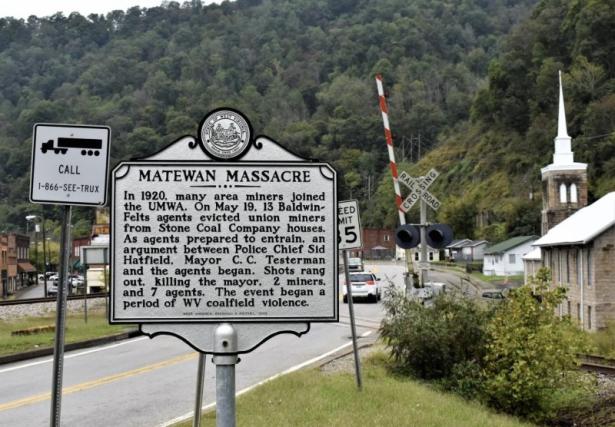
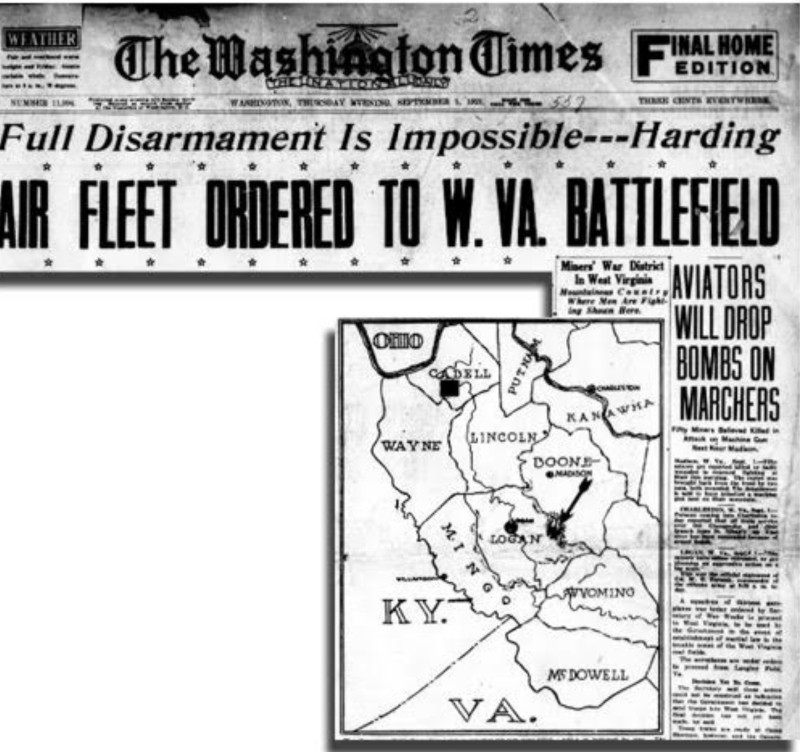
The West Virginia coal wars, beginning around 1912 and lasting about a decade, were fought between the United Mine Workers and coal operators (spreading out to the entire anthracite region from Southern Illinois to Western Pennsylvania). It reached its climax in 1920 – 1921 in Matewan and surrounding Mingo County during a bitter strike. Strikers’ families were evicted from their homes while shootouts took place between union miners on one side, detectives employed by management and state troopers on the other. Martial law was declared and the U.S. army was called in, facing off against an army of about 10,000 miners. Although there have been books and films about the conflict, it is little remembered. How many people know that the federal government used aircraft to drop bombs, troops with machine guns, to fire on working people for the crime of wanting better wages and fair treatment on and off the job?
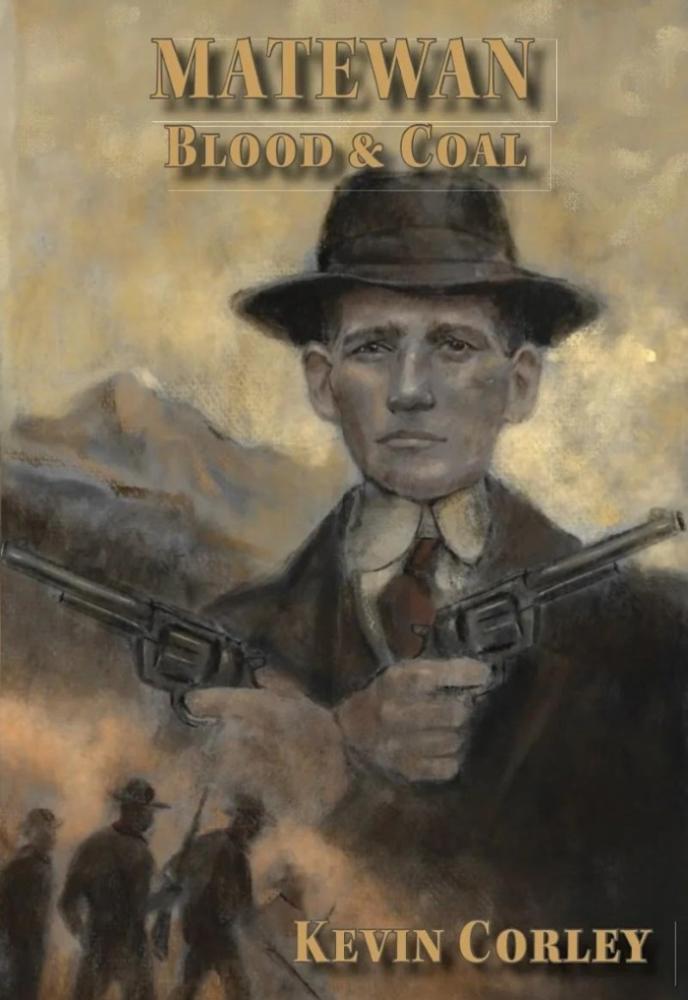
Kevin Corley’s novel, Matewan Blood & Coal, seeks to bridge that gap. A history teacher for many years in what had been coal county, he came to realize that most of his students did not know their own heritage. Corley, in this book (and others) writes of the struggles and sacrifices people have made to build a better life; struggles that engage wider communities and workplaces and thus become something more than personal. His writing goes beyond the dry facts of history, beyond telling of cardboard heroes and villains, breathing life into the flesh and blood individuals who made that history.
Matewan Blood & Coal
Kevin Corley
Hard Ball Press; 398 pages
May 29 2026
Paperback: $23.45
ISBN-13 : 979-8995092216
Remembering the past, after all, means not only recalling events; just as important, it means painting a picture, of the people at the heart of those events, giving voice to those whose voices are otherwise lost. Working people tend to leave little trace in the historical record, we don’t know their fears, their intimate hopes, who they loved, who they hurt – all the elements that make us human. Corley, by using oral histories of survivors of the battles in Matewan, alongside historical accounts, presents rounded individuals, with strengths, weaknesses and divergent views. He allows us to see relationships between women and men, adults and children, that help explain why and how miner resistance to the cruel conditions they faced took shape.
Matewan: May 16, 1920 – August 1, 1921
The novel is written in two parts. The first begins with a shootout in Matewan when private guards in the employ of coal operators try to evict a family from their home; a typical response of mine owners to striking workers living in company towns. The presence of the heavily armed detectives had another purpose: intimidation. They failed. Sid Hatfield, the town sheriff, was pro-union with a deep respect for those who labored with their hands. He refused to comply with the detectives’ warrant. When guns were drawn, Hatfield was joined by other armed miners, and the detectives got the worst of the fight. Seven of them lay dead at the end of the day. So too did two miners.
That fight made Hatfield a local hero, it also made him a marked man. State troopers flooded the county, provoking more miners to take up arms, especially after they forced out of their homes to live in tent colonies. Yet Corley’s novel is not a war story; framing his tale of repression and resistance lies the story of Hatfield’s relationship with Jesse Testerman (whom he marries after her the death of her first husband, the pro-union mayor also killed in the gunfight) as they each search for a way to assert their dignity at a time and place designed to grind people down. Neither is without faults, but each is fully due respect and admiration. And though they are at the center of the story, other characters are also given dimension – bringing to light the different way women related to each other and asserted themselves, bringing out the connections with mountain hill people who didn’t work the mines but knew a great deal about life’s harshness, bringing together black and white miners without ignoring the racial attitudes and racism that shaped daily life. Working together in the union could temper but not fully overcome that racism which Corley’s describes realistically.
Still the search for a life of dignity is everywhere apparent. For Sid, with the noose closing in on him, this is encapsulated by his reply to Jesse as to why he is willing to risk what he risks:
“I was thinkin’ today,” he said. “How I always looked up to them coal miners, the ones with hands like bark and lungs full of dust. My pa used to say, ‘A man’s worth’s measured he’ll bleed for. I believed that. Still do, I guess.”
For Jesse, who understands full well the risks he runs all too willingly in his pride, the whole struggle comes down to:
“The prosecution was painting Matewan as lawless, as if the massacre hadn’t started with those Baldwin-Felts bastards coming to evict women and babies at gunpoint. As if the men who died hadn’t come spoiling for blood, hands resting on machine guns before the first shot was ever fired. The prosecution called it murder. Jessie called it defense. Of the town. Of dignity. Of the very idea that a man had a right to live without bowing to a coal company.”
After the events at Matewan, we see miners try to keep the strike alive, keep their families together, keep hunger at bay. The pressure always increases, and the former UMW member turned company stooge, informer, and provocateur, C.E. Lively appears time and again to stir the pot. A counterpoint to the complexities of everyone else in the novel, Lively’s success is accompanied by moral degradation, his lack of solidarity with his community matched by brutality toward his wife and children (also part of the historical record, made “real” in readers eyes by Corley).
Hatfield, tried for his “crime” in the shooting, was acquitted by a jury. The UMW then brings him to Washington DC to testify before Congress about what took place that day – which likely sealed his fate. As the novel relates, he was called to appear in court again -- in McDowell County, bordering on Mingo -- where he and a friend (Ed Chambers) are murdered on the courthouse steps. Jessie and Ed’s widow, Sallie Mae, were later brought by the union to DC to testify about their murders.
Blair Mountain: August - September 21, 1921
Hatfield’s funeral is massive, attended by miners, farmers, whole families, near and far, culminating in a march to Charleston to protest his killing, to demand jailed miners be freed and to present the strikers demands. The governor is unmoved and concedes nothing. That is where the second part of the novel begins and thereafter events move quickly. Martial law is strictly enforced, while state police and company police act with ever-less restraint. The miners response is a mixture of desperation and determination as a call to arms goes out. Like the mountain itself, the miners army is sprawling, conflicts with state troopers taking place here and there, seemingly everywhere.
The arguments and disagreements amongst the miners, within their leadership are given space, arguments that reflect the challenge of how to move forward when the odds (and weapons) are against you. But there is no disputing about the demands of the miners themselves – at a meeting they call them out; seeing them in print reminds readers of how basic they were:
Paydays twice a month
No Yellow Dog Contracts
Union approved checkweighmen
A Union Rep on the Board of Arbitration
Abolition of the Mine Guard System
Freedom to not have to buy from company stores
Reading those demands should serve as a reminder of how much control the mine operators had over the labor and life of those they employed. Two of the central characters in this part of Corley’s novel are Red Williams and Charles “Popcorn” Brown – two black miners, who are at the heart of the Blair Mountain fighting. Red’s reflection on what the fighting is all about puts those demands in perspective:
“Once this war was won, Red and Lizzy would measure time by the number and growth of their children. His wife would teach them book learning and musical instruments. Red would teach all the children, boys and girls, how to enrich the soil to grow their own food. With mining wages they would buy pigs and cattle. They might not get rich, but they would be self-sufficient so none of his boys would ever have to crawl into another man’s pit for coal.”
The battle raged, the miners got the worst of it. There is much more to the novel than what is noted above. At the end, notwithstanding all the sacrifices made, the strike was lost, the number of miners blacklisted and jailed grew, while the UMW membership dropped to a shell of what it had been. A loss, no doubt, but it was one of many losses that prepared the way for the successful rebuilding of the UMW and the CIO in the 1930s. The novel’s epilogue ends in 1976 with Red and Jessie’s son, Jackson (Sid’s stepson) at the Lincoln Memorial thinking about what our country could be, not what it has been – a conclusion meaningful today in light of the dark clouds now hanging over our country.
With that in mind, book closed, we can best keep in mind on Corley’s reflection on a miner (William Greer) who decides at Hatfield and Chambers funeral, to join the march the march to Charleson then onto Blair Mountain:
“As he walked away from his home, the wind cut through the rain like the age-old mountain warning that whispered there are storms that clear the air, and storms that stir the dead.”
Spread the word