
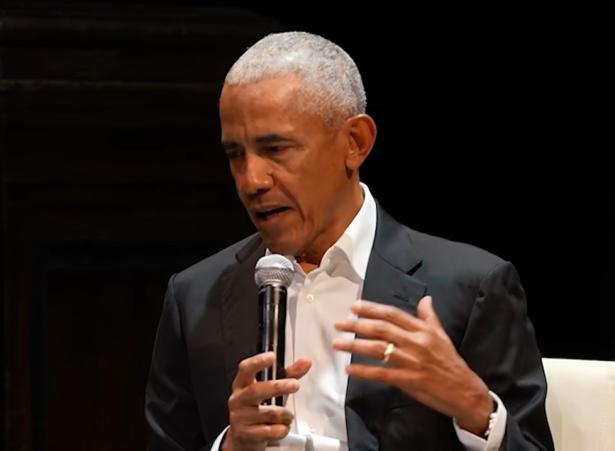
Barack Obama issued a private directive to House Democrats on Wednesday: Go big on health care, because Obamacare isn’t enough. “The ACA was jerry rigged on top of a legacy system, and that’s what we could get,” Obama told the Democrats, according to a transcript we obtained of his comments. He was referring to the fact that the Affordable Care Act in large part regulates and subsidizes private insurance. He added: “You should push further and get more.”
The remarks will give a morale boost to those who want the Democratic Congress next year to pass major elements of the expansion of Medicare that Senator Bernie Sanders has long championed. The comments also hint at a shocker: The new Democratic Congress might end up proving more unified on health care—which has long bitterly divided the party—than you might think. Hakeem Jeffries, the next House speaker, endorsed a large expansion of Medicare this week, including a lower age eligibility and coverage for all children, as well as for dental, hearing, and vision services. That’s a big step toward the sort of universal government health care that progressives have long fought for.
As it is, the new Congress is widely expected to pass a restoration of ACA subsidies that were expanded during the pandemic and allowed to expire last year by Trump and the GOP Congress, which bumped millions of people off coverage. (Trump will veto that restoration, and Democrats will attack him for it.) But the Medicare expansion proposal is another animal entirely. It entails a big push toward something much more like a single-payer system that works around the private insurance market.
In his comments, Obama suggested they should push hard in that direction. “I’m hopeful that you can get the subsidies restored,” Obama said, referring to the aforementioned expired pandemic-era subsidies. But he stressed that restoring Obamacare alone “is not the answer,” adding: “There are better systems than the ones we’ve got.”
Those will be welcome words to many Democrats. The party has long fought over whether to be for single-payer; in this election, victorious Senate candidates like Adam Hamilton in Kansas distanced themselves from the Sanders wing by denouncing Medicare for All. But Obama’s comments hint at an emerging short-term consensus position: Make incremental but meaningful pushes toward universal government coverage—like the proposal to expand Medicare that Jeffries just backed.
“The ACA tried to get to universal coverage on a certain path,” Jonathan Cohn, a health care wonk who wrote a well-regarded book on Obamacare and now writes about the issue for The Bulwark, told me. “Now he’s urging Democrats to think beyond the ACA structure toward more transformational changes. Presumably, that includes a bigger role for public programs.”
All this points to a major opportunity for Democrats. The party won governorships in a chunk of the remaining holdout states—mostly in the South—that still have not opted into Obamacare’s expansion of Medicaid to lower-income adults. Now there’s at least a reasonable chance that states like Georgia, Texas, Wisconsin, and Kansas expand Medicaid to millions.
While Republicans still control key legislative chambers in such states, the new Democratic governors—who campaigned on expanding Medicaid—will bring intense pressure on them to deal. As Larry Levitt of KFF told me, while Trump’s 2025 Medicaid cuts will complicate things considerably, “Medicaid expansion could be on the table.”
On top of that, congressional Democrats will now vote to restore Obamacare subsidies. And Democratic committees in both chambers will assemble proposals for a major new Medicare expansion. In doing all this, Democrats will be delivering on their promise to provide material relief to millions and millions of Americans who drove the blue tsunami. Trump will stand in the way of all of it. Fine: That’s a debate Democrats can really take into 2028.
Greg Sargent is a staff writer at The New Republic and the host of the podcast The Daily Blast. A seasoned political commentator with over two decades of experience, he was a prominent columnist and blogger at The Washington Post from 2010 to 2023 and has worked at Talking Points Memo, New York magazine, and the New York Observer. Greg is also the author of the critically acclaimed book An Uncivil War: Taking Back Our Democracy in an Age of Disinformation and Thunderdome Politics.
The New Republic was founded in 1914 to bring liberalism into the modern era. The founders understood that the challenges facing a nation transformed by the Industrial Revolution and mass immigration required bold new thinking.
Today’s New Republic is wrestling with the same fundamental questions: how to build a more inclusive and democratic civil society, and how to fight for a fairer political economy in an age of rampaging inequality. We also face challenges that belong entirely to this age, from the climate crisis to Republicans hell-bent on subverting democratic governance.
We’re determined to continue building on our founding mission.
Sign up for a TNR newsletter on politics, climate, culture and more.
Spread the word