It took profound transformation of Americans’ social and economic lives by deregulated and financialized capitalism to push Democrats left. It’s time that the media reconsider what constitutes the party’s new mainstream.
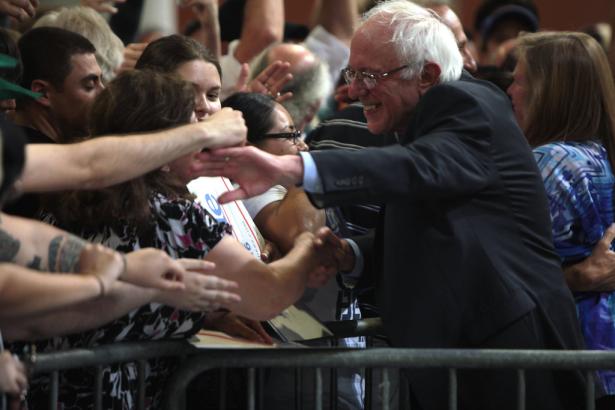
Bernie Sanders with supporters | by Gage Skidmore (CC BY-SA 2.0)
In Socialism, his 1972 magnum opus, Michael Harrington termed the American labor movement an “invisible” mass social democratic movement. Even as he noted that its language, its forms, and its foreign policy (at least at the AFL-CIO) suggested nothing like social democratic beliefs, it had been the leading force behind such landmark Great Society legislation as Medicare and Medicaid, and remained the leading force behind expanding such social welfare policies in the years thereafter. Most commentators and scholars of American politics had missed this transformation, Harrington wrote, because it had happened gradually and incrementally, with no ideological proclamations or even much in the way of discussions to herald this transformation. Hence, its invisibility.
In much the same way that Harrington called U.S. unions an invisible social democracy half a century ago, I’m inclined to slap that label on the Democratic Party today. If not all its elected officials—certainly not all its elected officials—then the term not only describes, but best describes, rank-and-file Democrats today.
Last month, Rep. Pramila Jayapal shared with Politico a GQR poll taken in November that showed fully 90 percent of Democrats favored Medicare for All—which would be tantamount to nationalizing the entire health insurance industry. This followed an Economist/YouGov poll from last summer that showed 85 percent of Democrats (and 57 percent of independents) favored Medicare for All, while just 7 percent of Democrats (and 24 percent of independents) opposed it. It’s also in accord with a Data for Progress survey from November that showed that even when informed that Medicare for All would eliminate most private insurance and be funded through higher taxes, 78 percent of Democrats (plus 64 percent of independents and 47 percent of Republicans) would nonetheless support Medicare for All.
Were this an ideological one-off—a reaction only to our steadily less affordable and steadily more dysfunctional system of private insurance, even as Democrats otherwise affirmed their belief in other sectors’ markets—it wouldn’t in itself make the Democrats a social democratic party. But it’s not. As I’ve noted throughout the past year, polling the Democrats on virtually any topic in 2025 revealed a consistent belief in social democracy. A Gallup poll from September showed that 66 percent of Democrats had a favorable view of socialism, while just 42 percent had a favorable view of capitalism. A YouGov poll from November showed that 66 percent of Americans—not just Democrats—supported socialist Zohran Mamdani’s proposal to provide free universal child care, while 57 percent even favored his proposal to establish city-owned grocery stores.

Spread the word