
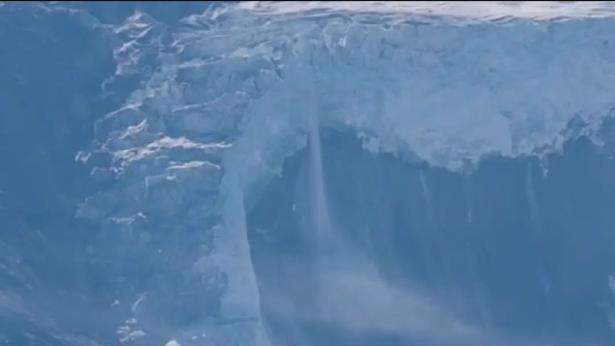
It’s been harder than usual for me to write these past few days, and that’s because the glacier collapse and subsequent calamity along the Tibet-Nepal border hit very hard. As it happens, I’ve stood in that border crossing where you’ve watched the giant wave obliterate…everything in a split second. I’d spent weeks in the high, dry, cold of Buddhist Tibet, and then crossed into the lush humid chaos of Hindu Nepal, and so I can summon up some sense of what it must have been like, and of the people who died almost before panic could grip them.
More, I knew it was coming. Not on that day, of course, but I’d been in Tibet twenty years ago partly to report on what we already knew was an enormous threat: the fallout from the rapid melt on what is sometimes called Earth’s Third Pole. The danger of these collapses, and the blocked lakes they can create, were well-known to scientists; they happen often, but usually in unpopulated valleys. I’m not going to concentrate on these reports—there’s been much good coverage in the last few days. Jonathan Watts, for instance, does the important service of laying out the exact link between the climate crisis and the collapse.
Two days before the collapse, the ground temperature hit its highest point in the last two years, according to Dr Hamish Pritchard, a glaciologist with the British Antarctic Survey, whose team had sensors 6 miles (10km) away from the site.
“These high temperatures would have weakened the snowpack, filled crevasses with water and thawed the bonds between ice and rock that hold these glaciers in place,” he told the Science Media Centre.
Jeff Berardelli tracks the ongoing increase in temperature in the region (it’s been about twice the global average, up 5 degrees Fahrenheit since 1940). And Jonathan Mingle provides a very fine account of his own travels in the region, and of the similar smaller incidents that have happened across the years.
I want simply to ask you to focus on the image at the top of this newsletter, taken by a Chinese mountaineer named Zhia Yitie, that shows the collapse—that’s the stream in the center of the picture that looks like a waterfall. And what I want you to notice is how much ice is still there—to the naked eye it looks like 99 percent of the glacier remains. And this is just one glacier of perhaps 50,000 across the Himalayas and Hindu Kush. My point is: there is infinitely more damage to be done, or to put it another way there is infinitely more damage we might still be able to forestall. And that’s what should concern us.
Just to do the math for a minute: on average, Nepalis produce about four-tenths of a ton of carbon emissions annually, compared with about 14 tons for an American. More than 99 percent of the country’s electricity comes from hydropower (though much of that capacity was wiped out in last week’s floods). They are not causing the crisis that is killing them: we are.
Indeed, even as the mud was settling over the ruins of Himalayan villages we took the next steps to insure these catastrophes would continue, announcing an “agreement” with the Venezuela that we control to dramatically increase its oil production. As Al Jazeera put it,
Shortly before the deal was announced, energy analyst Gregory Brew likened reports of the impending agreement to oil concessions sought by the British Empire in the early 20th century.
“Such a thing is without precedent,” Brew wrote on social media. “The closest thing would be BP [British Petroleum] (back when it was majority owned by the UK govt) claiming ownership of Iraqi and Iranian oil reserves pre-WWII.”
Trump himself has embraced the colonial-era slogan “Manifest Destiny”, as part of his plan for a “growing nation” that “increases our wealth” and “expands our territory”.
This is literal colonialism, in the service of Trump’s Big Oil donors—it’s pretty much precisely what we did to Iran’s Mossadegh in 1953, triggering a set of bloody events that continue to this day.
And it comes, of course, as we continue to sabotage renewable energy—this week’s installment, thanks to great investigative reporting from Evan Halper, finds the White House paying a European firm to cancel yet more wind leases, on the condition that the money be “reinvested” with a big Trump donor building export facilities for liquefied natural gas on the Louisiana coast.
In short: in a world beginning to turn away from oil, the United States has become the biggest force trying to insure we keep pouring carbon into the atmosphere. If the rest of that ice is going to fall off that Nepali glacier, this will be why.
Which means that the question I promised to raise in last week’s newsletter is more important than ever: how do we translate these horrors (of which there will be far far more as the growing El Niño envelops the world in record temperatures) into political change here?
To be clear: I don’t mean before November’s midterms. The issues on which that will be fought—democracy, data centers, dementia—are baked in by this point. Gas prices will play a crucial role too, which means that anyone challenging the GOP should be pointing out the absurdity of our energy policy: the polling is clear that Americans hate Trump’s attacks on wind and solar. I’ll be spending the rest of the fall out on the trail with the Third Act and Gray Pac, mobilizing voters in key races; for the moment the goal is just to reestablish some beachhead for sanity in DC.
But physics is giving us very little time now, and so the next set of elections in this country will be, I think, our last real chance to make the sea change—replacing oil and gas with sun and wind—that is our best hope for limiting warming. And the El Niño will be peaking just as the Democratic candidates start jockeying for position. So it is not too early to start trying to get them thinking about all this.
Matt Pawa, the lawyer who helped launch much of the litigation to hold oil companies responsible for global warming, has helpfully provided a three-part summation of why Democrats should run in part on climate. It is lawyerly in the best sense of the word, which is to say filled with fact—he finds the long-term polling data, offers the historical examples dating back to 1988, and brings it home with what I think will be the most salient argument: clean energy is potentially very cheap energy.
We are in an utterly extraordinary moment of energy transformation. Yet powerful corporations are keeping us stuck burning stuff from the dinosaur era to make energy. It’s dangerously heating up the climate and causing extreme weather. It kills millions of people who breathe bad air. It poisons our water. And yet renewable energy is now the cheapest way to make energy. This is not a moment for climate silence. It’s a moment for action.
You can see this dynamic playing out right now in the UK, which isn’t in the midst of an election but—since a parliamentary system means a kind of daily political battle—is nonetheless trying to figure out how to grapple with the schock they got this summer: week after week of blistering heat, and the drought that came with it. The green and pleasant land spent most of the summer brown and sweaty. (Not only that, but it turns out that shoppers shop less if the temperature gets above 25 degrees Celsius, and so businesses are grump too).
It’s all put the Labour government in a difficult spot. On the one hand, they’d like to appease the Murdoch press and open up more of the North Sea to drilling. This would accomplish nothing to reduce energy prices, since oil prices are set on a global market and there’s not enough crude left off UK shores to influence that number. But it would send a signal of “moderation,” which is the same kind of signal that American politicians—New York governor Kathy Hochul, say—have tried to send with their embrace of gas. (It turns out, new reporting shows this week, that Hochul was also lobbied persusasively by a natural gas front group).
But the problem is that danged heat, and the upsurge in concern, anger, and activism it’s causing among voters—it turns out that that latent hope for a workable future emerges quickly once the temperature rises. And so we’ve seen in recent weeks a spate of new data comparing the climate damage from North Sea oil drilling to the economic benefit: “the economic damage caused by the carbon pollution from the oil and gas produced would be between £119bn and £336bn in the coming decades, compared with the £28.7bn in value to the UK estimated by Adura, the fossil fuel company promoting the new fields.”
As Matthew Taylor lays out in a long and useful essay, it’s become a crucial question in UK politics, with the surging Greens on one side and the Conservatives and far-right Reform on the other
The leader of Reform UK, Nigel Farage, and the Conservative party leader, Kemi Badenoch, have called for a massive expansion of drilling in the North Sea, claiming they would reverse the ban on new licences if elected.
In a speech this year, Farage declared that the UK should be “self-sufficient in gas”. Badenoch followed with the promise of a growing UK oil and gas industry that would “ensure our energy security for generations to come”.
At the moment, the new Labour leader Andy Burnham is trying to figure out if there’s a straddle available. His new environment secretary, the wonderfully named Angela Eagle, tried to bluster her way through in a recent column for the Guardian but I suspect that promises of “healthier ecosystems” to fight fire risk won’t cut it. People are generally sophisticated enough by now to know that the real question hinges on fossil fuels.
I don’t know how the UK decision on drilling will fall next week—again, there’s a lot that’s been baked in by now—but I do know that ambitious American politicians would be well-advised to get ahead of this storm. I don’t think it’s hard. The basic argument goes like this:
“Donald Trump and the GOP are corrupt and stupid to insist that the future lies with fossil fuel. I will stop coddling Big Oil and instead start making it much easier to America to run on energy from the sun and wind. Instead of shutting down wind farms we’ll be opening them up; instead of tariffing solar panels we’ll be making it simple for Americans to stick them on the roof and balcony. This is our best chance to cut the risk and cost of catastrophe (not to mention rising insurance prices). It’s also our best chance to let Americans enjoy the plummeting energy prices that other parts of the world have begun to see. And it may be the only path we have to restoring even a little of our standing in a world that now sees us as a reckless and rogue state.”
If nothing else, prospective candidates should be thinking of it as a way to El Niño-proof their campaigns. And they should get on it sooner rather than later.
In other energy and climate news:
+The most comprehensive analysis I’ve seen of the energy demands of AI, from Erald Kolasi and Jesse Damiani, shows that
In 2026…AI diffusion and deployment is responsible for as much as 1.1% of all global energy demand, substantially higher than what most naïve conventional estimates suggest. For example, a simplistic analysis from Our World in Data claims that AI diffusion accounts for only 0.2% of global primary energy demand.
As we argue comprehensively in this piece, these kinds of assessments are generally less useful because they’re focused purely on electricity consumption and ignore the broader lifecycle energy dynamics powering AI diffusion globally. In reality, we show that AI-driven global energy use is likely already higher than the energy consumption of the entire United Kingdom. We also estimate that AI will be responsible for roughly 1.2% of all global GHG emissions for this year. These are stunning figures that undercut the typical narratives about the relative insignificance of AI on global energy consumption.
Just as interesting, here’s an Arizona State University study from May that I somehow missed, which shows that data centers can raise the surrounding temperature by four degrees.
The waste heat produced by a single data center can surpass the amount emitted by 40,000 households, according to ASU’s David Sailor. Air-cooled condenser arrays discharge air heated to 14 to 25 degrees F above the surrounding air temperature, creating thermal plumes that move downwind over neighboring areas.
“They’re such a concentrated load of electricity consumption and hence heat emissions that we became concerned about the impact that they could have locally, and also in the downwind neighborhoods,” Sailor said.
With hundreds of megawatts of data center capacity operating in many cities and thousands more centers proposed, the combined impact on urban temperature could be substantial. U.S. data center capacity is projected to more than double by 2030.
“Even if these data centers only contribute to an additional heat island magnitude of 1 degree or 2 degrees, that can still have a very significant impact on our lives,” Sailor said.
That’s especially true in places where extreme heat already poses serious public health risks.
A 1-degree boost in air temperature, for example, is enough to drive higher use of air conditioning across entire neighborhoods. Those air conditioners, in turn, put even more heat into the surroundings.
All of this doubtless helps explain why the now comically misnamed Environmental Protection Agency has just moved to restrict public comments on data centers. As Maxine Joselow reports:
The Environmental Protection Agency plans to eliminate a federal requirement that states publicize and solicit public input on applications for air pollution permits for a range of industrial facilities, including new data centers and the power plants needed to run them.
The move could prevent residents from raising concerns about — or even learning about — data centers before permits are approved and construction starts.
+The Texas grid has had a boring summer, Matthew Zeitlin reports, thanks to the boring boxes full of batteries that weren’t there even a couple of years ago.
The state’s grid operator, ERCOT, has not issued a single “conservation appeal” so far this summer, asking Texans to voluntarily reduce electricity consumption to support the grid. By contrast, in 2023, the grid manager issued six between August 24 and August 30….
Batteries on the system can still charge even when demand is at its highest, and then discharge in the evening to help make up for lost solar. “Even when we were setting peak demand records, we’re still on net charging batteries, which at first blush feels so wrong,” Rhodes told me. “We have so much solar on the system that we’re charging batteries when prices are low, getting ready to discharge as the sun goes down before the wind picks back up.”
Let’s take Monday as an example again: At 7:50 p.m., when solar was down to just 1.5% of the mix on the grid, batteries were discharging 11,573 megawatts and real-time prices were around $125 per-megawatt-hour. On the same Monday of 2023, real-time prices at 7:50 p.m. were bouncing up and down from just below the statutory peak of $5,000 per megawatt hour and batteries were putting out just over a gigawatt.
+Pete Hegseth’s Army has fired a West Point professor for daring to teach that humans cause climate change. According to the military newspaper Stars and Stripes (whose publisher was also fired last week),
Adam Kalkstein, a climate scientist who spent 17 years teaching future Army officers, said he consistently received “outstanding” appraisals of his work. When leadership last year imposed a ban on teaching that humans contribute to climate change, he tried to comply but ultimately pushed back, saying that it was a disservice to the cadets’ education.
“It’s not a college-level course. It’s not even a high school course. Not because it isn’t rigorous; it is. But because we’re leaving out essential information,” Kalkstein said during a November 2025 meeting of the geography department with Brig. Gen. Shane Reeves, then the dean of the academic board, according to the lawsuit. “We’re only telling cadets part of the story. We’re lying to them, deceiving them. It would be like trying to teach the law without being able to even mention the Constitution,” Kalkstein said…
The dean responded to Kalkstein by reminding him that Trump, as commander in chief, sets the agenda for West Point. The meeting ended with the dean storming out, according to the lawsuit.
I would just say: what contempt this shows for cadets, who we ask to put their lives on the line.
+They’re harvesting champagne grapes a month early in France, in an effort to cope with the record heat. As Claire Moses and Ségolène Le Stradic report,
“We’ve been a bit thrown by this harvest,” Mr. Toubart, a local grower, said. “We’ve never seen anything like it.”
He explained that “the vines start growing earlier, winters are milder than before, and weather conditions throughout spring and summer actually accelerate the vines’ growth cycle.”
France has seen four heat waves since May, totaling 63 days of heat wave conditions, according to the country’s weather service. Daily and monthly records for summer heat were broken this year, and a heat wave in July was longer than one in 2003 that killed 15,000 people in France.
+The venerable Fiona Harvey has the best account I’ve seen yet of why chefs are switching to induction cooktops—cooler, quieter kitchens that are much cheaper to run. And she provides a quote that I hope will put to rest the idea that you need gas to produce true wok cooking.
“There is that sense of theatre with fire and flames,” says Jeremy Pang, a third-generation Chinese chef in London and founder of the School of Wok. “It feels quite traditional and exciting. But we have found that we can get just as high temperatures, and just as good cooking, with electric.”
The secret to traditional Chinese cookery lies in the “wok hei” – literally, the breath of the wok, meaning the smoke and heat that the chef must master, to give all ingredients the right degree of scorching and flavour. Pang was worried that this would be harder to achieve with electric, but soon found that he could reach temperatures of 350-400C, and in an easily controllable fashion.
“We use carbon steel with oil, and you can still get that actual smoke and flavour that you would with gas,” he said. “Gas cookers are incredibly good equipment, but you get so much heat off them, it’s a huge problem.”
Meanwhile, one of Harvey’s longtime colleagues at the Guardian, environment correspondent Paul Brown, has died after a highly useful career. As he remembered of his early days on the beat, back in the Thatcher era:
“We were talking about what would happen 50 years away. It needed all our ingenuity to make it sound like a news story, because people find prospects that far into the future boring.” Any enduring newsdesk scepticism was dispelled when a readers’ survey discovered that it was the second most read subject after medical stories. “It certainly made a substantial difference to the editors’ attitude,” he added.
+The Ember thinktank has produced a hopeful report on the spread of solar in Africa, arguing that it is going even faster than official statistics indicate:
Three-quarters of Africa’s solar growth is likely from distributed solar – and that is exactly what’s difficult to measure
Distributed solar, which is small-scale, customer-side solar installed mostly on rooftops – makes up most of Africa’s solar growth, and it’s the hardest type to measure. Ember estimates that 75% (20 GW of 26 GW) of the total solar capacity added between 2023 and 2025 is distributed solar. That’s because only a quarter of new solar can be explained by utility-scale and off-grid solar – utility-scale solar is fairly well-documented and visible through government procurement projects, and although off-grid solar is growing fast, its scale would still be very small in context of the gap.
+Here’s a sad number for you, courtesy of Ayesha Tandon. Climate change is currently exposing 580 million children around the world to an extra 20 days a year of “heat stress.”
For example, the paper finds that people living in Côte d’Ivoire currently face 112 heat-stress days every year. It adds that around half of these are due to human-caused climate change.
In contrast, Germany sees only 0.1 heat-stress days per year in today’s climate on average, which is largely attributable to human-caused climate change.
As it happens, I’ve spent some sweaty nights in rural Cote d’Ivoire, and I remember vividly a man who told me he was deeply hopeful that he could get a solar panel so he could connect it to a fan so that he and his wife and daughter could sleep more easily. That’s the world we live in.
+An important new analysis from the Union of Concerned Scientists manages to deftly apportion blame for a drying West to big oil companies, with data that will doubtless be of interest to communities bringing legal actions against the carbon giants.
Our findings show that human-caused climate change has reduced April snowpack by roughly 36 percent, decreased warm season streamflow by approximately 13 percent, and increased irrigation demand by 4.3 percent. Roughly half of these impacts are attributable to emissions traced to the Carbon Majors since 1950, translating to a nearly 15 percent reduction in snowpack, a 6.1 percent decrease in streamflow, and a 2.4 percent increase in irrigation demand.
+Glad to see former Washington governor Jay Inslee’s new Substack. In its most recent number, he argues for greater action from states.
States control major levers over their own energy systems — from utility regulation and permitting, to infrastructure development and finance. And clean energy is the tool best suited to the moment. A July report from the advisory firm Lazard shows that solar and wind are now the cheapest forms of new electricity generation by far, cheaper than new gas power plants. Clean energy is also faster to build, which matters enormously given how quickly demand is growing. Clean energy made up 91 percent of new grid capacity added in the first quarter of 2026, and solar outpaced coal generation for the first time in American history this past May. States that embrace that reality can deliver real relief to their residents. States that don’t will be left paying more for less.
This year also presents an inflection point, in which American voters will elect the governors, legislators and public utility commissioners that will help determine our nation’s energy future. Thirty-six states hold gubernatorial elections this November, and at least 21 brand new governors will take office next year. Voters will decide on new members and majorities in state legislatures and utility commissions in places like Michigan, Wisconsin, Arizona and Georgia. One way or the other, 2027 will bring a new crop of state leaders, and with it the opportunity to build a more affordable and prosperous American economy — powered with clean energy.
Meanwhile, the retrograde directors of too-many rural electric co-ops are lining up behind natural gas as the fuel of the future, according to a new account from Diana DiGangi. That makes me even gladder that the Solar Advocates Project at Third Act is taking on rural co-ops as an organizing focus. Join us for a webinar Sept 9 to learn how you can help.
+Pre-election day shoutout to Ed Markey, the Massachusetts Senator who co-sponsored the Green New Deal alongside AOC. He’s facing a primary challenge Tuesday from Seth Moulton, who seems obsessed with transgender athletes in sports, the ultimate non-issue of our time.
+Scientists left microphones running at 12 midwestern solar farms…and heard twice as many grassland birds as in the adjoining corn and soybean fields. As Hugo Rojas reports
Most solar farms use single axis trackers, panels that tilt through the day on a horizontal steel tube running the length of each row. That tube sits a few feet off the ground and carries brackets, junction boxes and cable trays every few yards.
To a barn swallow or a robin, that is a cliff face with ledges on it. Underneath, the seeded mix grows up through the array and out into the strips between rows.
The two things together give a bird both cover and structure, a combination neither a crop field nor a plain grassland offers.
+As everyone says the fondest of goodbyes to Dolly Parton, let us remember that one of her last original songs was World on Fire, with these lyrics:
Liar, liar the world’s on fire
Whatcha gonna do when it all burns down?
Fire, fire burning higher
Still got time to turn it all around
Don’t get me started on politics
Now how are we to live in a world like this
Greedy politicians, present and past
They wouldn’t know the truth if it bit ‘em in the ass
Here she is singing it at the 2023 American Country Music awards
William Ernest McKibben is an American environmentalist, author, and journalist who has written extensively on the impact of global warming. He is the Schumann Distinguished Scholar of environmental studies at Middlebury College and leader of the climate campaign groups 350.org and the Third Act Movement. Wikipedia
Subscribe to Bill McKibben substack The Crucial Years
Spread the word