The Brazilian Coup's Image Problem

Gianpaolo Baiocchi Boston Review
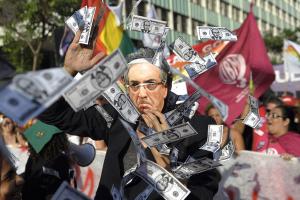
Romero Jucá, recently appointed planning minister, was recorded saying: `We have to stop this shit. We have to change the government to be able to stop this bleeding - the corruption investigation. The motives and nature of the plot to remove Rousseff are apparent in the transcript of the phone conversation between Jucá - a ally of new president Michel Temer - and Sérgio Machado, former senator who until recently was president of the state oil company, Transpetro.
Brazil’s Elite and the Drive to Impeach President Dilma Rousseff

David Miranda The Guardian
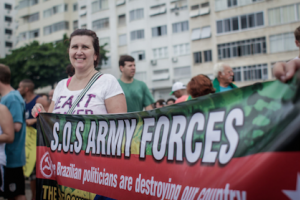
Corruption is not the cause of the effort to oust Brazil’s twice-elected President, Dilma Rousseff, merely the pretext. Brazil’s elite and their media organs have repeatedly failed to defeat Rousseff and her Workers' Party at the ballot box. So the plutocrats are now attempting, through a bizarre mélange of evangelical extremists, far-right supporters of a return to military rule, and non-ideological backroom operatives, to simply remove her from office.

Overthrowing Dilma Rousseff - It's Class War, and Their Class is Winning

Alfredo Saad Filho Socialist Project
The judicial coup against President Dilma Rousseff is the culmination of the deepest political crisis in Brazil for 50 years. Dilma's second victory sparked a heated panic among the neoliberal and U.S.-aligned opposition. The fourth consecutive election of a President affiliated to the centre-left PT (Workers' Party) was bad news for the opposition, because it suggested that PT founder Lu¡s In cio Lula da Silva could return in 2018.

Canoas: A Government of, for and by the People

Ruth Needleman Portside
Here in the states, we know what it means to see our democratic rights attacked. But do we have a vision of what an expansion of democracy and popular participation in government might look like?

film

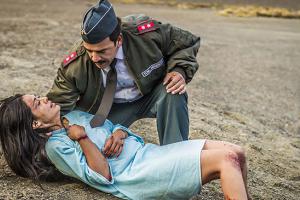
Film Review: Carlos Bolado’s ‘Olvidados’ Uncovers the CIA’s Role in Latin America’s Bloodiest Dictatorships

José Raúl Guzmán NACLA
Olvidados serves as powerful indictment of the military personnel who were responsible for thousands of deaths and disappearances of political dissidents in Latin America during Operation Condor, estimated at 30,000 forced disappearances, 50,000 deaths, and 400,000 arrests. Beginning in 1975 the political campaign of repression spanned across Argentina, Chile, Bolivia, Brazil, Uruguay, and Paraguay—carried out by the right-wing military dictatorships, backed by the CIA.

Rival Political Movements Duel over the Future of Brazil

Marianna Olinger Waging Nonviolence
Recently the mainstream media has portrayed the political crisis in Brazil as a result of internal corruption and the lack of economic growth, which is blamed on the President Dilma Rousseff and the Workers’ Party. What is rarely mentioned, however, is that Brazil is experiencing a historical divide. Some Brazilians believe President Rousseff hasn’t followed the dictates of neoliberalism closely enough, while others argue the corporations have far too much power.

Brazil’s Dilma Rousseff Re-elected in Close Vote

Emile Schepers People's World
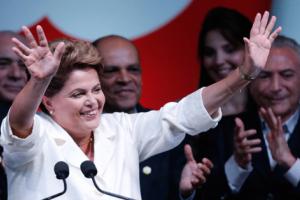
Rousseff won most of Brazil's 26 states including Minas Gerais, Neves' home state where she was the governor from 2003 to 2010. Neves did well in a band of states in the West and South of the country, where the population is wealthier and predominantly of European ancestry, while Rousseff did well in the East and North, where there is a higher proportion of people of African and mixed African and European ancestry.
Subscribe to Brazil