Just Recognize It
The Outline
 Hearst is pushing back against its employees’ union drive, but it would be advantageous for them to support it.
 Hearst is pushing back against its employees’ union drive, but it would be advantageous for them to support it.
 A new report lays out how effective the assault on organized labor has been. The decline of unions—which now represent just over one in ten US workers, down from one in five from 1983—has been less about their value for workers than the result of a concerted effort to destroy the labor movement.
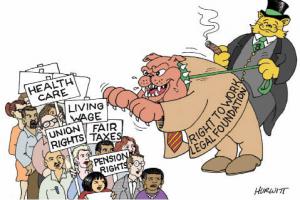 If the U.S. Supreme Court rules in favor of a lawsuit filed by the National Right to Work Legal Defense Foundation, every state in the country would essentially turn into an anti-union "right to work" state, which would be a significant blow to public sector unions' collective bargaining efforts and also complicate thousands of existing contracts between organized workers and municipalities, cities, counties, and states across the country.
 The AFL–CIO is a multifaceted institution composed of scores of autonomous unions, so President Richard Trumka’s leadership can hardly turn around this cumbersome vessel all that quickly. But the new emphasis is clear: the unions should ally with progressive partners and devote more energy to make the kind of changes in social policy that can benefit millions of poorly paid and insecure workers.
 Faced with the very real threat of extinction, unions have largely put collective bargaining on the back burner, and instead must try to remind American workers of the basic concept of worker solidarity. “We start from the point of view that, because so few people are in unions these days, very few people have personal experience with collective power,” explains Karen Nussbaum, the executive director of Working America.
Spread the word