The Mathematicians Who Want to Save Democracy
Nature
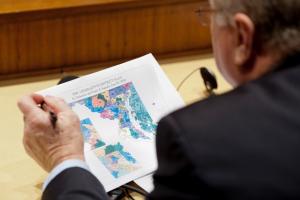 With algorithms in hand, scientists are looking to make elections in the United States more representative.
 With algorithms in hand, scientists are looking to make elections in the United States more representative.
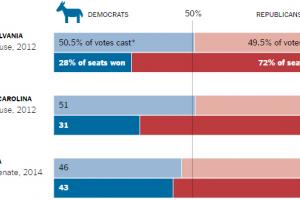 To gauge where this type of gerrymandering is taking place and its magnitude, this report used election results [from 2012, 2014, and 2016] in states with six or more congressional districts to assess the extent and the durability of “partisan bias” — the degree of systematic advantage one party receives over another in turning votes into seats . . . It also looked at the relationship between the body that drew the maps and the degree of bias observed.
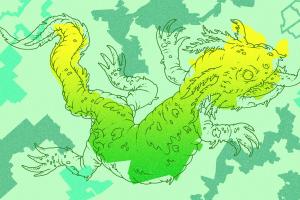 Powerful new quantitative tools are now available to combat partisan bias in the drawing of voting districts.
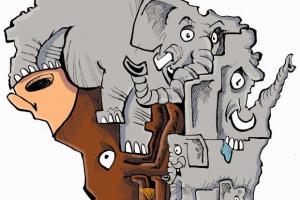 As Justice Kennedy writes: “Yet the law responds to proper evidence and valid inferences in ever-changing circumstances, as it learns more about ways in which its commands are circumvented.” This is a strong signal to lower courts not to apply prior cases formalistically or mechanically, but to ferret out unconstitutional racial gerrymanders that take ever-evolving form.
 This was first time in more than three decades that a federal court ruled for the plaintiffs in a partisan-gerrymandering suit after a full trial. It also dealt a critical blow to a very particular kind of gerrymander—call it “extreme seat-maximization”—that emerged in Wisconsin and a handful of other states in the most recent redistricting cycle.
 Since the early 1970s, the right has conducted a sustained drive to gain power and set policy in the 50 states. The left, by contrast, has been far less effective at the state-level. The sustained determination on the part of the conservative movement has paid off in an unprecedented realignment of power in state governments.
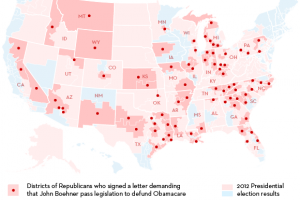 The members of the suicide caucus live in a different America from the one that most political commentators describe when talking about how the country is transforming. The average suicide-caucus district is seventy-five per cent white, while the average House district is sixty-three per cent white. Latinos make up an average of nine per cent of suicide-district residents, while the over-all average is seventeen per cent. 76 of the members are male. 79 are white.
 Hysteria, aggression and gerrymandering are a fading demographic's last hope to maintain political control.
Spread the word