Liberalism’s Crisis, Socialism’s Promise
Convergence
Portraying her subject as a radical voice of the dispossessed, author Jacqueline Mulhallen presents the poet Shelley less as a romantic and more as a traitor to his own class for his revolutionary politics. Here is the Shelley who, though writing when the British working class was in its infancy, grasped and wanted to overturn the oppression under which they lived. It's that red Shelley who inspired among others Karl Marx, even as his poetry became part of the canon.

This interview discusses wages, the struggle for $15/hr, stagnating worker incomes, and TPP’s attack on wages in the US and develops into a much broader critique of the current system’s political economy, a way to fundamentally alter the way we produce, distribute, and consume. It is not enough to bargain with capitalists. We must instead look to how workers can take over the means of production and employ them for the benefit and wellbeing of all.
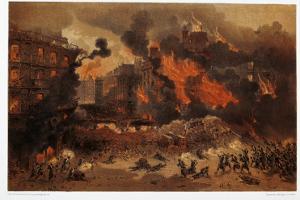
Marx called it "the dictatorship of the proletariat" and its militants those who "stormed heaven." For 76 days in 1871, this first experiment in workers self-government and armed defense against troops of the old order also made costly mistakes leading to its slaughter. The author chronicles not only Commune governance and the role of women as leaders and fighters, but the intricacies of a counter-revolution that sought nothing less than crushing Paris' working class.
Yanis Varoufakis is currently the Greek Minister of Finance. In this essay, posted to his website one year ago, he explains why he believes that radicals must work to stabilize the Eurozone on a more equitable basis so as to mimimize human suffering and to provide the time and space to develop a humanist alternative to Corporate Europe. He also describes the influence of Karl Marx on his views and asserts the necessity to embrace -- critically -- Marx's insights.
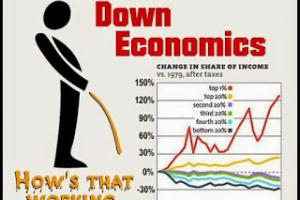
Piketty's central theme is not that inequality of the ownership of wealth is going to skyrocket. The central theme is that the 1% already owns a lot of the capital stock, and the capital stock is going to get gigantic relative to the rest of the economy. Whatever the weakness this meg-tome and mega-best seller, there is no denying - the rich are getting richer, the poor, poorer. (And Piketty is not a Marxist.)
Spread the word