Eduardo Galeano, Monster Wanted
TomDispatch
My knowledge of Cuba’s revolutionary offensive in Latin America is based on conversations with Cuban and Latin American protagonists, including – after two decades’ knocking at the door – a five-hour tête-à-tête with Castro in June 2015; as well as on documents from the US, the USSR, the GDR, Canada and Britain.
A country that hasn’t had a civil war in more than 150 years, where secessionist movements from Texas to Vermont have generally caused merriment not concern, now faces divisions so serious, and a civilian arsenal of weapons so huge, that the possibility of national disintegration has become part of mainstream conversation. Indeed, after the 2016 elections, predicting a second civil war in the United States has become all the rage across the political spectrum.
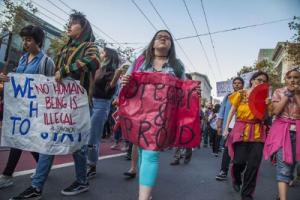
The "dreamers," young recipients of the Deferred Action for Childhood Arrivals (DACA) program—are the true children of the North American Free Trade Agreement (NAFTA). More than anyone, they have paid the price for the agreement. Yet they are the ones punished by the administration of President Donald Trump, as it takes away their legal status, ability to work and right to live in this country without fear of arrest or deportation.
“No impression should be permitted in Latin America that they can get away with this, that it’s safe to go this way. All over the world it’s too much the fashion to kick us around.” * U.S. President Nixon. Right now it is critical for the U.S. public to get some lessons on U.S. imperialism and Latin American history, and for progressive voices to condemn U.S. intervention in elections throughout Latin America and, in particular, in funding violence in Venezuela.
On Friday, a group of members of Congress published a letter opposing the threatened sanctions. It began, “We write to express our deep alarm regarding the escalating political, economic and social crisis in Venezuela and urge you to work with our regional partners to help prevent a civil war. We strongly recommend that you support negotiations mediated by respected external actors such as Pope Francis, who enjoys credibility with broad segments of Venezuela’s people.
Central America policy-making, hardly an open book to begin with, is set to become more secretive. What we do know is U.S. Secretary of State Rex Tillerson will be there, as will Vice President Mike Pence — and of course, General John F. Kelly, the director of Homeland Security and the previous head of SOUTHCOM.
Spread the word