
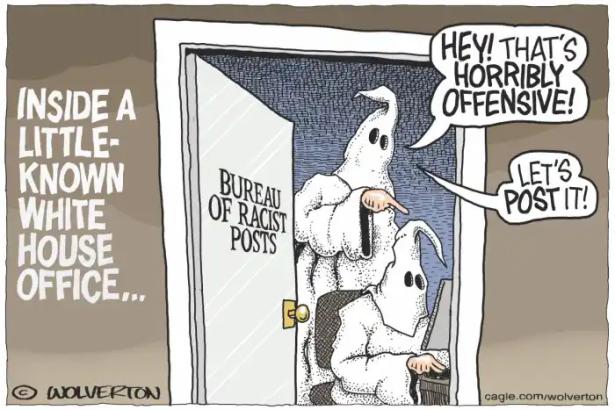
In early February 2026, President Trump (in the words of The New York Times) “posted a blatantly racist video clip portraying former President Barack Obama and the former first lady Michelle Obama as apes.” Republican Senator Tim Scott of South Carolina, the Senate’s only Black member and usually a supporter of Mr. Trump, wrote that “it’s the most racist thing I’ve seen out of this White House.”
But the video has plenty of competition. And Trump’s racist manifestations go back decades. (In the early 1960s Trump’s dad, Fred, received permission to build on a forty-acre parcel near Brooklyn’s Coney Island. This development, known as Trump Village, contained a series of seven high raises, consisting of about 3800 apartments.) In 1973, when Donald was listed as the president of Trump Management, the Justice Department sued the company for discriminating against Blacks. It charged that at Trump Village, the Trumps had refused “to rent and negotiate rentals with Blacks, requiring different rental terms and conditions because of race, and misrepresenting that apartments were not available.”
As Donald would often do later, however, the Trumps countersued the government, accusing it of making baseless charges. And the company asked for $100 million in damages. Leading the Trump court team was Donald’s friend Roy Cohn, who had previously worked for Senator Joseph McCarthy. In 1975 the Trumps, though not admitting guilt, signed a consent decree that included pages of stipulations agreeing to ensure the desegregation of Trump Village.
Yet, in 1978, the government charged that the “Trump company had not complied with the 1975 agreement.” It alleged that the Trump company “discriminated against Blacks in the terms and conditions of rental, made statements indicating discrimination based on race, and told Blacks that apartments were not available for inspection and rental when, in fact, they are.” Again, the Trumps denied the charges.
But in 1983,Trump Village still had white majorities of at least 95 percent.
The next major case illustrating Donald Trump’s racism was in 1989 when he took out took out ads in New York newspapers with the heading “BRING BACK THE DEATH PENALTY. BRING BACK OUR POLICE!” He did this in response to the rape of a White woman in Central Park. The accused and convicted were five Black and Latino teenagers who were found guilty (in 1990) and jailed. But in 2002someone else confessed to the crime, and based on DNA evidence, the charges against the five were dropped.
Yet, Trump never confessed that he was wrong about the attack—in fact, he claimed that he was not a bigot. “Probably the least of anybody you’ve ever met.” The core of Trump’s being is his lack of empathy. He just cannot put himself in the position, for example, of a poorer Black person. He seems destined to forever be the privileged son of a rich man and one who grew up in 23-room house with a chauffeur and a cook and possessing a Cadillac. Despite such a background, some people evolve and develop an empathy for society’s unfortunates. Donald Trump has not.
In her 2024 debate with him, Vice President Harris accused him of making false statements in his 1989 newspaper ads. In his reply to Harris’s charge, he falsely claimed that the raped woman died, and he was sued by the five young men for making a false, defamatory statement. Trump's lawyer called it a “baseless lawsuit...another unfounded and meritless attack against President Trump.”
By 2024-25, however, Trump’s racism was already on display in various other ways, especially in regard to immigration. In 2015, he claimed that the Mexican government was “forcing their most unwanted people into the United States. They are, in many cases, criminals, drug dealers, rapists, etc.” In 2018 he said, "Haiti? Why do we want people from Haiti [and Africa] here? Why do we want these people from all these shithole countries here? We should have more people from places like Norway." In February 2025, President Trump signed the executive order “Addressing Egregious Actions of the Republic of South Africa.” In it, he directed that “the United States shall promote [in the USA] the resettlement of [White] Afrikaner refugees escaping [Black] government-sponsored race-based discrimination, including racially discriminatory property confiscation.”
In the 2024 Presidential election, Trump made some gains (compared to 2020) among non-White and non-male voters, but by the end of February 2026 polls showed that most of that increased support had disappeared, and this was true among women, Blacks, Native Americans, and, to a lesser extent, Hispanics. (See here, here, and here.)
The fact that Trump has brought or nominated a few minorities like FBI director Kash Patel and just recently Sen. Markwayne Mullin (R-OK), a Cherokee citizen, to replace Kristi Noem as head of the Department of Homeland Security means little. There are always going to be some minorities who vote atypically, and the very conservative Mullin has very little Cherokee blood.
During his second-term presidency, Trump has surrounded himself with conservative individuals whose primary trait is loyalty to him. In December 2025, two admittingly left-leaning publications, Britain’s The Guardian and the U. S The Atlantic, called attention to Trump’s racism. The first in an article entitled “Donald Trump in his own word–the year in racism and misogyny”; and the second in “Why Doesn’t Trump Pay a Political Price for His Racism?” Both provide plenty of additional evidence for Trump’s irrefutable racism.
Finally, there are considerable indications that many, though certainly not all, Trump’s MAGA followers harbor racist feelings. Some, especially among White males, simply resent Affirmative Action and want the U. S. to go back to the pre-1960s days of White-male superiority. (I wrote about the choice still facing us in my 2019 “Do We Want the America of Frederick Douglass or Donald Trump?”)
A example of the racism of some of Trump’s followers recently came to light in Florida. In early March 2026, the Miami Herald reported the following: “The secretary of Miami-Dade County’s Republican Party started a group chat primarily for conservative students last fall—and within three weeks it was filled with racist slurs, someone wrote dozens of ways of violently killing Black people....Participants used variations of the n-word more than 400 times, regularly described women as ‘whores,’ used slurs to talk about Jewish and gay people and mused about Hitler’s politics. Interspersed throughout were discussions about events promoting the Republican Party at Florida International University....The conversations included some of the campus’ top conservative leaders: the county GOP secretary, FIU’s Turning Point USA chapter president and the former College Republicans recruitment chair. The group chat....reveals the extent of racism and extremism within the highest ranks of campus Republican Party leadership in Miami at a time Florida’s Republicans are reckoning with an increasingly emboldened far right.”
While it would certainly be a mistake to label all of Trump’s followers as racists, it would also be wrong to ignore the racism among some of them—and of Trump himself.
Walter G. Moss is a professor emeritus of history at Eastern Michigan University. He is the author of Russia in the Age of Alexander II, Tolstoy and Dostoevsky (2002). For a list of all his recent books and online publications, including many on Russian history and culture, go here.
LA Progressive is an independent, justice-driven publication amplifying the voices, struggles, and triumphs of those working toward a more equitable America. Founded by Dick Price and Sharon Kyle, the editor and publisher, we expose systems of power that marginalize communities and spotlight solutions born from grassroots movements, visionary thinkers, and everyday changemakers. Rooted in Los Angeles yet national in scope, our mission is to inform, engage, and mobilize readers to confront racism, economic inequality, and all forms of injustice—transforming awareness into action.
Spread the word