
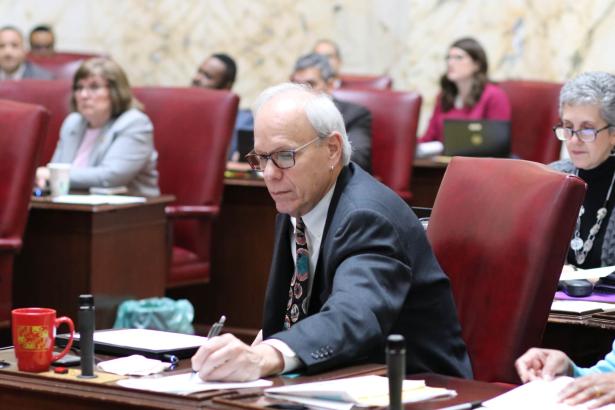
Progressive lawmaker failures, we need to acknowledge, sometimes come self-inflicted. All too frequently, the siren-song lure of leadership status can have a hypnotic effect on progressive lawmakers. The higher they rise in the legislative food chain, some start believing, the more real change they’ll be able to deliver. But only “team players,” for the most part, find themselves rising, and the compromises they need to make for the good of “the team” all too often serve to homogenize any real progressive agenda.
Add into these dynamics the ego-stoking that comes with winning elected office, and we have a toxic brew that undermines solidarity and prospects for true progressive legislative success.
But success can come, despite all these pressures. That success takes marrying progressive goals with just the right measure of legislative pragmatism. In my final state Senate term, as a committee chair, a good bit of that marrying took place.
The “Blueprint for Maryland’s Future” enacted and signed into law in 2020 unleashed the biggest investment in education in the state’s history, with much of that investment specifically directed to overburdened and underserved communities, essentially prioritizing onto a pedestal targeted funding for schools serving the state’s poorest children. I played an active role in this drive and came away with a strengthened appreciation of what broad-based coalitions can accomplish. Those of us on the left should never shrink from participating in — or even helping lead — these liberal efforts.
The next year, 2021, would see the surfacing of a different sort of coalition challenge. Other lawmakers, environmental groups, and I had been working for over a year on a major new piece of climate change legislation. We had mobilized widespread grassroots involvement. Then, in the waning days of the 2021 session, we suddenly faced a major decision point after the House of Delegates eviscerated the precedent-setting legislation I had introduced in the Senate.
The bill the House passed removed almost all the key components in the Senate-passed bill. All of us who had shepherded that bill through the Senate now faced a difficult choice. Would we accept the House’s much weaker version of the legislation to give climate activists a partial victory or would we progressive senators say “no” and come back to fight the next year?
Environmental group leaders supported accepting the drastically amended version. That put me, as the original bill’s sponsor, in a difficult and unusual position. In battles over whether to accept half a legislative loaf, advocacy groups usually find themselves accusing lawmakers of being willing to compromise away too much. But, in this case, I believed that we wouldn’t have an opportunity the next year if this weakened bill ended up getting signed into law. A grassroots disillusioned by a pyrrhic “victory” in 2021 wouldn’t be likely to mobilize enthusiastically in 2022.
So I held firm, one of the few times I differed with my advocacy organization allies. The weak House bill would go to die an unmourned death. The grassroots would not get disillusioned.
The next year we came back with a strengthened bill. The utilities didn’t like it, and neither did major Maryland property owners. The Senate president had problems with the newly strengthened legislation as well. But, with considerable grassroots support behind us, we had the naysayers in a box from which they couldn’t escape. The Democrats responsible for weakening the previous year’s legislation turned out not to have the guts to backtrack again.
The enacted Climate Solutions Now Act of 2022 became a shining example of what principled state action could accomplish. Among many other strong provisions, the legislation called for a 60-percent reduction in greenhouse gasses by 2031 and full carbon net neutrality by 2045.
The lesson here: A half a loaf can be worse than no loaf at all. Progressive lawmakers need to weigh the dynamics of each situation carefully.
That episode would be my last heavy-duty legislative struggle. Early in 2023, I left the legislature to join the administration of Maryland’s newly elected governor to lead the state Energy Administration and advocate for clean energy and limits on the fossil fuel industry. But three years in that position had me facing retirement considerations and other political barriers. At age 75, I stepped away.
I had entered electoral politics almost four decades earlier. At that time, how I labeled myself politically didn’t seem that important. The Democratic Socialists of America back then didn’t have anything near the strength or visibility that DSA holds today. In our current political life, self-identifying as a socialist holds much more import and helps build a growing socialist world view. Three dozen years ago, in a much different political environment, would self-identifying as a socialist been anything more than a distraction from the work of advancing a progressive agenda? Hard to say. Red-baiting back then felt hard-wired in American political life.
I chose back then to openly wear my class politics on my sleeve without placing my socialist perspective in bright lights. People knew where I stood on the ongoing struggle between workers and capital, about fighting for higher taxes on the rich to help fund services for working families, about racial and gender discrimination, gun control, and other progressive priorities.
Bernie Sanders recently recalled an article he once saw in the local Burlington paper. A local resident, asked what he thought about having a socialist mayor, answered simply: “Well I don’t know much about socialism, but I do know they’re getting the snow off the streets a lot faster than they used to.”
“You gotta do your job,” Bernie added after telling that story. “If you’re on the city council, the school board, the state legislature, you gotta do it. And if you do your job well, people will give you the latitude to talk about many other issues.”
I don’t see Bernie’s comment as an argument to hide your politics until you “do your job,” something, obviously, Bernie has never done. Progressive lawmakers, I believe, need to absolutely be clear on which side they’re on, which class they represent.
As left activists who choose electoral work, we can both maintain ideological clarity while also remaining politically pragmatic. That can be done.
In the difficult times we now find ourselves in, that must be done.
Paul G. Pinsky, a long-time activist, served over thirty years in the Maryland legislature and headed up the Energy Administration for Gov. Wes Moore. He has been arrested four times for demonstrating.
Thanks to the author for submitting this article to Portside.
Spread the word