
- Palantir’s Manifesto in Depth
- Ted Turner and Television
- Clickbaiting History
- Radical Booksellers
- AI News and Analyses
- Big Media Mergers: When Bigger Isn’t Better
- Maryland Bans Surveillance Pricing
- Trump’s Press Enablers
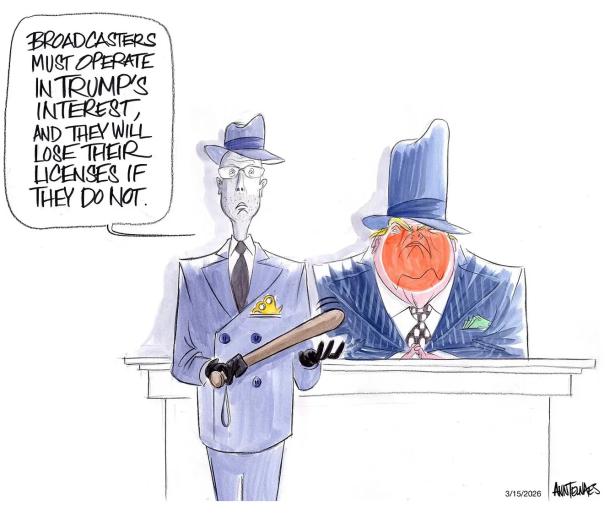
- ABC is Fed Up with the FCC
- Podcasts: Finding Joy in Resistance
By Rezgar Akrawi, Links
Palantir Technologies’ manifesto, The Technological Republic: Hard Power, Soft Belief, and the Future of the West, is neither a technical document nor an economic vision. It is an explicitly political document announcing a new phase in the trajectory of digital capitalism. Abandoning claims to neutrality, the manifesto reveals digital capitalism’s true ideological face.
By Michael J. Socolow, The Conversation
Ted Turner, who died on April 6, 2026, was bright, shrewd and, most of all, lucky. The cable TV visionary proved to be in the right place, at the right time, to change television and video news forever. Turner will be remembered mostly for the creation and development of the Cable News Network, which made our knowledge of distant events instantaneous and our world more comprehensible.
By Lincoln Cushing, The Stansbury Forum
In the social media sphere a persistent story line is about an ordinary person who subverted the standard way of doing things, came up with a clever solution to a problem, and then vanished from public knowledge. It’s an attractive trope, ostensibly honoring the “little people” whose street smarts ends up being better than conventional wisdom. But what if the story, presented as fact, is false?
By J. Patrick Patterson, In These Times
Radical booksellers create democratically governed spaces where the public is encouraged to build movements, rather than merely participate in the retail economy.
AI News and Analyses
The Fetishism of AI By John Bellemy Foster, Monthly Review
The Workers Taking on Big Tech By Grace Blakely, Substack
Can Technology Respect Human Rights? By Rezwan, Global Voices
Will AI Ever Show a Profit? By Jim Naureckas, FAIR
You Gotta Believe By Kiera Butler, Mother Jones
Data Center Resistance in Utah By Devin B. Martinez, Peoples Dispatch
Big Media Mergers: When Bigger Isn't Better
Media and Democracy Project
The charge of every broadcasting station is to serve the public interest. As our newspapers rapidly disappear or become the bullhorn of wealthy interests, it’s more important than ever that television broadcast news fills that gap by providing local, impartial stories that Americans can use to make informed decisions. Mergers work against that.
Maryland Bans Surveillance Pricing
By Becky Robertson, Moneywise
Retailers are taking advantage of AI and their access to consumer data to customize prices based on a shopper’s location, search history, personal details, past buying habits and more. In response to these trends, Maryland is about to become the first state to ban the practice in the grocery sector.
By Mark Jacob, Stop the Presses
No one in the media is so clueless that they can’t see what’s happening. No one can watch videos of masked federal agents executing people in the streets and think this is normal. No one can ignore the illegal war with Iran, or the attempted takeover of elections. It’s not cluelessness anymore. It’s cowardice and complicity. And it’s inexcusable.
By Jon Brodkin, Ars Technica
Led by Chairman Brendan Carr, the FCC accused ABC’s The View of not complying with the equal-time rule, even though the interview portions of talk shows have historically been exempt from the rule requiring equal time for opposing political candidates. ABC is fighting back against the Trump administration’s attempt to police broadcast television content.
Podcasts: Finding Joy in Resistance
By Commons Librarian, The Commons Social Change Library
In these hard times, find your joy! Here is a collection of podcasts to listen to about finding joy in activism, resistance, and movements.
Spread the word