
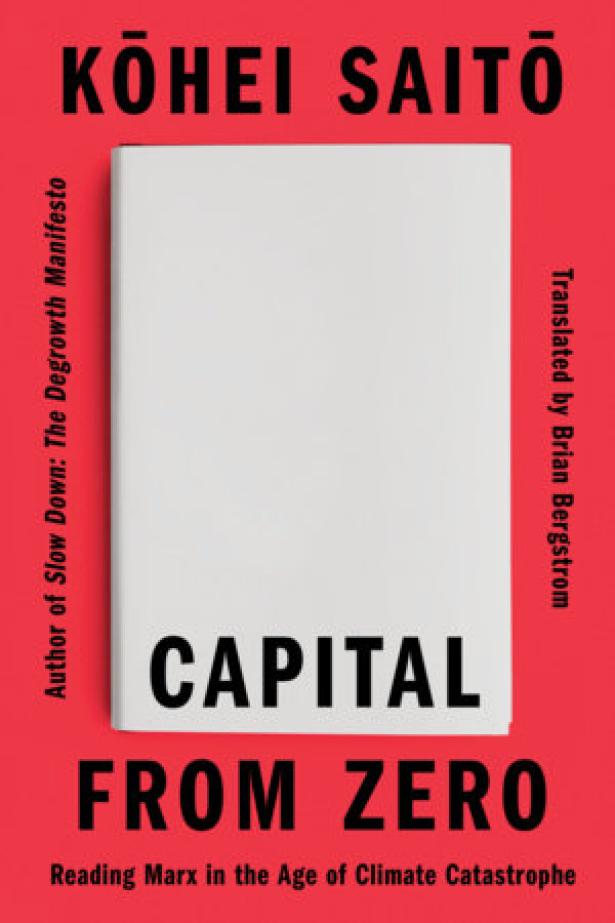
Capital From Zero
Reading Marx in the Age of Climate Catastrophe
Kohei Saito. Translated by Brian Bergstrom.
Astra House
ISBN: 9781662603419
WHEN I RIDE the New York subway back home from Manhattan to Queens, I’m surrounded by gig workers so exhausted that they can barely keep their heads up. One day I noticed that these same subway cars were increasingly festooned with ads by obscure companies such as Genspark.ai, proclaiming the time-saving benefits of artificial intelligence. “Go home early,” the perky ads declare, “we’ve got your spreadsheets.” Hovering above the heads of exhausted workers, AI is represented as a kind of work buddy, someone who’s got your back as well as your rote tech tasks covered. “One prompt,” the ads proclaim, and “job done!”
Some ads go further, depicting AI not just as an invisible workmate but also as a furry purple llama sidekick that snuggles up against you, helping you approach the coming week with confidence and tranquility. I get the blond-haired white dude with the visionary entrepreneurial gleam in his eyes—that’s how all Fortune 500 corporations want people to imagine themselves, after all—but isn’t there something a bit weird about the Monday sidekick? He’s like Big Bird on some freaky combination of acid and ecstasy. I mean, I like you, man, I might even go to a rave with you, but I don’t know you like that!
These AI ads are playing on—and playing up—the brilliant marketing gambit known as the chatbot. When OpenAI kicked off the current AI boom with the release of ChatGPT in 2022, they engineered a revolution in how people conceive of technology. Chatbots trick our simian brains, which are wired by millions of years of evolution to respond to social cues and prompts. When we interact with a chatbot, it’s hard not to think that there’s a “person” in the machine, a kind of furry friend who cares about us and will care for us. AI is like the friend we all wish we had, someone who will never bail on dinner plans or leave dirty dishes in the sink.
Things are so extreme that you cannot even walk down a street in New York without being told by an ad on a bus that you should start using AI as your therapist. Not everyone is happy about our new furry friends. In fact, I frequently come across ads that have been defaced, the result of a guerrilla AI-resistance campaign intent on bringing out the sinister implications of the technology. But Big Tech bosses like Elon Musk sure are stoked about AI’s liberatory potential. Despite referring to ChatGPT in 2023 as “one of the biggest risks to the future of civilization,” Musk has changed his tune and now proclaims that “millions of robots will [soon] take care of everything for you,” making money and work irrelevant by 2035. Musk is not alone: pretty much all the Big Tech billionaire bros have adopted this line. It’s a seductive one, apparent in those Genspark subway ads: after all, if Big Tech is really giving us a bunch of furry friends who excel at doing work, why not let them do our spreadsheets and go home early? Hell, why go to work at all? Why not spend all your time at home snuggling with your furry purple friend?
Can we really expect AI to relieve the exhausted of the earth of their material and affective burdens, as those subway posters and bus ads suggest? In his new book Capital from Zero: Reading Marx in the Age of Climate Catastrophe (translated by Brian Bergstrom), Kohei Saito offers a clear answer to this question. Saito, a Japanese philosopher whose previous books have managed to make the phrase “best-selling Marxist” something other than a risible oxymoron, now offers readers an accessible introduction to Karl Marx’s magnum opus in which he deftly interweaves readings of Capital (1867–94) with reflections on the contemporary crises of capitalism.
To the extent that AI seems to be initiating a new regime of accumulation that may render vast swaths of today’s labor force obsolete, Saito’s reassessment of Marx’s culminating work is supremely well timed. Saito does not mince words in his verdict on AI: “It should now be clear,” he says, “that the promise that technological advances like AI and robotics will enable workers to enjoy more freedoms is an enduring lie.” Like the forms of automation that Marx observed in his own day, contemporary technologies such as AI are not introduced to lighten the load of workers but, as Saito puts it, “to more efficiently control and surveil workers, and to guarantee that they will work tirelessly and without complaint.”
To support this conclusion, Saito reminds his readers that it was crystal clear to Marx that capitalist bosses introduced machinery to raise worker productivity. The goal of automation is to make more money, not to make work easier. Worse still, the transformation of the labor process that results from automation also deskills the workers themselves. By thus revamping the labor process, capitalists can both generate more surplus value and make workers more dependent on them, since the bosses rather than the workers now seem to oversee production. Marx called this process of automation “real subsumption” since it involves capital’s control not just of workers but also of the way in which work is done.
To get a sense of what Marx and Saito are arguing, think of the assembly-line scene in Charlie Chaplin’s classic film Modern Times (1936), in which Chaplin’s hapless worker is reduced to tightening a bolt repeatedly in a simple but increasingly sped-up gesture. His futile struggle to keep up with the assembly line eventually leads him to fall into the gears of the machine. Chaplin’s film is a brilliant visualization of Marx’s account of the impact of automation on workers. Marx in fact argues that the capitalist transformations of the labor process “distort the worker into a fragment of a man [and] degrade him to the level of an appendage of a machine.” In his discussion of the relentless drive to augment productivity that motivates capitalist automation, as in so many other sections of his book, Saito weaves deftly between his own explications of Marx’s analysis and direct quotations from Capital. The degradation that this process inflicts is not merely a manual one: it also involves intellectual and emotional subordination—or what Saito calls “subsumption of the spirit,” a condition in which workers internalize the idea that it is capital that generates value rather than the workers themselves.
As its title suggests, Capital from Zero is intended for readers with little to no experience with key concepts from Marx’s work. It is therefore written in a manner likely to engage young people, making it a perfect tool for teaching in schools, universities, and popular assemblies. Saito’s discussion of Marx’s distinction between use value and exchange value exemplifies this sly accessibility. As Marx famously argued, commodities have two faces: a use value for people who have material needs for clothing, shelter, and so on, and an exchange value for the capitalists who strive to sell commodities to consumers. Under capitalism, Saito writes, the key issue is how much money can be made from things, rather than whether they are useful. He illustrates his point by explaining that bubble tea shops are popping up everywhere not because everyone needs bubble tea but because selling the stuff can make money. But this drive to commodify human needs leads to fundamental contradictions. We should all want comfortable and durable clothes made from sustainable fabric, for the good of our wallets as well as the planet. Saito observes that “fast fashion,” however, does not fulfill these needs but instead “fills our closets with clothes made as cheaply as possible with no regard for environmental costs.” In this example, use value is severed from exchange value, and the latter comes to predominate to the point that people end up with hundreds of pairs of expensive sneakers, hoodies, jeans, and other clothes, all of which are produced from fabric grown using toxic chemicals on parched land in the nations of the Global South and then sewn together under horrendous sweatshop conditions, only to be tossed aside after being worn for the brief season they are in vogue.
Yet while Capital from Zero undeniably serves as an introductory text, it simultaneously offers incisive interventions into pivotal political debates of our times. This is perhaps most evident in Saito’s account of Marx’s development as an ecosocialist thinker. As he has done in previous, more academically framed work such as Marx in the Anthropocene: Towards the Idea of Degrowth Communism (2023), Saito challenges accounts of Marx’s work as unrelentingly productivist and therefore wedded to the liberation of workers solely through the development of the forces of production. This reclamation of Marx’s environmental thought is based both on work Marx published in his lifetime and on recently discovered unpublished work, much of it surfaced through the MEGA project, of which Saito is a member.
For instance, Saito cites “Machinery and Large-Scale Industry,” a chapter from the first volume of Capital, to explain Marx’s argument that the feckless exploitation of nature that characterizes capitalist agriculture threatens not simply the bottom line for individual farmers but also the physical foundation of society in general. Building on the work of theorists such as John Bellamy Foster who, in recent decades, have helped unearth the ecosocialist elements of Marx’s thinking, Saito argues that Marx was inspired by his study of contemporary natural science to develop the concept of capitalism’s “metabolic rift,” the rupture of the cyclical relationship that once existed between humans and nature. In contrast to these natural cycles, capital consists of a one-way process of extraction from workers and the natural world. Capitalism seeks to cope with the resulting environmental destruction, Saito argues, by exporting wasted nature to geographical areas that are thereby turned into sacrifice zones: “Capital always works to externalize the costs of its operations, but the planet acts as a limit on this ‘externality.’” As the oceans turn to acid and rainforests morph from carbon sinks to carbon-emitting deserts, we have reached the limits of capital’s strategy of externalizing waste. This does not mean capital will cease exploiting people and the planet—indeed, capital will continue to find ways to profit from environmental breakdown. It does, however, portend a steep acceleration of intersecting ecological and social crises.
How does Saito propose to change the political arrangements that are greasing the wheels of global ecocide? Certainly not through fantasies about technological change decoupling economic growth and environmental impact. Capital from Zero extends the critique of ecomodernist currents of thought that Saito articulated in Slow Down: The Degrowth Manifesto (2024), an important intervention since these ideologies have a strong grip on Silicon Valley outfits like the Breakthrough Institute and on portions of the left as well. This includes thinkers who embrace the notion that capitalism’s technological innovations will get us to “fully automated luxury communism,” a tendency known as accelerationism. Saito’s critical analysis can be seen as encompassing both starry-eyed techno-utopian intellectuals and sectors of the organized working class who have embraced a state- and capital-centric “just transition” framework grounded in building renewable energy and other infrastructure for carbon mitigation and adaptation.
The promise of this Green New Deal strategy for workers is predicated not just on shutting down fossil fuels but also on creating many new “green” jobs. Yet while fossil capital certainly needs to be terminated, the just transition approach endorsed by organizations such as the International Trade Union Confederation (ITUC) does not fundamentally challenge capitalism’s unfolding restructuring of the global economy. Evident in massive lithium extraction projects in countries like Bolivia, the green capitalist just transition strategy pits trade unions against other sectors of the working class, particularly those—such as Indigenous communities, subsistence farmers, and landless rural workers—who bear the brunt of capital’s renewed cycles of global extraction.
Saito also holds out little hope that a left-wing capture of state power, even if it were possible, would offer a truly empowering and revolutionary horizon of transformation. In fact, for Saito, the emphasis on solidifying state power that characterized dominant left politics for much of the 20th century is linked to an increasingly restricted vision of alternatives to capitalism, one that privileged competition with capitalist states through economic growth. Capital from Zero offers an extended critique of the Left’s disastrous adoption of the hierarchical party form and of nationalist socialism, which Saito argues characterized not only the Soviet Union but also many postcolonial nations such as Cuba and Vietnam. Who ends up planning a society’s overall production when it’s nationalized? Saito asks. It is not, he answers, the workers. Rather, the task falls to party officials, who become a special class separate from the rest of society.
Nationalizing the mode of production, Saito concludes, all too often leads to oligarchy and dictatorship. His argument that “Marx was not calling for a government official–dominated society like the Soviet Union, but rather for a democratic society founded on freely given mutual aid and fellowship,” is not simply a retrospective reflection on the past failures of the Left; it is also an indictment of much current thinking. Given the magnitude of the environmental crisis, many leftists have called in recent years for party- or state-centric forms of “war communism” or climate Maoism to radically speed up the shutdown of fossil capitalism. For those who grasp the gravity of our crisis, the temptation of such a position is easy to understand. Yet Saito’s excavation of Marx offers an important caution against this temptation.
If not in technological change or top-down planning, then where does hope lie? To answer this question, Saito again draws on Marx’s later work, written after the Paris Commune established models of popular sovereignty not simply in workplaces but throughout the city of Paris. Saito argues that Marx was inspired by the Paris Commune and by his engagement with Russian revolutionaries such as Vera Zasulich, who sought to convince him that peasant communes offered a model of the communist society to come. These influences led Marx, Saito argues, to embrace what he calls “anarchist communism,” a “form of ‘association-ism,’ in which social organization would occur from the bottom up, avoiding the hierarchical relations and domination demanded by capital and the state.” Saito makes a case that worker cooperatives could form nuclei of a revolutionary environmentalism from below, one that would maintain worker autonomy while permitting a scaling-up process through forms of federation on an urban scale. For Saito, the Fearless Cities movement that developed out of such radical municipalism in Barcelona, Spain, is a real-world example of what these trends might look like.
How might such movements expand beyond the urban scale? After all, although cities house an increasing majority of humanity and are already struggling with the worsening impact of the climate crisis, they cannot be the sole site of revolutionary struggle. What about rural areas, where some of the most militant resistance movements have arisen in recent decades, from the Zapatistas in Chiapas, Mexico, to the water protector movement led by the Standing Rock Sioux Tribe? Two key traditions of radical thought might have strengthened Saito’s theorization of a liberatory communism. One of these is an analysis of racial capitalism. While Saito frequently criticizes capital’s tendency to externalize its toxic by-products, generating global inequities that analysts have called the “imperial mode of living,” his discussion in Capital from Zero does not reexamine Marx’s work through a lens that illumines how racism and capitalism are coeval.
Pioneered by Cedric Robinson, the analysis of racial capitalism highlights the ways in which capitalism developed alongside and through discourses of racialization that not only segmented the globe but also divided the working class through invented racial divisions. Such distinctions have been a key technology of control for capitalist bosses, one that some unions have lamentably helped perpetuate in settler colonies like South Africa and the United States. Social divisions, in other words, run not just between the Global North and South but also through social formations in core capitalist and postcolonial nations alike. Reckoning with this reality is fundamental to overcoming the global spread of fascism and the xenophobia on which it is founded. The movement that Saito terms “degrowth communism” must develop these theoretical tools if it hopes to abolish the forms of racial inequality and injustice that the intertwined climate and capitalist crises are generating today.
The other glaring elision in Saito’s analysis is the question of social reproduction, a feature of capitalist societies that was theorized powerfully by ecosocialist feminist activists like Silvia Federici and Stefania Barca. Marxism has historically failed to engage adequately with the vast population whose daily labor in the world’s fields, streets, kitchens, and bedrooms produces and reproduces the workforce and is often key to protecting the environmental foundations of society. Capital from Zero hints at such an analysis but fails to engage adequately with these social subjects or with feminist ecosocialism. For instance, while Saito emphasizes the importance of common-pool resources, he does not systematically theorize the significant segment of the global working class whose social cooperation is key to sustaining and reproducing labor power. We desperately need a thoroughgoing and substantial redefinition of the working class to include care work and social reproduction, a redefinition that includes both the waged and the unwaged.
Exhausted gig workers returning home from jobs as nannies, deliveristas, security guards, and nurses are a vital part of this neglected segment of the global working class. As my subway photographs of AI ads suggest, we are on the precipice of a massive transformation in how work is done and who does it. Organizing the gig workers who sit exhausted beneath publicity promising a labor-free future will be key to the abolition of capitalism. To do such organizing work, however, we must first actually see these workers. Now more than ever, we need a capacious account of the global working class, one that will help build revolutionary movements grounded in the class unity and power necessary to overthrow capitalism.
Ashley Dawson is a distinguished professor at the City University of New York. He is the author, most recently, of Environmentalism from Below: How Global People’s Movements Are Leading the Fight for Our Planet (Haymarket Books, 2024) and co-editor of Decolonize Conservation: Global Voices for Indigenous Self-Determination, Land, and a World in Common (Common Notions, 2023).
Spread the word