
- Global AI Governance — Three Approaches
- The Sun Sets on Google’s Empire
- Against Tech Oligarchy
- Ilhan Case: Nary a Peep from the Elite
- Meta Explains Its Political Interference: “Oops”
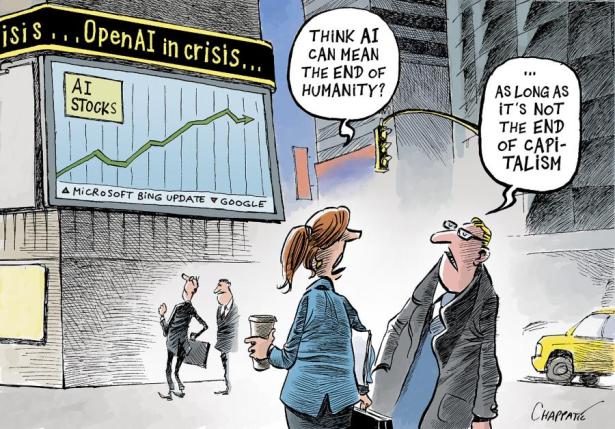
- Can AI Save Capitalism?
- College Radio Under Fire
- Political Cartoons Smear el-Sayed
- Weiss’s MAGA CBS is a Bust
- Ohio’s Revolt Against Data Centers
Global AI Governance — Three Approaches
By Yves Tiberghien, East Asia Forum
Global AI governance is taking shape around competing visions and national interests. The United Nations pursues shared rules, Washington prioritises technological dominance and national security, while Beijing focuses on international cooperation and AI capacity-building in the Global South. None of these approaches provide effective safeguards against the loss of human control.
The Sun Sets on Google’s Empire
By Cory Doctorow, Pluralistic
For most of its history, Google operated in a virtuous cycle with publishers whereby they allowed Google to crawl their sites and Google located audiences and connected them with the pages on those sites. Today, that cycle has turned vicious, with Google acting as a parasite that extracts value from the web's publishers and offers nothing in return.
Amy Goodman, Clarissa Redwine and JS Tan, Democracy Now!
Tech companies are embracing AI, workplace surveillance and increased automation. At Meta, a new initiative will collect workers’ mouse movements, keystrokes and some screenshots to help train AI models to replace them in the future. In response, Meta workers reached out to a branch of the Communication Workers Union, to discuss unionization efforts and how best to resist.
Ilhan Case: Nary a Peep from the Elite
By Adam Johnson, The Intercept
No editorials, no opinion columns in the Times, Post, or Journal; no preening in The New Yorker or Politico or Atlantic about the erosion of “rule of law.” The Atlantic did run an article on the Omar raid but it was equivocal and Both Sides in its tone. As a rule for U.S. media, the consistent application of principle — as high-minded and lofty as they may appear — takes a back seat to class solidarity.
Meta Explains Its Political Interference: “Oops”
No Kings? No Access By Jasmine Fernández, The Independent
Boosting Bolsonaro By Jake Johnson, Common Dreams
Deleting LGBTQ Accounts By Anna Iovine, Mashable
By Michael Roberts, Marx Memorial Library annual lecture
US GDP growth is now driven almost exclusively by rising tech spending. So if this starts to drop, the US economy will enter recession very quickly — even if tech investments decline only by a little bit, say 4 to 6 per cent, as happened after the much smaller tech booms in the 1960s and during the 2009 recession.
By Lucy Schiller, Columbia Journalism Review
The Trump administration’s ideological attacks on public media and education converge at university-based radio stations. Some are breaking free.
Political Cartoons Smear el-Sayed
By Hank Kennedy, FAIR
Political cartoons commenting on Michigan’s 2026 US Senate race have been dominated by a torrent of Islamophobia and anti-Arab racism directed at Democratic nominee Dr. Abdul El-Sayed, an Arab-American Muslim. These caricatures do not come out of nowhere, of course, but reflect the poisonous atmosphere of the campaign against El-Sayed.
By Sophia Tesfaye, Salon
The crisis at CBS News is bigger than one controversial editor. It is about what happens when corporate power no longer values a news organization’s independence as a principle to be defended. Now the network is caught struggling to hold on to the credibility it inherited while forging the political project its leadership appears determined to impose.
Ohio’s Revolt Against Data Centers
By Dan Gearino, Inside Climate News
The prospect of unchecked development has galvanized a cross-section of Ohioans, urban and rural, Democrat and Republican, alarmed about the spread of the giant computing facilities. Residents are demanding that local governments impose bans and moratoria on data centers while gathering signatures for a statewide ballot measure that could go before voters in 2027.
Spread the word