Can Podemos Win in Spain?
The Nation
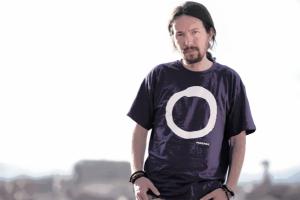 Just a year after its founding, it’s the country’s leading party.
 Just a year after its founding, it’s the country’s leading party.
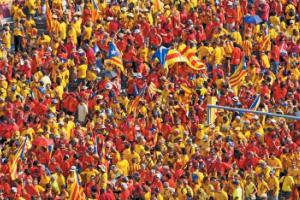 Catalonia has decided to recast its planned November 9 referendum on independence as a nonbinding consultation.Why are so many Scots (45% in September's referendum) and Catalans (50% in recent polls) set on leaving now? The answer is surely a desperate search for sovereignty with longstanding resentments over discrimination by the power centers in their respective states. Like many other Europeans, they feel cheated by their governments' response to the Great Recession.
 Reader Comments- People's Climate March - climate change, environmental activism, labor unions; Syria, Iraq, ISIS; public education; labor organizing; Zephyr Teachout - Working Families Party, Democratic Party, 2016 elections; Spain, Scotland, Cuba, Gaza, El Salvador; racial bias; worker cooperatives;
Announcements - Film Screening African Americans in Spanish Civil War; Mobilizing Against Inequality Book Launch; Southern Tenant Farmers Union celebrates 80th anniversary
Reader Comments- People's Climate March - climate change, environmental activism, labor unions; Syria, Iraq, ISIS; public education; labor organizing; Zephyr Teachout - Working Families Party, Democratic Party, 2016 elections; Spain, Scotland, Cuba, Gaza, El Salvador; racial bias; worker cooperatives;
Announcements - Film Screening African Americans in Spanish Civil War; Mobilizing Against Inequality Book Launch; Southern Tenant Farmers Union celebrates 80th anniversary
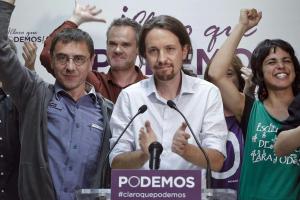 In Spain this past May, the elections to the European Parliament produced a shock. A two-month-old party led by a 35-year-old, pony-tailed political scientist appeared out of nowhere—but clearly from the Left—to win 8 percent of the votes and five seats, transforming the infant organization into the country’s 4th largest political force. One of the party's founders, political scientist Juan Carlos Monedero, spoke with us in late August.
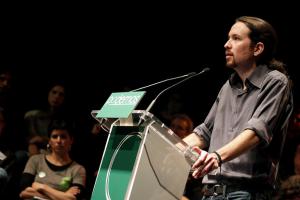 While heavy on academics, the candidates on the Podemos ticket represented more of a cross-section of the Spanish citizenry than any other party in the country. Their ages ranged from eighteen to seventy-eight, and their vocations from firefighter to librarian, but most importantly they included unemployed workers of all shades.
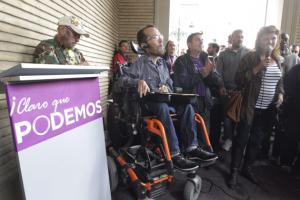 Podemos ('We can') is a left-wing party that surprised Spain by winning more than 1 million votes and five seats in the European Parliament elections last month, a mere four months after being founded. Physicist Pablo Echenique is one of those elected.
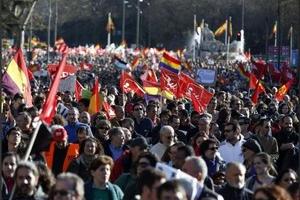 Once the March for Dignity became public, it rapidly became clear that it was an initiative for which millions had been waiting. Endorsements of its manifesto rapidly multiplied and the popularity of the initiative forced the mainstream union confederations to give it their blessing. No to the payment of the debt; bread, shelter and work; and not one more service cut.
 It is safe to assume that Pope Francis knows very well that the Catholic Church supported the military coup and dictatorship of General Franco in Spain. In this light, the recent service honoring the members of the Church who fell during the Spanish Civil War on the fascist side casts doubt on what motivated the silence of Bishop Bergolio (Pope Francis) during the Argentinian coup.
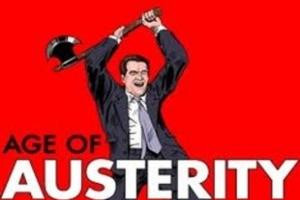 Inequality across much of Europe has widened, but it is still quite modest when compared with the vast income gap in the United States.The question is whether relative equity can hold as workplace institutions that for decades protected European employees’ standard of living give way to a more lightly regulated, American-style approach, where the government hardly interferes in the job market and organized labor has little say.
Spread the word