Fast Food Walkout in Chicago
Salon
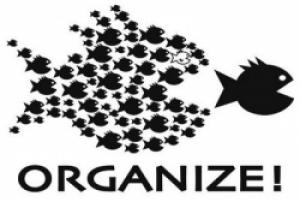
Unions have looked to the US for ideas about how to fight back. They adopted "The Organizing Model," an approach to organizing first developed by the AFL-CIO in the 1980s that is now a core principle in virtually every major labor organization in the US, Europe, Australia, and parts of Asia. While the shift to an "organizing" orientation is more than necessary, it is also less than sufficient to revive the labor movement and it's shortcomings have also become apparent.
NLRB passed by Congress and later amended by Congress - weakened by the courts - judges who are not elected. The answer is that the strong protections in the law Congress passed have been weakened by "judicial amendments" - that is, by court decisions that weaken or even eliminate worker rights and protections created by Congress.
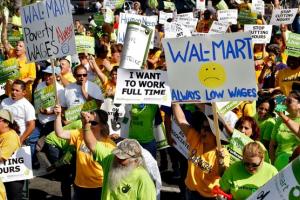
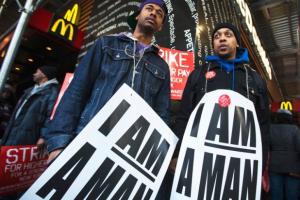
The ongoing organizing effort of fast-food workers has highlighted the highly exploitative conditions faced by those at the deep fryers and cash registers of America’s most profitable fast food outlets, which include Burger King, McDonald’s, Dominos, Pizza Hut and KFC. The actions and considerable media attention has also begun to chip away at the conventional image of a fast-food worker as someone who bears her servitude with a youthful grin.
Employers hope the guest-worker program will prevent low-wage Americans from getting a raise. With any increase in demand, employers can claim a "labor shortage" allowing in more guest workers, driving wages down. Because some 11 million undocumented workers are here, doing much of this work, the only way these undocumented workers can become organized -- and not undercut attempts to unionize legal workers -- is if the undocumented workers also become legal.
Labor experts say unions are focusing on the hospitality field and less traditionally unionized workplaces - car washes, retailers, taxi and limo companies - as membership rolls have decreased. The percentage of private sector workers represented by unions has fallen from a peak of about 35 percent in the mid 1950s to about 7 percent, said Fred Feinstein, a former general counsel with the National Labor Relations Board who now works as a union.
Spread the word