
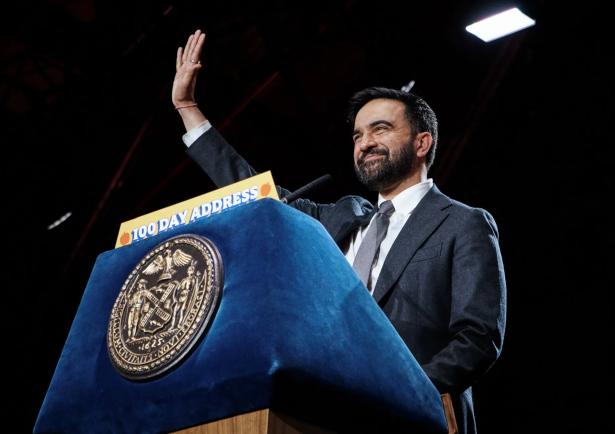
Six months after Gov. Kathy Hochul scolded New Yorkers for telling her to tax the rich, she joined New York City Mayor Zohran Mamdani to do just that.
The two officials instituted a “pied-à-terre tax” on second homes worth over $5 million, a fee that would apply to the ultra-wealthy who “store their wealth in New York City real estate but who don’t actually live here,” Mamdani said in a video announcement of the new tax set to music that sounds like the theme song to Succession.
“They’re able to reap the huge financial rewards of owning property in, dare I say, the greatest city in the world,” Mamdani said, and most of the time the units sit empty. “This is a fundamentally unfair system that hurts working New Yorkers.”
He gave examples of the types of homes he’s talking about, including billionaire Ken Griffin’s $238 million penthouse in Midtown, once the most expensive home in the country, and Russian auto dealer Alexander Varshavsky’s $20.5 million property, which he bought in cash. Mamdani counted “thousands more” similarly opulent homes “owned by foreign oligarchs and the global ultra-rich.”
The new fee would bring in about $500 million annually, less than 10 percent of the city’s projected budget deficit of $5.4 billion. Nonetheless, it’s a crack in Hochul’s stone wall against the idea of applying any new tax against the rich, which she’s maintained for months. At a rally for the Mamdani mayoral campaign in October, New Yorkers chanted “Tax the rich” at Hochul when she took the stage. Initially, she pretended that she thought the audience was yelling “Let’s go, Bills,” in reference to the NFL team from Buffalo. Then she tried other ways to get out of the intensely popular demand, including repeating the lie that taxes on the ultra-wealthy prompt them to leave, which has repeatedly been proven untrue, and saying that having to listen to a repeat request from the constituents she serves is akin to her having to “put up with a lot of crap.”
“I hear you,” Hochul said a month later when some in the audience at a political conference in Puerto Rico told her to tax the rich. “But I’m the type of person, the more you push me, the more I’m not going to do what you want. So little lesson to all of our friends out there.” Later, she told reporters that Buffalo natives “don’t put up with a lot of crap,” adding, “You look at the history of people who’ve run multimillion-dollar ad campaigns to try and get me to change my position. I don’t change my position.”
But that was 2025, and her constituents did not shut up. Not only did Mamdani continue to advocate for taxing the rich, but the massive volunteer network built during his campaign did as well. Volunteers knocked on doors to tell their neighbors that Hochul was standing in the way of Mamdani’s project to tax the rich, plugging in with the new 501(c)(4) Our Time to sign up for canvassing shifts. Unlike 501(c)(3) nonprofits, 501(c)(4) organizations can lobby.
Mamdani also threatened to institute unpopular measures to increase city revenue if taxing the rich wasn’t possible. He proposed a citywide property tax increase across all four categories of buildings, including offices and hotels, which would have imposed an additional $700 cost on typical owners of family homes, according to the Citizens Budget Commission. He also proposed taking $980 million from the rainy day fund and another $229 million from the city’s Retiree Health Benefits Trust. The blame for all those measures would have fallen at Hochul’s feet.
New York’s tax on international billionaires is a huge win, said Mamdani, who on Wednesday praised Hochul for getting it done.
“Thanks to the support of Governor Hochul, we are one step closer to balancing our budget by taxing the ultra-wealthy and global elites with a pied-à-terre tax—the first of its kind in our state,” he said in an announcement of the fee. “Alongside the governor, our administration is fighting every day to make sure we address this fiscal deficit fairly, where the wealthy contribute what they owe and our budget reflects our commitment to the working New Yorkers being priced out of our city.”
Efforts to make the rich pay their fair share are taking off after decades during which Democrats generally shied away from the issue. Yesterday, responding to New York’s new tax, Democrats flooded social media with calls to tax the rich, from progressive candidates like James Talarico, their Senate nominee in Texas, and from the Democratic National Committee itself, which posted “TAX THE RICH” on social media platforms multiple times after news of the new tax dropped.
[Whitney Curry Wimbish is a staff writer at The American Prospect. She previously worked in the Financial Times newsletters division, The Cambodia Daily in Phnom Penh, and the Herald News in New Jersey. Her work has been published in multiple outlets, including The New York Times, The Baffler, Los Angeles Review of Books, Music & Literature, North American Review, Sentient, Semafor, and elsewhere. She is a coauthor of The Majority Report’s daily newsletter and publishes short fiction in a range of literary magazines. More by Whitney Curry Wimbish]
Read the original article at Prospect.org.
Used with the permission. © The American Prospect, Prospect.org, 2026. All rights reserved.
Support the American Prospect.
Click here to support the Prospect's brand of independent impact journalism.
Spread the word