
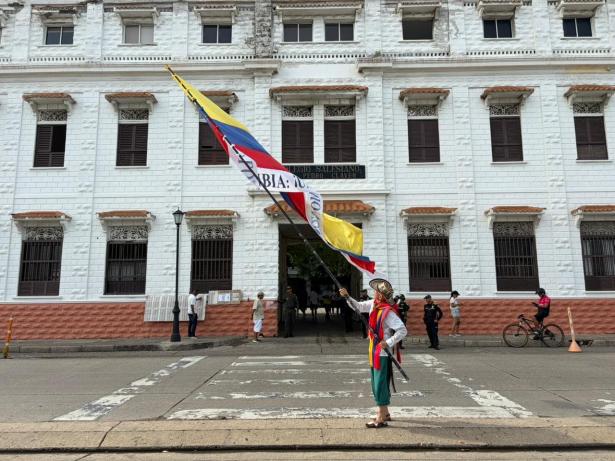
On June 21, Colombians appeared to elect far-right outsider Abelardo de la Espriella in the second round of presidential elections. The race was highly contested, with left-wing Senator Iván Cepeda trailing by one percentage point during the preliminary count. While the official tally is likely to narrow the gap between the two candidates, it is unlikely to alter the outcome.
With over 25 million votes cast, the runoff saw the highest voter turnout in Colombian history. The results, however, reveal a deeply divided country. De la Espriella won by a razor-thin margin of approximately 250,000 votes. According to official results, De la Espriella received 12.9 million votes while Cepeda received 12.7. If the current margin holds, it would be the narrowest presidential victory in Colombian history.
Cepeda performed strongest in regions that continue to bear the brunt of armed violence. He won in the Pacific departments of Valle del Cauca, Cauca, Nariño, and Chocó, and had a strong showing along the Caribbean coast and in southern Colombia. For his part, De la Espriella dominated the center of the country and historically conservative strongholds like Antioquia. He also cut into the left’s margins in major cities and on the Caribbean coast, where Cepeda lost 2.6 percent of the support Gustavo Petro had received in 2022.
With the results so close, it is clear that De la Espriella will not have an easy time enacting his agenda. Though he appeared to moderate his rhetoric while addressing his supporters on Sunday evening, his track record, platform, and campaign statements point toward the return of a more confrontational political climate that will test Colombia’s democratic institutions. At the same time, the left achieved a historic turnout and now faces the challenge of forging a unified opposition to the incoming government.
The Far-Right and the Shadow of “Narcoterrorism”
Abelardo de la Espriella, a 47-year-old lawyer and businessman who received Donald Trump’s endorsement after the first round of voting, signals a return to conservative rule following the government of Petro, the country’s first left-wing president. He joins the ranks of other far-right leaders in the region, having modeled his campaign after El Salvador’s Nayib Bukele and Argentina’s Javier Milei. His election also extends the growing list of anti-incumbent right-wing electoral victories across Latin America, including those of José Antonio Kast in Chile, Rodrigo Paz in Bolivia, and Nasry Asfura in Honduras.
With De la Espriella’s victory, Colombia now appears poised to join the mano dura trend represented by countries like El Salvador and Ecuador.
De la Espriella quickly embraced the “narcoterrorism” rhetoric promoted by the Trump administration as one of the central tenets of his campaign. He claimed that he would command the Armed Forces to “shoot down any drug-laden plane coming out of Colombia,” and “sink any boat coming out of the Caribbean, Pacific, and the Gulf of Urabá.” His statements are a clear nod to the U.S. strategy of carrying out illegal airstrikes on alleged drug-trafficking vessels in the Caribbean and Pacific, operations that have left over 200 people dead without slowing down the flow of drugs. His willingness to collaborate with the Trump administration also includes joining the Shield of the Americas initiative, marking a sharp contrast with his predecessor Petro, who often clashed with Trump over his approach to security and counternarcotics.
With De la Espriella’s victory, Colombia now appears poised to join the mano dura (“iron fist”) trend represented by countries like El Salvador and Ecuador, both of which have faced sustained criticism over human rights abuses. While these measures, which include building more prisons and giving the Armed Forces more control over internal security matters, may yield short-term political gains, they do not address the structural conditions that give rise to violence and criminal economies in the first place.
Peace Is Out, Militarization Is In
De la Espriella’s hard-line security policies draw from a longstanding conservative tradition of U.S.-backed counterinsurgent strategies aimed at defeating guerrilla groups and rolling back key elements of the 2016 Peace Agreement with the Revolutionary Armed Forces of Colombia (FARC), Colombia’s largest insurgent group. His proposals rely on the instrumentalization of the fight against organized crime to subordinate social and economic issues to “national security.”
While de la Espriella’s campaign platform did not explicitly mention the 2016 Peace Agreement, he frequently attacked the transitional justice tribunal that emerged from it, the Jurisdicción Especial para la Paz (JEP). He also questioned the agrarian reform efforts promoted by the Petro government but rooted in the agreement, which sought to redistribute and return land to peasant communities affected by land grabbing and displacement during the armed conflict.
De la Espriella is also expected to halt ongoing peace talks with armed groups. The negotiations were a cornerstone of Petro’s “Total Peace” strategy, but his administration failed to achieve any significant advances, and the lack of coordination between its peace and security policies are partly to blame for the current increase in violence against civilians.
De la Espriella’s militarized approach to security—which mirrors the policies of former president Álvaro Uribe–is likely to add fuel to the fire.
De la Espriella’s militarized approach to security—which mirrors the policies of former president Álvaro Uribe–is likely to add fuel to the fire. Fears of renewed militarization are tied to the central role the Armed Forces, often working alongside paramilitaries, have played in some of the worst human rights violations of Colombia’s armed conflict. Paramilitary organizations were responsible for the largest share of massacres and civilian deaths during the height of the conflict. De la Espriella’s ties to these groups—he served as a criminal defense lawyer for several high-profile paramilitary leaders—have deepened fears that these types of massacres, and the land dispossession associated with them, will return.
At the same time, the right-wing leader is set to inherit a very different security situation than Uribe did in the early 2000s. Rather than a conflict dominated by drug cartels, paramilitaries, and large guerrilla groups, today’s landscape is characterized by a fragmented patchwork of armed and criminal groups competing for territorial control. These actors increasingly seek to establish local governance through the imposition of rules and social controls on communities, while criminal economies such as drug trafficking and illegal mining have become more complex and decentralized. Coupled with the constant threat of U.S. intervention, the current moment is markedly different from Colombia’s earlier “war on drugs.”
Even so, de la Espriella has advocated for a return to familiar strategies. He has called for a “Plan Colombia 2.0,” a repeat of the multi-billion-dollar U.S.-Colombia security partnership of the early 2000s, which led to grave human rights violations perpetrated by the Armed Forces that ultimately failed to significantly reduce drug trafficking or violence.
A Bittersweet Defeat
Despite appearing to lose the presidential election, Colombia’s left-wing movements achieved their highest voter turnout in history. In 2022, Petro won the presidential election with 11.2 million votes. This time, Cepeda received 12.7 million—over a million more than Petro’s total and the strongest showing ever by a progressive candidate in Colombia.
Speaking to the crowd gathered in Bogotá on Sunday night, Cepeda reassured his voters that there was reason for hope. “We are a decisive force, and those who think that we can be ignored are wrong,” Cepeda said, calling for calm while the official results come in.
While the Pacto Histórico and other left-wing parties are well positioned in Congress to oppose some of the more radical reforms of a De la Espriella government, they will have to contend with a likely coalition of political parties that supported his campaign. Even so, De la Espriella may seek to curtail Congress’s powers if he fails to gather enough support; there is reason to fear he will emulate the authoritarian strategies of other far-right populist figures in the region. In an interview with Colombian news outlet El Tiempo, he claimed to have at least 90 decrees ready to sign once he reaches the Casa de Nariño—a strategy used by Trump to bypass the Congress and enact his agenda—which experts have said could inflame tensions with both the legislative and judicial branches of government.
If anything, the result demonstrates that the Colombian left’s vision of society is far from a minority position.
Analysts have pointed to a combination of factors in the left’s apparent defeat, including the campaign’s lackluster messaging, Petro’s role in alienating moderate voters, and a broader failure to recognize the threat posed by De la Espriella before the first round of voting.
Still, Cepeda came within roughly 300,000 votes of the presidency, defying a regional trend in which several left-wing government projects—including those of Bolivia, Honduras, and Chile—were followed by decisive conservative victories. If anything, the result demonstrates that the Colombian left’s vision of society is far from a minority position. Its challenge over the next four years will be to transform the advances of the outgoing government into a coherent and effective opposition.
Lara Loaiza Arias is an award-winning Colombian journalist and associate editor at NACLA. She has reported on crime, conflict, and violence in Latin America and the Caribbean, and is currently a master’s student in Latin American and Caribbean Studies and Journalism at NYU.
The North American Congress on Latin America (NACLA) is an independent, nonprofit organization founded in 1966 to examine and critique U.S. imperialism and political, economic, and military intervention in the Western hemisphere. In an evolving political and media landscape, we continue to work toward a world in which the nations and peoples of Latin America and the Caribbean are free from oppression, injustice, and economic and political subordination.
Spread the word