

New data from the Census Bureau shows a South at the edge of extraordinary demographic shifts, including sharply falling numbers of people moving to the region and a white population that is beginning to shrink in absolute terms.
Since the end of segregation in the 1960s, the South has powered the population growth of the United States, becoming the nation’s largest region and gaining 31 congressional seats in the process. The Covid-19 era saw especially large population gains in many southern states as people moved around the country at an unprecedented rate, leaving states like California and New York for perceived greener pastures elsewhere.
But census data offers signs that this multi-decade period of continuous southern growth may be slowing significantly or perhaps even moving toward an eventual end, as rates of both domestic migration and immigration fall sharply.
At the same time, the data shows another big change in the offing as the white population of the South is aging and beginning to decrease, making people of color the drivers of the entirety of the region’s growth.
If these emerging trends continue to hold, the impact for both the region and the country will be profound.
A Slowing and Potentially Fading Southern Population Boom
The South is still by far the country’s fastest growing region, but many of its longstanding growth patterns show signs of changing. This especially true for the boom states of Florida, Georgia, North Carolina, South Carolina, and Texas that have seen uninterrupted, multi-decade population growth since the 1960s and long been the principal drivers of the region’s rapid population growth.
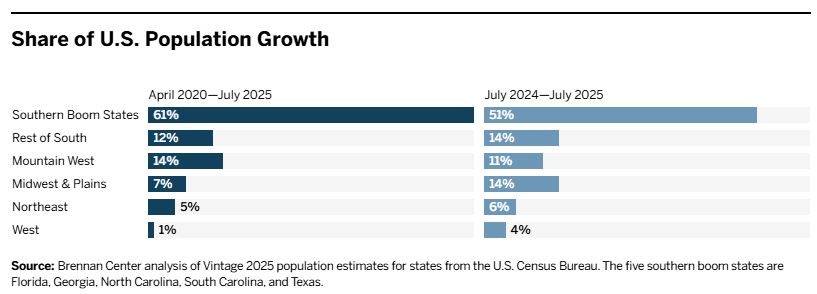
Between 2020 and 2025, these five southern states accounted for 83 percent of the South’s population growth and a remarkable three-fifths of the growth of the entire United States.
But the most recent census data reveals that the pace of growth in the five southern boom states subsiding — the states are still growing, just more slowly. Between July 2024 and July 2025, they were responsible for just over half the nation’s population gains.
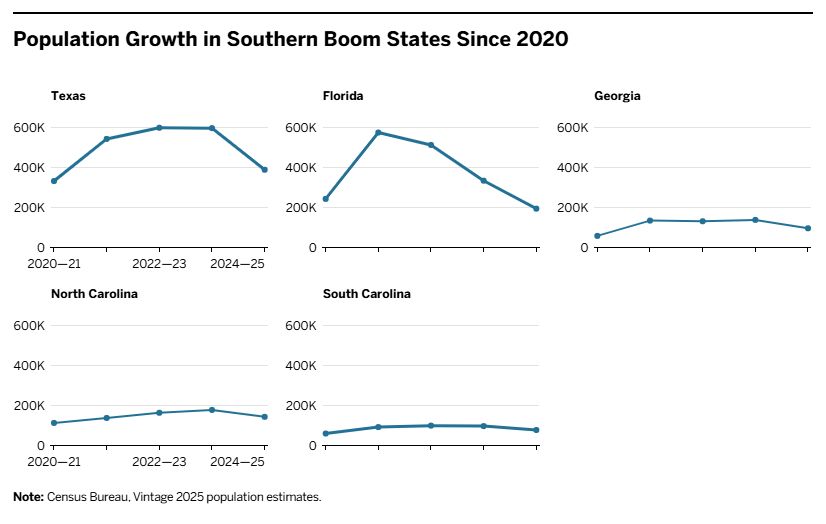
The most pronounced slowdowns were in Florida and Texas, which have long been the country’s two fastest growing states. However, the most recent census data show Florida’s population growth falling by two-thirds from highs earlier in the decade. Texas’s growth in that same period likewise fell by more than a third. Georgia, North Carolina, and South Carolina also each saw growth slow in the period by between a fifth to just over a quarter.
Two main factors are driving this change: slowing rates of domestic in-migration and, since January 2025, the Trump administration’s aggressive implementation of a range of hardline immigration policies.
These changes hit Florida especially hard. For decades, the Sunshine State managed to be one of the consistently fastest growing states in the country both by attracting people relocating from other parts of the United States and large numbers of immigrants from outside the United States, principally Latin America and the Caribbean. (As a state with an older population, Florida derives little to no growth from births.)
Both these two sources of growth are now under stress.
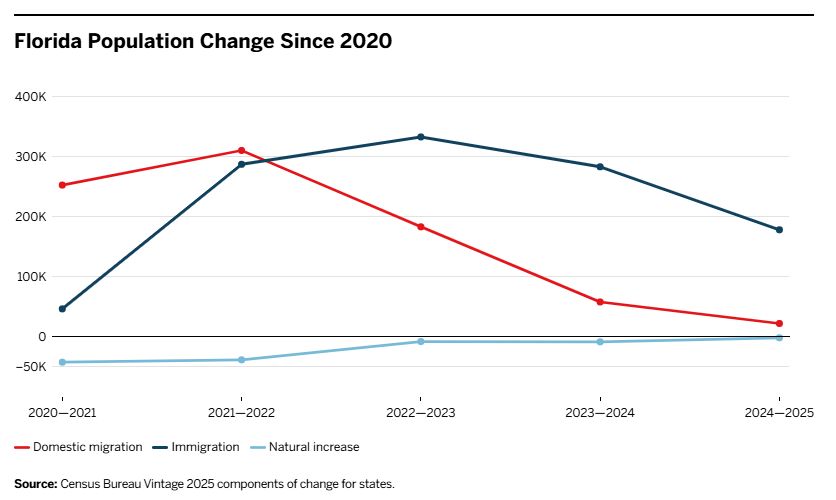
In the last several years, the number of people moving to Florida from other states has fallen precipitously as housing and associated living costs have risen dramatically. Florida gained 310,892 people as a result of domestic migration between 2021 and 2022. But that number fell to just 22,517 in the one-year period ending July 1, 2025 — a drop of more than 90 percent.
At the same time, the number of immigrants arriving in Florida has also fallen rapidly. Nearly 60 percent of Florida’s population growth this decade has come from immigration. Between 2022 and 2023, Florida received 333,449 immigrants, more than any other state. But with changes to the country’s policies, that number fell by nearly half in the one-year period ending July 1, 2025.
This immigration decline, moreover, may be just a harbinger because data released this year only covers the first six months of the second Trump administration. Most experts think the rate of immigration will fall further when updated data is released in January — and remain low for the foreseeable future — as the full effects of the Trump administration’s tightened immigration policies come to bear. Some experts even think the rate of immigration could become negative for the immediate future, with more people leaving the United States for the first time in the nation’s modern history.
These changes have meant Florida’s growth rate fell from 2.6 percent between 2021 and 2022, the fastest in the nation, to a 0.8 percent between 2024 and 2025, barely faster than middle-of-pack growers like Indiana and Oklahoma.
Texas offers a slight variation on the same theme.
Domestic in-migration and immigration from outside the United States have been key drivers of Texas’s population growth, and both have fallen from their heady highs earlier in the decade.
However, Texas also has the country’s second youngest population — only Utah has a lower median age — and women of childbearing age in Texas also have more children than women elsewhere. Thus, unlike Florida, Texas also derives a sizeable share of its growth from natural population increase, or the number of births in excess of deaths. Since natural increase is less prone to fluctuation than either domestic in-migration or immigration, Texas’s growth rate has shown less volatility than Florida’s.
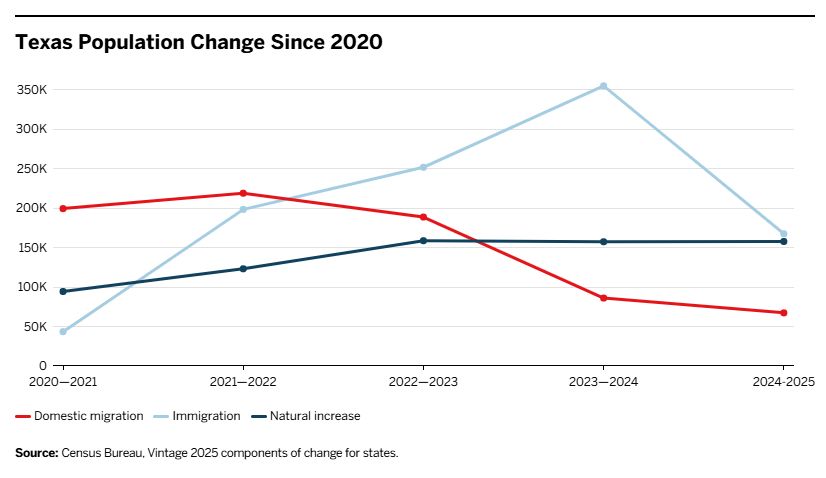
Still, both domestic migration and immigration to Texas are each down by more than half from their post-2020 peaks. This is enough of a reduction to mean that there will be nearly a million fewer Texans in 2030 than if growth had continued at the faster pace of the first part of the decade. The actual difference is likely to be even greater as immigration, in particular, seems likely to fall even further.
By contrast, the other three southern boom states — Georgia, North Carolina, and South Carolina — have seen growth rates slow but at a less steep rate than Florida and Texas. Each has a unique story.
In South Carolina, 81 percent of the state’s growth this decade has come from domestic in-migration as the Palmetto State has become a new retirement hotspot, increasingly filling the role long played by Florida. While the rate of domestic in-migration has varied somewhat from year to year this decade, in general it has been more constant than either Florida or Texas, steadily giving the state between 66,000 and 83,000 new residents a typical year.
The rest of South Carolina’s growth comes from immigration, a volatile source of growth there as elsewhere. However, because South Carolina derives less than a fifth of its growth from immigration — compared with nearly 60 percent in Florida and more 40 percent in Texas — those fluctuations have had less impact on the state’s overall growth rate. With one of the country’s older populations, South Carolina, like Florida, now typically sees more deaths than births each year and thus has no growth attributable to natural increase this decade.
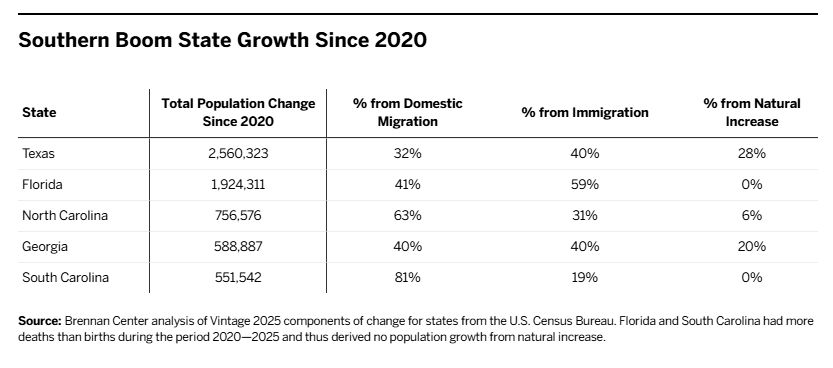
Similarly, more than three-fifths of North Carolina’s growth this decade is from domestic in-migration, and unlike Florida or Texas, its domestic migration has remained steady.
Another 31 percent of North Carolina’s population growth this decade has come from immigration. However, perhaps because North Carolina has not been as much of a center-of-gravity for new immigrants as states like Florida and Texas, its immigrant numbers have also thus far remained more stable.
By contrast, only around 6 percent of North Carolina population growth this decade has come from natural increase compared with 28 percent in more youthful Texas.
Of these three other southern boom states, Georgia most resembles Florida and Texas. This decade, 40 percent of Georgia’s population growth has come from immigration, on par with Texas though less than Florida. Another 40 percent of Georgia’s population growth this decade has come from domestic in-migration, with the remaining 20 percent attributable to natural increase.
Like Florida and Texas, Georgia has seen its domestic in-migration numbers fall sharply as the decade has progressed. Between 2021 and 2022, more than 79,000 people moved to Georgia from other parts of the United States. However, that number fell by nearly two-thirds to just 27,333 people in the one-year period ending July 1, 2025. Immigration to Georgia also fell by around half after a surge between 2023 and 2024. But Georgia, like Texas, has a comparatively young population and has seen its growth rate propped up by a stable rate of natural increase.
However, while these three states have not seen as pronounced a falloff in population growth as Florida or Texas, this may not last, particularly as levels of immigration look likely to continue to fall in coming years.
In sum, the South used to look like a major exception to the trend of slowing American growth rates. Now even that region’s dynamic boom states are increasingly looking more and more like the rest of the United States.
The South’s White Population Growth Starting to Shrink
At the same time that overall population growth is starting to slow across the South, another demographic trend is beginning to reshape the South. New census data released this summer shows that people of color are responsible for all the region’s population growth.
Indeed, this summer’s data release reveals that the white population fell in absolute terms in 10 of 15 states in the South. These include both big states like Florida, Georgia, and Texas, as well as smaller ones like Louisiana and Mississippi.
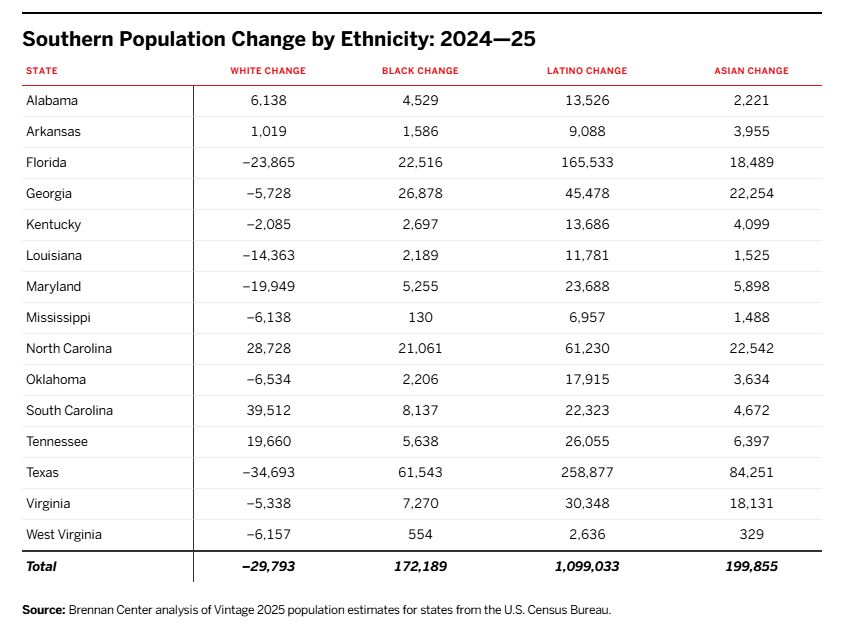
This is a striking change from earlier in the decade when the South was one of only two regions, along with the Mountain West, where the white population was still growing.
Moreover, even in the five southern states where the white population is still growing, the rate of growth in each dropping. The trend line suggests that several — and perhaps all — of those states also soon could see declining white populations.
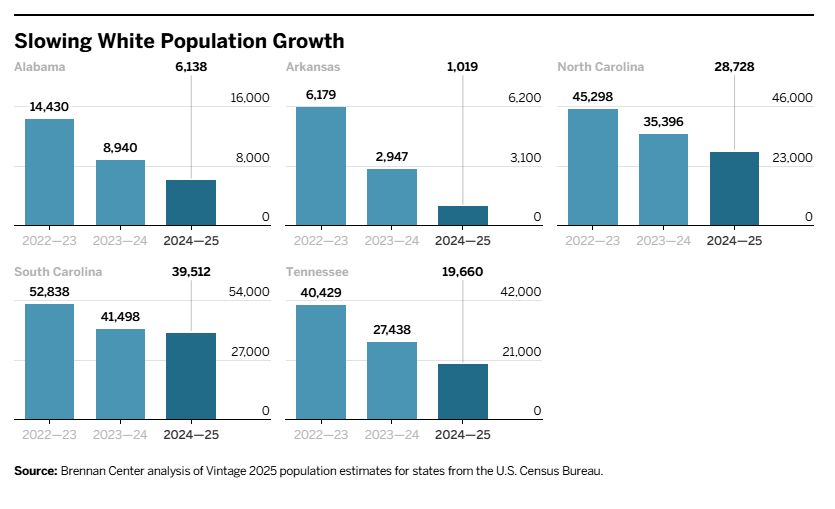
To be sure, the white population declines in the South are so far relatively modest compared to other parts of the country. States like California and New York have seen steeper declines. But, in this area, too, the signs are that the South is becoming increasingly more like the rest of the United States.
A Coming Southern Reapportionment Bonanza
Powered by growth among communities of color, the South is on track to gain a record nine congressional seats after the 2030 census, even with slowing population growth. This would give the South nearly 40 percent of the seats in the U.S. House. If projections hold, Texas would have just six fewer seats than California.
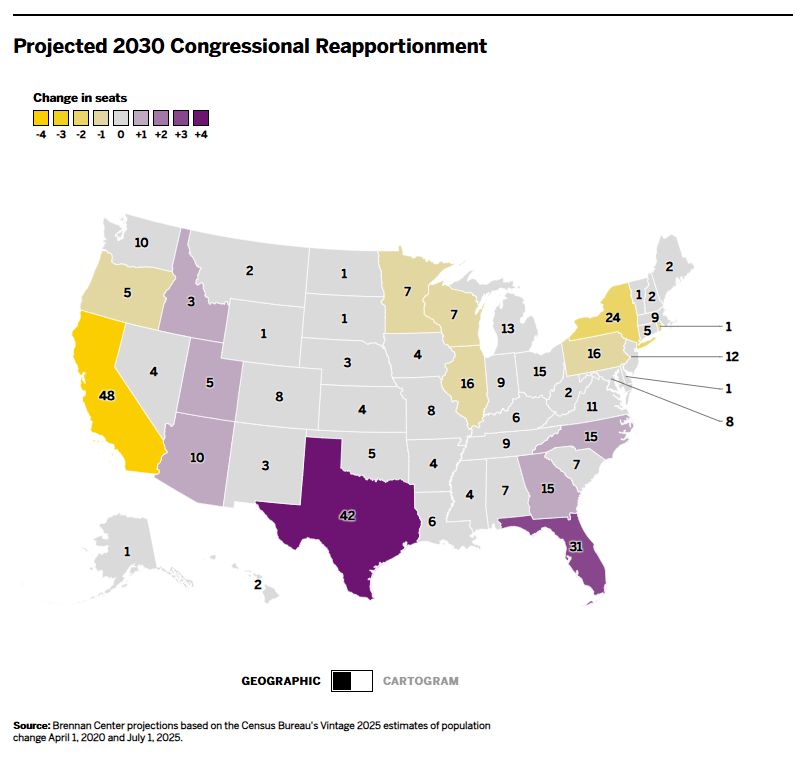
The question, of course, is whether the southern communities of color who are responsible for those gains in the region’s political power will see increased representational opportunities for their communities without congressional action to restore and strengthen voting rights laws.
After the Supreme Court gutted key provisions of the Voting Rights earlier this year in Louisiana v. Callais, states across the South rushed to dismantle districts where Black and Latino voters had successfully elected their preferred candidates to office, in some cases for decades. Southern lawmakers in some states even cancelled elections already in progress to give themselves time to put in place new racially discriminatory maps.
The wide expectation is that more racially discriminatory redrawing of existing maps will take place across the region after the 2026 midterms.
Key Texas officials have already signaled plans for the legislature to redrawn not only the state’s congressional map next year but also legislative and state board of education maps. A redraw of Georgia’s congressional and legislative maps could also come as soon as the legislature’s lame- duck session later this year. Tennessee lawmakers, likewise, are expected to redraw legislative maps next year to eliminate several Black districts. More states are likely to do similar map redraws.
Only Congress can stop to this wholesale attack on the political power of communities of color. If lawmakers fail to act with the urgency the moment demands, communities of color in the South will never realize the increased electoral opportunities their dynamic growth is bringing to the region. Even worse, their political power will likely move backwards.
Michael Li is senior counsel in the Brennan Center’s Democracy Program, where his work focuses on redistricting, voting rights, and elections. Prior to joining the Brennan Center, Li practiced law at Baker Botts L.L.P. in Dallas for 10 years.
In addition to his election law work, Li previously served as executive director of Be One Texas, a donor alliance that oversaw strategic and targeted investments in nonprofit organizations working to increase voter participation and engagement in historically disadvantaged Black and Latino communities in Texas.
Li was the author of a widely cited blog on redistricting and election law issues that the New York Times called “indispensable.” He is a regular writer and commentator on election law issues, appearing on PBS Newshour, MSNBC, and NPR, and in print in the New York Times, Los Angeles Times, USA Today, Roll Call, Vox, National Journal, Texas Tribune, Dallas Morning News, and San Antonio Express-News, among others.
Li received an undergraduate degree in history from the University of Texas at Austin and his law degree with honors from Tulane Law School.
The Brennan Center for Justice at NYU Law is an independent, nonpartisan law and policy organization that works to reform, revitalize, and defend our country’s systems of democracy and justice.
The United States is in the midst of a great fight for the future of constitutional democracy. The Brennan Center works to build a nation that is democratic, just, and free for everyone. We are committed to the rule of law. We work to craft and advance a transformative reform agenda of solutions that aim to make American democracy work for all.
The Brennan Center has built a distinct model to advance legal and policy change:
- We’re a think tank, conducting rigorous research to identify problems and craft transformative solutions.
- We’re an advocacy group, fighting in court and working with elected officials to advance legislation.
- We’re a communications hub, shaping opinion by taking our message directly to the press and public.
Now, the vital safeguards and checks and balances that underpin democracy are under attack. Amid harsh assaults on immigrants and communities of color, today’s politics are polarized and Congress paralyzed. We know this: The best response to an attack on democracy is to strengthen democracy.
That’s why we’ve pioneered innovative reforms including:
- Small donor public financing programs, which would give ordinary Americans a much louder voice in political campaigns.
- Ballot initiatives that end partisan gerrymandering.
- Funding incentives for state policies that both shrink the prison population and bolster public safety.
In all this, we take our cue from Abraham Lincoln’s admonition at another time of constitutional debate:
“Public sentiment is everything. With public sentiment, nothing can fail; without it, nothing can succeed. Consequently, he who molds public sentiment goes deeper than he who enacts statutes or pronounces decisions. He makes statutes and decisions possible or impossible to be executed.”
Truly effective legal and policy change requires winning, first and foremost, in the court of public opinion.
Spread the word