
- Fighting Fascism: Lessons from South Korea
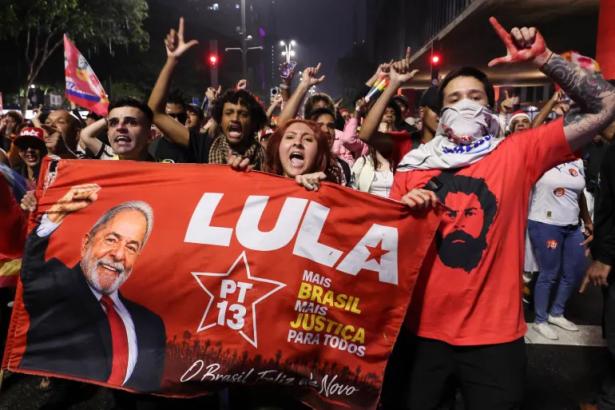
- Brazil: The People’s Victory
- Students Depose Serbian Autocrat
- US-Morocco Attack on Western Sahara
- Mass Protest Updates
- Looming Shift in Québec
- Standing Together and Palestine Solidarity
- Gen Z: Protests Reshaping Asia
- Popular Economies in Africa
- From France: The Politics of Violence
Fighting Fascism: Lessons from South Korea
Paul Rogat Loeb and Jungmin Choi / Z (Woods Hole MA)
How do you stop a would-be dictator? The first requirement is knowing that it’s possible. In 2024, the people of South Korea took to the streets and stopped a would-be coup in its tracks. Their example offers lessons for how Americans can counter Donald Trump and his allies if they disrupt or defy the results of November’s midterms.
__________
Tiago Rogero and Tom Phillips / The Guardian (London)
Lula’s victory in Latin America’s largest country does more than halt the far right’s return to power in Brazil. It breaks a succession of right-wing electoral victories across the region and deals a major blow to United States President Donald Trump’s increasingly interventionist agenda in the Western Hemisphere.
__________
Students Depose Serbian Autocrat
Center for Applied Nonviolent Action and Strategies (Belgrade)
Serbia’s student-led political movement has secured a historic election victory. Preliminary results suggest the so-called Student List has won 141 of the 250 seats in parliament, with the ruling Serbian Progressive Party taking 104. The result brings the 12-year rule of Alexander Vučić to an end.
__________
US-Morocco Attack on Western Sahara
Daniel Falcone and Stephen Zunes / CounterPunch (Petrolia CA)
The US-backed Moroccan plan for autonomy for Western Sahara falls well short of the international legal definition of autonomy and what is required in bringing about a peaceful resolution to the conflict. Moreover, it seeks to set a dangerous precedent that threatens the very foundation of the post-World War II international legal system.
__________
Mass Protest Updates
Across Europe Olivia Rosane / Common Dreams (Portland ME)
Argentina Stella Calloni / Resumen Latinoamericano – English (Oakland)
Costa Rica / The Tico Times (San José)
France Olly Haynes / Novara Media (London)
Indonesia Sheany Yasuko Lai / Arab News (Riyadh)
Mexico Miguel Paiva / The Latin Times (Montgomery)
Portugal José Soeiro and Maria Manuel Rola / International Viewpoint (Paris)
Spain James C. Reynolds / The Independent (London)
__________
Andrea Levy and André Frappier / Canadian Dimension (Winnipeg)
The question of Québec independence and a first-term referendum, to which the Parti Québécois purports to be firmly committed, took centre stage during much of the campaign. Two separatist parties now sitting in the Québec provincial parliament—the second being Québec Solidaire, the only left-wing party in the running, which now holds nine seats.
__________
Standing Together and Palestine Solidarity
Himmat Zoubi / +972 (Tel Aviv)
A meaningful partnership must recognize the need to work toward a future beyond Zionism, one grounded in recognition of Palestinian sovereignty and the right of Palestinians to determine and shape their own political future — rather than rearranging their relationship within the existing terms of Jewish sovereignty.
__________
Gen Z: Protests Reshaping Asia
Ruhi Bhasin / LA Progressive
__________
Samuel Giraut, Semhar Haile, Mwangi Mwaura, David Njenga, Elvira Pietrobon, Pierre Wenzel and AbdouMaliq Simone / Africa is a Country (New York)
From traders’ credit circles to self-built water networks, Africa’s urban majority keeps finding ways to thicken city life. Can these popular economies still decouple the future from capital’s calculations, even as they open new frontiers for capture?
__________
From France: The Politics of Violence
Roger Martelli / Regards (Paris)
[Moderator’s note: The left in France is debating the use of violence which has erupted from the student protests. This open letter, in response to a defense of violence as a tactic from Frustration Magazine, raises questions of importance for the global left. A translated excerpt follows.]
The 20th century was born in 1914 from the worst kind of violence. And the extreme violence that resulted from it weighed heavily on the subsequent course of human history, the revolution, and the counter-revolution.
This initial violence gave rise to fascism and legitimized Stalinism. Failing from the outset to put the necessary brakes on its unstoppable expansion, the Bolsheviks who came to power found themselves caught in a spiral for which it is too easy to place the blame solely on Stalin. The Bolsheviks thought they were “taking” the state; in fact, they were taken by it. Even if it is intended to be proletarian and temporary, dictatorship is a process whose beginnings are visible, but whose human costs of persistence are never seen early enough. I am not moralizing violence in itself, but I know all too well that the line is very thin between violence in itself and violence for its own sake. […]
I believe that history has been one of struggle for positions and classes; but I am wary of the facile metaphor that slips from struggle to war, from adversary to enemy. Violence perpetuates itself, and even when it is managed to be stopped, it leaves the traces of a culture of war, of vanguards and leaders at the head of armies.
Today, violence creates the very real possibility of the worst, whether it be state-orchestrated violence or the violence of those who believe they can use it against the state. Nothing would be worse than becoming accustomed to large-scale mobilizations being hijacked by acts that fuel fear when what is most needed is hope.
A peaceful and potentially majority-based movement, founded on an emancipatory project: this is the only way to curb the rise of the far right. To suggest that violence can be a driving force in a deadlock is a mistake. The left, which must resist the temptation of repressive solutions and authoritarianism, cannot fall into this trap.
Spread the word