The Truth About Abolition
The Atlantic
Recent tragedies have shown all too clearly the state of crisis in which we find ourselves. The Colorado Springs Planned Parenthood shooting illustrates how right-wing hostility to women's rights makes those providing and seeking reproductive services targets for murder. The shooting of Black Lives Matter protesters in Minneapolis by white supremacists demonstrates that anyone doing work around racial justice must now expect and prepare for a violent racist response.
Images of Czech police inking the skin of newly arriving Syrian migrants, and the government says they were unaware that this brought back memories of the Holocaust, when prisoners at Auschwitz were systematically tattooed. While in the north of Europe, in 24 hours, responding to a Facebook campaign, 10,000 Icelanders opened their doors to their Syrian brothers and sisters.
Ta Nehisi Coates is best known for his June, 2014 article in the Atlantic, "The Case for Reparations." Since then, he has emerged as one of today's most important commentators on racism and anti-racism. His new book has garnered both praise and push-back, placing it right at the center of our contemporary debates on the subject. Here, Josie Duffy calls it "an important book—perhaps the most important in a generation—on how race in this country functions."
As part of the deep and broad reaction to the killings in Charleston, historian Chad Williams and his colleagues have put together a deeply informative and useful bibliography of essential readings on African American life and history, and on the struggle against racism. We have provided a link to the project, below, followed by a short article on it, published in The Guardian, by Marta Bausells. More links and information are available at the Guardian site.
As an anti-racist white feminist, I wonder if it is enough to be an “ally” in this present and “newest” moment of racist/militarist/carceral violence. Or, is there something more to do? I am thinking hard about this “newness,” which is also very old. White anti-racist feminists can take the lead from our Black and Brown sisters and embrace an abolitionist stance towards chattel slavery and its racist and misogynist remains.
Born into the segregated rural South, James Gustave ("Gus") Speth didn't see the oppression and poverty his black neighbors faced. A confrontation at a northern university with civil-rights advocates in the early 1960s triggered a life-long moral compulsion to support the burgeoning civil rights struggle. The newly minted anti-racist grew into a leading environmentalist, political activist, prolific author and Yale dean. The book under review is his memoir.
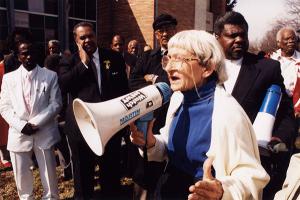
Her biographer Cate Fosl has wisely said about Anne, "Hers has been among the most forceful and persistent of white voices for racial equality in modern U.S. history." Fosl's "Subversive Southerner: Anne Braden and The Struggle for Racial Justice in the Cold War South" is an invaluable history of our Southern civil rights movement.
Spread the word