Popular Movements Toward Socialism: Their Unity and Diversity
Monthly Review
Corporate interests have taken credit for reducing private-sector unions to a fraction of their former strength, and for eroding public-sector collective bargaining, especially since the 2010 “Tea Party midterms.” A resurgence in low-wage worker organizing, sparked by growing inequality in the United States, promises to help defend the rights—and paychecks—of vulnerable workers. But corporations and their paid shills aim to snuff out the movement before it catches fire.
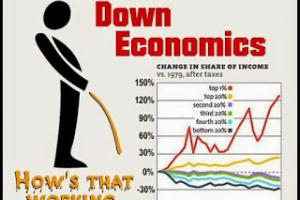
Piketty's central theme is not that inequality of the ownership of wealth is going to skyrocket. The central theme is that the 1% already owns a lot of the capital stock, and the capital stock is going to get gigantic relative to the rest of the economy. Whatever the weakness this meg-tome and mega-best seller, there is no denying - the rich are getting richer, the poor, poorer. (And Piketty is not a Marxist.)
Reason makes possible the calculations, science and technological advances of industrial civilization. But reason does not lift us upward to the heavens. It does not bring us into contact with the sacred. It does not permit us to curb our self-destructive urges. Herman Melville, Fyodor Dostoevsky, Emily Dickinson, Marcel Proust, William Faulkner, James Joyce, Samuel Beckett, Lorraine Hansberry and August Wilson mocked the myth of human progress and the folly of hubris.
New scholarship by the French economist is a bona fide phenomenon - and the right is terrified. Thomas Piketty argues that the main driver of inequality - the tendency of returns on capital to exceed the rate of economic growth - threatens to generate extreme inequalities that stir discontent and undermine democratic values. He calls for political action and policy intervention. Video - Joseph Stiglitz and Paul Krugman on the significance of the work, and the stir.
These are the first two parts of a four-part interview with Costas Lapavitsas focusing on the Era of Financialization and the transformations at the “molecular” level of capitalism that are driving changes in economic performance and policy in both high-income and developing countries. Lapavitsas is a professor of economics at SOAS, University of London, and the author of Financialised Capitalism: Expansion and Crisis (Maia Ediciones, 2009)
Spread the word