Cold War Revisionism Revisited

Harry Targ Monthly Review
In the early years of the Cold War, the academic study of international relations was an ideological tool serving the foreign policy of the United States and its allies. But in the 1960s, a new generation of scholars began to challenge the reigning orthodoxy.

A Century Ago, the Working Class Redefined Peace

Liz Payne Morning Star
One day after the Revolution, the Soviet government issued a Decree of Peace -- a signal of the centrality of the struggle against war to the building of socialism.

‘We Wrapped the Guns in Plastic Bags’

Piero Gleijeses London Review of Books
My knowledge of Cuba’s revolutionary offensive in Latin America is based on conversations with Cuban and Latin American protagonists, including – after two decades’ knocking at the door – a five-hour tête-à-tête with Castro in June 2015; as well as on documents from the US, the USSR, the GDR, Canada and Britain.

The Way We Talk About Puerto Rico Is Bullshit

Jack Mirkinson Splinter News
Puerto Ricans are all U.S. citizens. They pay taxes and serve in the military and don't need a passport to come to the U.S. mainland, and they deserve the same help the people of Texas and Florida received when they were hit by hurricanes. Puerto Rico is a colony, and like other colonial empires, the United States has brutally exploited it's colony.

books

What Is Great about Ourselves

Pankaj Mishra London Review of Books
Five books by neoliberal authors extolling glories that never were, the essayist eviscerates a state of mind that flatters a cosmopolitan liberal tolerance that has been more at home with nationalism, imperialism and even racism and a worldview that presupposes a chasm between civilized whites and uncivilized nonwhites. even accusing leftists of enabling racism by such affronts as squashing alleged dissimilar people together on buses, trains and subway cars.

Trump Turns Back on a Future with Cuba

Jesse Jackson Chicago Sun-Times
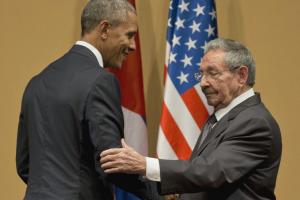
In his perverse fixation on overturning all things Barack Obama, President Donald Trump now turns his attention to Cuba, the island located 90 miles off our shore. Reports are that the president plans to travel to Florida to announce that he will reverse Obama’s opening to Cuba, reinstate restrictions on the right of U.S. citizens to travel to Cuba and curtail business opportunities that Obama had opened up by executive order.

U.S. Military Should Get Out of the Middle East

Jeffrey D. Sachs The Boston Globe
It's time to end US military engagements in the Middle East. Drones, special operations, CIA arms supplies, military advisers, aerial bombings - the whole nine yards. Over and done with. That might seem impossible in the face of ISIS, terrorism, Iranian ballistic missiles, and other US security interests, but a military withdrawal from the Middle East is by far the safest path for the United States and the region. That approach has instructive historical precedents.

tv

FX’s Taboo Is More Fun to Think About Than to Watch

Matt Zoller Seitz New York Magazine
Taboo is about the return of the repressed, but also the suppressed, with the protagonist serving as a vessel for social commentary about the species-wide violence and corruption wrought by imperialism, racism, and capitalism.

Sovereignty and the State of Emergency

Jean-Claude Paye Monthly Review
The U.S. government, following the 9/11 attacks, expressed no intention of reforming its Constitution. It was left free of any procedure for exception or emergency. This does not mean that the United States has remained a more democratic country than France. Attacks against privacy, civil rights, and, above all, habeas corpus have proven even more virulent in the United States than in Europe.

Fidel Castro and the Question Of Power

Van Gosse Portside
Fidel Castro's life, and the example of the Cuban Revolution, demonstrates the enduring relevance of state power. It is fundamentally irresponsible for anyone on the left to think one can avoid the question of power, and let someone else face its contradictions and deformations. Somebody will exercise it, for good or ill. Fidel Castro embraced this question, choosing to wield power in as many ways possible for what he deemed social goods, even on the global scale.
Subscribe to imperialism