Latin America: Then and Now
Portside
The government has everything to lose from violence in the demonstrations, and the opposition has something to gain. Protests are initiated by ultra-right factions of the opposition in the hope of an eventual systemic overhaul. When is it considered legitimate to try and overthrow a democratically-elected government? In Washington, the answer has always been simple: when the U.S. government says it is.
“I can't say enough good things about The Empire of Necessity. It's one of the best books I've read in a decade. It should be essential reading not just for those interested in the African slave trade, but for anyone hoping to understand the commercial enterprise that built North and South America. The sprawling commerce in slaves also supplied Europe with the retirement money it's been living on for more than a century.”
Reader Comments- Sports, Police Killing, Tea Party, Robin Hood Tax, Doug Ireland;
Announcements- Tim DeChristopher, Environmental Activism-NYC-Nov.02; Perspectives from NYC Food Service Workers-Nov.03; Mario Savio Memorial Lecture-Berkeley-Nov.12; Cuba Skate: Art on Deck-Washington, DC-Nov.16; Politics of Immigration Reform Forum-NYC-Nov.20; Memorial for Stephen Coats-Washington, DC-Nov.25; International Conference In Israel: For A Nuclear Free Zone In The Middle East
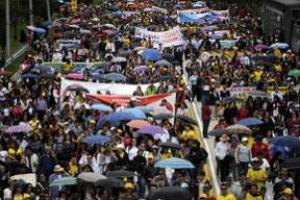
Strikes, demonstrations and protests are at a record pace in Colombia this year as workers seek a bigger share of wealth generated by the country’s expanding economy. After 50 years of guerrilla warfare, the government’s success in weakening illegal armed groups has drawn investment and rewarded businessmen, while the gap between rich and poor remains considerable, according to the World Bank’s Gini index of income distribution.
Spread the word