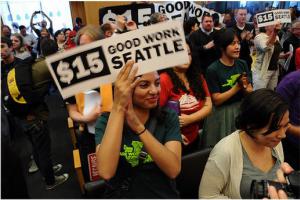
L.A. City Council Votes for Minimum-Wage Hike to $15.37 at Big Hotels
Los Angeles Times
Senator Orrin Hatch, in an earlier round of this century-long debate, told the Times, “Youth unemployment and black unemployment will drastically rise. It’s amazing to me that some black leaders want an increase in the minimum wage.” African-Americans and young adults are evidently consulting oracles different from Hatch’s. Both groups support raising the minimum wage to even higher rates than do Americans as a whole.
Historical discrimination, demographics, and public funding have left home care workers at the very bottom of the American work hierarchy. The wages these workers earn are painfully low: the median salary for a personal care aide is $19,910 annually, or $9.57 an hour; a home health aide earns $20,820 or $10.01 per hour. On the Bureau of Labor Statistic's list of 30 fastest-growing jobs, personal and home care aides are the worst paid.
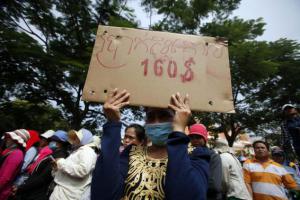
For global companies that have shifted production to Southeast Asia's low-cost manufacturing hub, greater cross-boarder labor coordination could mean less room for wage bargaining, a squeeze on profits and maybe even higher price tags on anything from shoes and clothing to cars and electronics appliances. But even as wages rise, labor activists are confident they aren't at risk of pricing themselves out of the market.
A recent National Labor Relations Board ruling means unions could one day organize nationally among all McDonald’s workers, rather than one store at a time. Nowhere perhaps did the ruling reverberate louder than in Atlanta, headquarters for Arby’s, Chick-fil-A, Popeye’s and other fast-food franchises, as well as many hotel, retail and temp agency chains.The ruling could be a huge boost for the Service Employees International Union, which is organizing fast-food workers.
Spread the word