
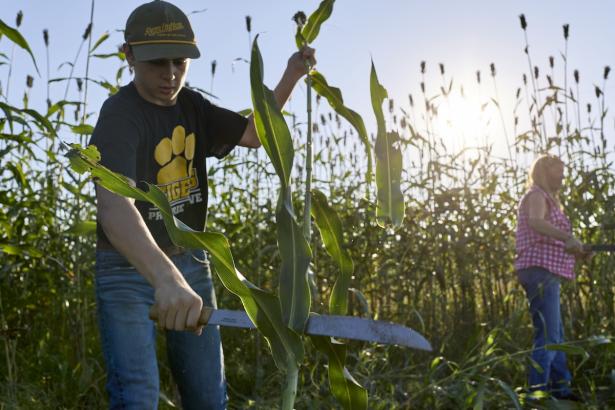
There’s always a day in the late Summer when we worry that our sorghum cane won’t be ready before frost. But it always makes, and soon enough we send the call to friends and family that we’ll be cutting and working on an October Saturday a week or two out. Then we ready the cookstove, sharpen the machetes, and clean up the wagon.
On the chosen day I wait for daylight, pulling boots onto my feet and a hoodie over my head. I stand for a second, gathering my thoughts, grab my coffee and go out. The cane stand is just outside the barnyard, and the horses, Belle and Ted, are waiting for me in the corral, stamping a little. They know the work will soon start, and they’re tired of waiting.
I set my mug out of the way where I’ll find it later, grab halters and bring the horses into the barn and get their work clothes on. We settle into the day’s excitement as I go round each one, softly talking and brushing, cleaning feet and pulling collars and leather straps across their bodies, chains from the tugs murmuring. I put the driving lines to their bits, and we three become one in a simple Trinity. We leave the barn, hook to the wagon, and pull alongside the edge of the sorghum patch.
By this point folks have come over the creek down below us, wound up the mountain and into the farm. We all stand for a bit, laughing as the sun burns the morning mist from the ridgetops around us. Finally, with kids running and coffee finished, we pick up the machetes and head into the cane.
At that moment, if you just drove up and looked around, you might be confused. You’d hear a steady chop, crack, and then a scratchy, Velcro sound; it’s all on a loop now as tall canes steadily flip out of view and snippets of song and laughter rise out of the green wall, birdsong without bodies. The thing to do is go around the edge of the cane patch till you find the work. There, sweating in the sun, you’d find five or ten people in rhythm, bending slightly, arms swinging blades toward the ground as they catch the falling cane stalk, joining a dance that stretches back generations. A crack follows as the cane is topped and the seed head falls to the earth. The workers rake their knives down the stalks, taking the leaves and leaving behind naked cane. Youngsters old enough to help gather the stalks and set them on the wagon.
While some of us strip cane, others build a cook fire, preparing a bed of coals for when the juice starts running. One of the horses is brought to the cane press, and as it turns in circles, cane is fed through opening of the old contraption, butt end first, where it runs between tightly spaced drums that press the liquid from the stalks, sending a bright green stream out one side and the spent cane out another.
We collect the juice from the press straining it twice through a cheesecloth. And then, once the juice is in the pan, we wait—it’ll take hours more for the heat to work its transfiguring powers. We take turns feeding the mill, carrying the bucket of juice over, and skimming the green bubbles and scum off the top. By late afternoon, ten or so gallons of juice is now a gallon of sorghum syrup. I like ours on the lighter side; it tastes sweeter to me.
When it’s done, we grab fresh biscuits or cornbread and butter and dip into the hot syrup, licking the stickiness off our hands as we judge how well we did. The flavor is complicated, like the work to make it. At once sweet, tangy, and smoky, it’s a flavor that can make you understand why folks say a little goes a long way.
We pour the syrup into a motley collection of old jars as the sun slides behind the trees between us and Oklahoma. More neighbors and friends arrive to enjoy the fresh syrup and the fall evening. We string lights out from the barn loft over long tables filled with food. Laughter chases the mob of kids around the barnyard as somebody tunes a guitar. Squares form as the musicians settle. A caller steps up, reminding everyone how the dance goes.
And then, feet stomping in the grass, we send the last echo of summer to its sleep and prepare for winter’s dark nights around the woodstove.
Like a lot of kids from the Ozarks, I grew up putting sorghum on cornbread and biscuits. I understood it was grown and cooked down—I saw the cook pans at various parks and along roadsides throughout the region. But by the time I was old enough to know what I saw, sorghum making, like so many things that kept communities connected in the rural South, was hanging on by a thread.
It was, I guess, a natural consequence of the times. Folks left the countryside, leaving fewer people caring for the old ways as the lopsided promises of the New South came to pass. It became easier (and cheaper) to buy white sugar, until eventually sorghum was an unfamiliar taste in modern mouths. For me, keeping sorghum alive is a way to hold both an agricultural practice and a community close.
I’m under no illusion that the way we do things on our farm makes sense at first glance, and I’m aware that farming with horses and relying on slow, old-fashioned systems isn’t the most efficient way to feed ourselves. But I think that our way of working offers the gift of slowness in an age built on the presumptions of speed. Even in the conversations around regenerative or local agriculture, the methods championed often echo the industrial logic that unmoored and depopulated the mountain South and rural America over the last few generations.
From where I sit, there isn’t much left that supports the old towns and small farms crucial for maintaining the natural world around us. I’d argue that rebuilding those systems, flawed though they were, is just as important as preserving soil or capturing carbon. After all, if we reduce farmland to just a few farms, it doesn’t matter how efficient or regenerative they are. Those few farms can’t sustain a landscape because a landscape isn’t just trees and fields and pretty views. It’s people and towns and customs; a delicate combination of people and nature evolving together over lifetimes. Farming slow and small, especially with horses and crops like sorghum, offers connection—with our neighbors, and with the old ways we’ve chosen to carry forward.
I can’t change all the world at once, and I probably can’t even change the Ozarks. But I can help, I hope, the rebuilding of my home each year when I join with those around me to chop and strip and cook, telling stories and joining ourselves to the rhythm of a song not quite forgotten; one that holds the speed of the world at bay for a little longer and lets us just be, if only for a season.
Spread the word