
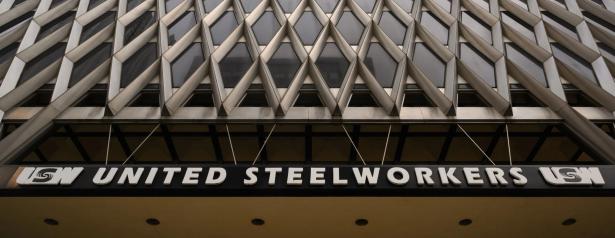
A novel national security agreement between US Steel and the Trump administration complicates labor relations for the company and competitor Cleveland-Cliffs as they race to negotiate new contracts with the United Steelworkers.
The USW’s original pact with both companies expired at midnight, but on Monday the parties agreed to extend the bargaining contract terms for thirty days while negotiations continue. The USW represents over 20,000 workers across both steel manufacturers.
The talks are an early test of the labor effects of President Donald Trump’s agreement that allowed him unprecedented control over US Steel in exchange for approving its acquisition by Nippon Steel Corp. Trump is now able to stop the combined company from relocating jobs overseas, closing or idling plants, or walking back planned investment decisions under most conditions.
The USW publicly opposed the acquisition and the “golden share” agreement last year, arguing that the Japanese steelmaker would transfer US Steel jobs to non-union facilities.
But labor experts said the deal could give the USW a boost in bargaining, particularly concerning job protections and other aspects of the company’s business strategy that US Steel already negotiated with the Trump administration.
“The golden share allows the union leverage over terms and conditions that are hard to bargain over,” said Alvin Velazquez, a labor and corporate law professor at Indiana University. “The real question is, how does it get used?”
Golden Share Effects
Parallel negotiations between the union and both companies began in Pittsburgh in July.
Because the framework gives the president a veto if US Steel wants to move jobs overseas, the union is already coming into the talks with a certain amount of job protections they would normally have to negotiate for, Velazquez said.
“It expands the possibility of what can be bargained for,” he said. “It’ll be a very interesting dynamic to see how that plays out.”
Trump’s deal with US Steel also gives the union added leverage in negotiations with Cleveland-Cliffs, even though it isn’t subject to the same presidential oversight, labor observers said.
Federal anti-trust laws typically exempt labor negotiations, so it’s not uncommon for unions to try and extract comparable concessions from companies that are competitors.
When one company settles, the other usually agrees to similar conditions to avoid a one-sided work stoppage. That could push Cleveland-Cliffs to accept some of the quasi job and investment protections US Steel already agreed to in the acquisition deal.
“Cleveland-Cliffs doesn’t want to have a strike. If Nippon/US Steel settles, that would put them in a very vulnerable position,” said Susan J. Schurman, a labor professor at Rutgers University.
The golden share, however, doesn’t prevent the company from moving jobs to non-union facilities, a chief concern for the USW when it was opposing the Nippon purchase. It also adds significant uncertainty for the workers whose jobs are now more subject to political whims.
“In the hands of a president who was consistently and soberly pro-union, it would be significant leverage,” Velazquez said. However, with a president “who doesn’t define themselves by their support of unions and union workers, it’s a wild card.”
The golden share creates hurdles for US Steel to adjust its investment strategies if economic conditions change, because many decisions are now subject to federal government review. That could make the company more hesitant to agree to higher wages and healthcare proposals, labor observers said.
The deal’s “constraints are operative and they’re significant,” said Lee Howard Adler, labor professor at Cornell University. “With that, the math has to be done extremely carefully and negotiations move more slowly.”
Union Priorities
This round of talks are an early test for newly elected USW President Roxanne Brown, who took office in March as the first woman and person of color to lead the 850,000-member union. Brown has touted the negotiations as a chance for the labor group to lock in guarantees for workers, and influence the company’s long-term strategy.
In an interview with Bloomberg News earlier this year, Brown said she would prioritize guarantees on employment levels and capital spending as well as healthcare and wages during the talks.
On July 23 US Steel offered the union a five-year contract which contained an 18% wage increase with no changes to the company’s current profit sharing and retirement plans.
The USW rejected that deal, saying the contract’s healthcare plans would shift major costs onto employees.
“USS hasn’t moved on their healthcare proposals that would almost certainly lead to substantial cost increases and benefits cuts, shifting costs and risk from USS to all of us,” local union leaders said in an Aug. 28 letter.
On the Cleveland-Cliffs side, the union also said the company “still has not proposed any wage increases yet” after five weeks of bargaining, and that similar to US Steel, it had presented a “healthcare plan that would mean paying monthly premiums and thousands more in deductibles while receiving less coverage,” according to bargaining updates.
“It looks to me like the healthcare issue is really the big one on the table. And I predict that the United Steelworkers aren’t going to agree to a contract where they have to have co-pays,” Schurman said.
The union said Monday that while the parties were still far apart, negotiations were expected to continue in the coming days and would prioritize “wages, benefits, job security, health and safety, capital investments.”
Amanda Malkowski, spokesperson for US Steel, said in an e-mail that the company was continuing to engage in “good faith negotiations” on issues concerning healthcare, wages, and capital investments. A spokesperson for Cleveland-Cliffs said the company wouldn’t comment on the negotiations out of respect for USW.
Spread the word