
Enforcement of an Immoral Law Inspires the Extermination of the Law’s Authors
ONE HUNDRED AND SEVENTY-FIVE YEARS AGO, ON OCTOBER 1, 1851, a group of civilians in Syracuse, New York, took the law into their own hands and violently prevented federal officials from enforcing the year-old Fugitive Slave Act.
They broke into the city jail, where a formerly enslaved carpenter was awaiting deportation to the South, busted him out, and enabled his escape to Canada and a life as a free man in a country where could not be extradited or charged with having done anything illegal.
The successful act of resistance in Syracuse was at least the third time in less than a year that multi-racial groups of armed civilians had risked the possibility of being shot or arrested while defending the liberty of Black men who were alleged to have escaped from bondage in states where slavery was legal.
The first successful direct action against the hated law had taken place in a Boston courtroom, where the crowd overpowered lawmen and hustled an alleged fugitive slave to a nearby hiding place, after which he was clandestinely given transportation to Canada, where he lived the rest of his life without fear of apprehension.
The second was in Christiana, a southeast Pennsylvania farming town where a posse of citizens killed a Maryland farmer who was attempting to kidnap a man whom the farmer claimed to own.
Before a decade passed and the Civil War began, at least 80 similar incidents occurred in states from Massachusetts to Wisconsin.
Each time that determined civilians risked their own well-being to prevent the law’s enforcement served as a vivid reminder to the broader public that more than three million victims of an immoral and inhumane institution also awaited the opportunity to end the nightmare of their bondage.
The strength and breadth of resistance to the Fugitive Slave Act and the obviously limited ability of local and federal authorities to enforce it was a continuous inspiration to everyone who opposed slavery.
A year after the successful Syracuse attack on the law’s enforcement, the incident was an inspiration for Frederick Douglass when he told the National Free Soil Convention in Pittsburgh, “Human government is for the protection of rights; and when human government destroys human rights, it ceases to be a government, and becomes a foul and blasting conspiracy; and is entitled to no respect whatever.”
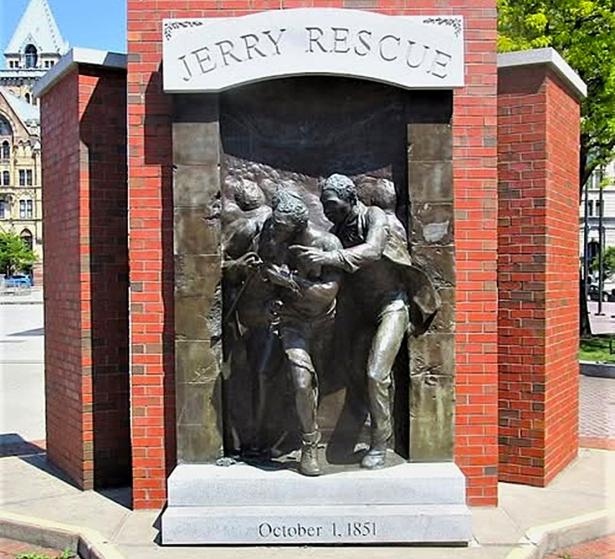
The Syracuse event – called the Jerry Rescue – is regularly commemorated by anti-racists and advocates of civil and human rights. Its 150th anniversary in 2001 was marked with the unveiling of a dramatic statue in the city's civic center, a photograph of which accompanies this article. Click here to read Frederick Douglass’s 1852 speech to the National Free Soil Convention.
For more People's History, visit
https://www.facebook.com/jonathan.bennett.7771/
Spread the word