
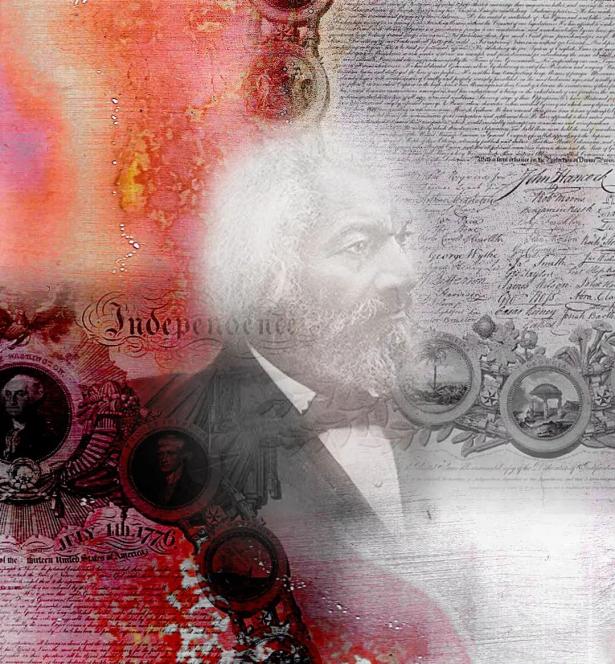
We the darker ones come even now not altogether empty-handed: there are to-day no truer exponents of the pure human spirit of the Declaration of Independence than the American Negroes.
W. E. B. Du Bois, The Souls of Black Folk (1903)
very so-called Independence Day I made my kids listen to passages from Frederick Douglass’s famous jeremiad “What to the Slave Is the Fourth of July?” Standing before a gathering organized by the Rochester Ladies’ Anti-Slavery Society on July 5, 1852, Douglass declared the nation’s celebration “a sham … [a] mere bombast, fraud, deception, impiety, and hypocrisy — a thin veil to cover up crimes which would disgrace a nation of savages. There is not a nation on the earth guilty of practices, more shocking and bloody, than are the people of these United States, at this very hour.” I wasn’t alone. I knew of Black families for whom the reading of Douglass’s address was as much a part of the Fourth of July festivities as barbecue and fireworks.
As we approach the U.S. semiquincentennial, Douglass’s speech is in constant rotation, one track in a cacophony of political noise extending from Trump’s 1776 Commission and his Freedom 250 initiative to Ken Burns’s long-awaited 12-hour documentary The American Revolution. Writers, judges, legal scholars, journalists, pundits, and celebrities hoping to cash in on the nation’s 250th birthday are making podcasts and pumping out books about the Declaration of Independence and 1776, adding to the thousands of volumes gathering dust in our libraries and filling the remainder bins of most corporate bookstores.
Revisiting “What to the Slave Is the Fourth of July?” underscores the need for a critical and informed response to the spectacle barreling toward us, whether it is coming from MAGA propagandists or patriotic liberals who still believe we are on the path toward a more perfect union. Black studies has long challenged right-wing and liberal mythmaking, even at the expense of criticizing our own heroic icons. For example, Douglass’s fury over the hypocrisy of the Declaration is accompanied by a vigorous defense of the U.S. Constitution as “a GLORIOUS LIBERTY DOCUMENT” thoroughly opposed to slavery. His insistence that slavery was unconstitutional and contrary to natural law misjudged the foundational role of enslavement, racism, and dispossession in the birth of the Republic — what the late philosopher Charles W. Mills called “the Racial Contract.”
The Declaration of Independence, however, is another matter. In 2014, Gerald Horne challenged established U.S. historians with the publication of The Counter-Revolution of 1776: Slave Resistance and the Origins of the United States of America, which argues that the colonies declared independence in order to maintain and expand slavery as Britain was moving inexorably toward abolition. The colonists may have believed this when, in 1772, Lord Mansfield, chief justice of the Court of King’s Bench, ruled in favor of James Somerset, a fugitive who escaped his putative “master,” James Steuart, while on British soil. After he was recaptured, abolitionists appealed to the high court for his freedom. Mansfield’s ruling did not abolish slavery, nor was it his intention to do so. His decision centered on whether or not Steuart had the legal authority to forcibly seize him on English soil absent a “positive” parliamentary law legalizing slavery. Yet the Somerset ruling did not free all enslaved people in England. American slaveholders’ fear that Mansfield’s ruling would apply to the colonies turned out to be premature. The British crown’s ongoing investment in the slave economy was evident in its decision to occupy Saint-Domingue (Haiti) from 1793 to 1798, where it attempted to restore slavery after Revolutionary France had abolished it, not to mention the fact that slavery persisted in the British Empire until 1834 — facts Horne knows all too well. Still, I read Horne’s subtle interpretation of the American Revolution as less a counterrevolution than a struggle between factions of the same class over who would benefit from the spoils of slavery, slave-produced commerce, and Indigenous dispossession.
The Declaration’s significance extends far beyond the aims of the American Revolution or an expression of American nationalism. For Black thinkers, captive and fugitive, it was a referendum on the definition of the human, a rhetorical weapon against America’s conceits of liberty and democracy, and an exhortation on the right to rebel. Black people did not need a document to justify revolt, but it came in handy. It is most powerful when the people it was never meant to represent grab hold of its language and toss it back like an undetonated grenade, whether those hands belong to Denmark Vesey, Nat Turner, Maria Stewart, Dr. Martin Luther King Jr., or Ho Chi Minh of Vietnam. For these and other reasons, the Declaration should be read as a core text in Black studies.
My first encounter with a Black studies interrogation of the Declaration and the American Revolution was 45 years ago, when as an undergraduate I read Felix Nwabueze Okoye’s provocative essay “Chattel Slavery as the Nightmare of the American Revolutionaries.” The Nigerian-born Okoye, a noted Africanist and inaugural chair of the department of African and African American studies at SUNY Brockport, wanted to understand why the patriots persistently used the language of slavery to describe their condition. Writing in the wake of the U.S. Bicentennial, Okoye contended that white settler fear of being reduced to chattel slaves was the catalyst for the American Revolution. He takes to task every historian of the American Revolution for failing to see that the pamphlets, broadsides, and oratory did not refer to political or metaphorical slavery but dreaded the prospect of actual bondage. “What they feared,” Okoye wrote, “was ‘unmerited slavery,’ a slavery that was passed on to one’s descendants. What they detested was ‘ignominious slavery,’ a slavery that aroused feelings of shame in the breast of the oppressed. What they scorned was ‘abject slavery,’ a slavery that deprived its victims of all rights, a slavery whose elements were ‘cruel bondage and insults.’” In other words, servile status was reserved for Africans, not white men.
The propagandists of the new Republic generally camouflaged the effect of their proximity to the existing slave regime by invoking analogies to lord-vassal relations in England or relations between dominant and subordinate nations within Europe — anyplace but North America and the Caribbean. It was enough to persuade subsequent historians that chattel slavery had nothing to do with their fight. Their anxieties were not always contained, however. Okoye quoted Richard Wells of Philadelphia, who in 1775 explained his opposition to England’s 1766 Declaratory Act (also known as the American Colonies Act), which asserted the Crown and the British Parliament’s absolute authority over the colonies, by pointing out, “[W]hat security have we, that they will not one day portion amongst themselves, our fair inheritances, and force us into their new claimed fields, like Guinea slaves to till the soil?”
Ironically, this seemingly irrational fear of white Britons becoming slaves partly drove legal arguments in the Somerset case. One of James Somerset’s attorneys, Francis Hargrave, warned the court that a ruling in favor of James Steuart would mean slavery “may be lawfully imported into this country, at the discretion of every individual foreign and native. It will come not only from our own colonies, and those of other European nations; but … from every part of the world, where it still continues to torment and dishonour the human species. It will be transmitted to us in all its various forms, in all the gradations of inventive cruelty; and by an universal reception of slavery, this country, so famous for publick liberty, will become the chief seat of private tyranny.” Slavery haunts not only the colonists but the residents of the metropole, extending beyond the Africans recognized for their “slavish servitude” to others, perhaps even freeborn Englishmen. As the legal historian Michael Meranze perceptively observes, Hargraves is here considering “not only the liberty of Somerset, but also the liberty of all those around him — whether enslaved or not. Slavery in this telling will infect any constitutional order in which it is placed — infect it with tyranny that is.”
For Okoye, the “nightmare” of being reduced to chattel, i.e., Negroes, represented the settler unconscious. He anticipated the work of whiteness studies, especially David R. Roediger’s landmark 1991 work The Wages of Whiteness: Race and the Making of the American Working Class, one of the few texts of its time to cite Okoye. Yet Okoye was interested less in whiteness than in taking historians to task for failing to center slavery in studies of the American Revolution and asking why the revolution had not generated a more robust abolitionist impulse. While he was well aware of the few 18th-century white abolitionists, such as Samuel Hopkins, David Cooper, Anthony Benezet, and John Woolman, who excoriated racism and genuinely believed the Declaration’s assertion that “all men are created equal,” he concluded that merely recognizing African humanity and the inhumanity of slavery was not enough. “The true friend of the slave,” Okoye wrote, “would not only call upon his master to emancipate him but would also urge the man in chains to murder his oppressor and reclaim his freedom.”
David Walker, the militant Black abolitionist intellectual, made the same observation a century and a half earlier in his 1829 pamphlet, Appeal to the Colored Citizens of the World. Turning his attention to white readers, he asked: “Do you understand your own language? Hear your language, proclaimed to the world, July 4th, 1776. … Compare your own language … extracted from your Declaration of Independence, with your cruelties and murders inflicted by your cruel and unmerciful fathers and yourselves on our fathers and on us — men who have never given your fathers or you the least provocation!!!!!!” He urged white people to read the text with greater care, especially the passage asserting that it is both the right and duty of oppressed people “to throw off such government, and to provide new guards for their future security.” He then warned that those who think Black people “will never throw off your murderous government” ought to think again. Violent insurrection is inevitable, he predicted, and anyone familiar with the Declaration should already know that.
Thomas Jefferson, the Declaration’s principal author, as well as its signatories must have known this, at least at the level of the unconscious. The problem of slavery lay just beneath the surface of the Declaration, buried in such a way that its seams remained visible in the document’s final draft. Echoing the rhetoric of Common Sense by Thomas Paine, published seven months earlier, the Declaration charges King George III with fomenting insurrections by “merciless Indian Savages” and enslaved Africans — the latter by recruiting slaves to fight for the British in exchange for their freedom. He was referring to the proclamation issued in 1775 by Lord Dunmore, the royal governor of Virginia, offering freedom to African captives willing to fight for the British. Paine himself, though often touted as an abolitionist, had nothing to say about Black freedom in Common Sense. Instead he presented Africans as merely a threat to white liberty. An earlier draft of the Declaration repeated Paine’s charges, accusing the “Christian King” of foisting slavery onto the colonists, of “suppressing every legislative attempt to prohibit or restrain” the slave trade, and “exciting [the enslaved] to rise in arms among us, and to purchase that liberty of which he has deprived them, by murdering the people on whom he has obtruded them: thus paying off former crimes committed against the Liberties of one people, with crimes which he urges them to commit against the lives of another.” To call this Jefferson’s “antislavery” passage is misleading. It rebukes the Crown’s absolute power and claims the moral high ground for the colonists without ever calling for the abolition of slavery. And why should it? About three-fourths of the 56 signatories owned slaves, including its author. Still, Jefferson’s vivid description of the slave trade as a “cruel war against human nature itself, violating its most sacred rights of life & liberty in the persons of a distant people who never offended him, captivating & carrying them into slavery in another hemisphere” was too much for the South Carolina and Georgia delegates, as well as Northerners invested in the trade in humans and slave-produced commerce. Jefferson later reflected in his Autobiography, “Our northern brethren also I believe felt a little tender under those censures; for tho’ their people had very few slaves themselves, yet they had been pretty considerable carriers of them to others.”
Jefferson’s deleted paragraph nonetheless exposed yet another dimension of the settler unconscious, the nightmare that would haunt the American Republic to this very day. They were not only afraid of becoming slaves, they were terrified of succumbing to Black revolt, of being slain by their property. Even the final draft of the document contains its share of Freudian projections. The Declaration’s description of oppressions under the British mirrors the rebels’ treatment of Africans and Indigenous people. Consider the line about King George waging war on the colonists: “He has plundered our seas, ravaged our Coasts, burnt our towns, and destroyed the lives of our people.”
Roughly 20,000 enslaved Africans fought for the British in exchange for their liberty, but countless others regarded the Declaration of Independence as a general call for emancipation. Black people weren’t naïve — they knew the “men” whose rights for whom the text spoke did not include them. But that did not stop them from proclaiming their unalienable right to liberty. Slaveholders, rebel leaders, and local officials were deluged with petitions for manumission based on the language of the Declaration. In 1777, a free Black man named Prince Hall and seven others petitioned the Massachusetts government on behalf of “a great number of Blacks detained in a state of Slavery in the Bowels of a free & christian Country” for their release from bondage. The petitioners cited their “Natural and Unalienable Right to that freedom … Bestowed equally on all mankind, and which they have Never forfeited by any Compact or Agreement whatever.” They were not only claiming enslaved people’s natural right to freedom but also charging their Christian owners and the state with a crime. Africans, the petition argued, “were Unjustly Dragged, by the hand of cruel Power,” and stolen from a “populous, pleasant and plentiful Country and in Violation of Laws of Nature and of Nation and in defiance of all the tender feelings of humanity brought either to be sold like Beasts of Burthen & like them Condemned to Slavery for Life.” In contrast to Paine, who declared in Common Sense that “Africa is in a state of barbarism,” Hall and his fellow petitioners asserted their humanity, vindicated their native land, and asserted the moral superiority of their own freedom claims over settlers who hold their people in bondage. The petitioners expressed their “Astonishments that It has Never Been Considered that Every Principle from which America has Acted in the Course of their unhappy Difficulties with Great Britain, Pleads Stronger than a thousand arguments in favor of your Petitioners.”
Freedom suits came from Black women as well, disrupting both racial and gendered assumptions as to who is entitled to rights and liberty. “Men” in the Declaration is not a universal, gender-neutral category. Jefferson and his fellow signatories embraced parochialism; African women demanded universalism. Emblematic of Black women’s revolutionary universalism is Mum Bett (or Mumbet), a captive of Colonel John Ashley, a slaveholder in Sheffield, Mass. In 1780, she decided to sue for her freedom and that of all enslaved people in the state, insisting that she had an inherent right to freedom and Massachusetts never legalized slavery. Some accounts report that she walked five miles from Ashley’s place to the home of Theodore Sedgwick, a prominent lawyer and slaveholder himself, and asked him to take her case, after hearing the new state constitution read aloud. It is no small irony that both Ashley and Sedgwick helped draft the Sheffield Declaration of 1773, also known as “Sheffield Resolves,” widely understood to be a model for the Declaration of Independence. Its first resolution states: “Mankind in a state of nature are equal, free, and independent of each other, and have a right to the undisturbed enjoyment of their lives, their liberty and property.” Sedgwick and a lawyer named Tapping Reeve agreed to represent Bett and an enslaved man named Brom in 1781 and won. Upon obtaining her freedom, Mum Bett changed her name to Elizabeth Freeman.
These petitioners not only exposed the revolutionary ideals’ narrow parochialism; they pushed at the limits of the Enlightenment’s understanding of the human, defined, in the words of the scholar, novelist, and playwright Sylvia Wynter, as “European Man.” Wynter, along with Cedric Robinson, Edward Said, Aimé Césaire, and others, has long argued that the Negro, the Savage, and the Oriental were inventions. The modern world was built on such fabrications, and the exclusionary definition of the human designating racial groups as uncivilized and lacking the capacity for liberty not only justified enslavement but also obscured the violence of dispossession. Under settler colonialism’s herrenvolk democracy, freedom belonged to white men, liberty meant the right to own and dispose of property — including property in humans — and while the revolutionary cry for equality partly leveled class distinctions, it reinforced racial distinctions. Equality in this instance meant not being a slave.
Eighteenth-century Black thinkers understood their place in the nascent racial regime, but they refused to accept it. Instead they attributed their exclusion to cruelty, avarice, hypocrisy, and the white elite’s limited capacity for reason. In a letter published in the Connecticut Gazette on March 11, 1774, the poet Phillis Wheatley told the Rev. Samson Occom, a member of the Mohegan Nation, that all people are not only born free but are born with a “Love of Freedom.” She found slaveholders fighting for freedom to be a “strange Absurdity”: “How well the Cry for Liberty, and the reverse Disposition for the exercise of oppressive Power over others agree, I humbly think it does not require the Penetration of a Philosopher to determine.” And yet it has taken a virtual army of philosophers to evade.
These manumission petitions and Black antislavery jeremiads not only refuse such philosophical evasions but also represent a radical critique of “natural rights” discourse in this period that ought to be read alongside Hugo Grotius, Thomas Hobbes, and John Locke. Arguably the sharpest and most sustained critique came from Quobna Ottobah Cugoano’s 1787 text Thoughts and Sentiments on the Evil of Slavery. Born in West Africa around 1757, Cugoano was kidnapped in 1770 and transported to Grenada. He was eventually purchased by a British plantation owner who took him to England in 1772 — the same year as the Mansfield decision — where he was freed in unknown circumstances. His book argued that slavery is contrary not only to natural and divine law but also to civil society, since the kidnapping and selling of human beings is an act of theft — the theft of liberty. But he didn’t stop there. According to the Black studies scholar Anthony Bogues, Cugoano made a persuasive case that slavery, as well as colonialism, also violates reason. Refuting claims that Africans were inferior to Europeans and naturally servile, he argued that Africans were “born as free, and are brought up with as great a predilection for their own country, freedom and liberty, as the sons and daughters of fair Britain.” He saw no separation among natural liberty, civil liberty, and political liberty, making slavery in any form incompatible with civilized society. In short, contrary to the Enlightenment thinkers of his day, Cugoano concluded that natural right meant, as Bogues explains, “the right of the individual to be free and equal, not in relationship to government but in relationship to other human beings.”
Thirty-two years after the publication of Thoughts and Sentiments on the Evil of Slavery, the Rev. Jacob Gruber, a Methodist minister, stood trial for inciting the enslaved to mutiny with his sermon at a camp meeting in Maryland. More than 3,000 congregants, including about 400 Black people, most of them enslaved, gathered to listen to Gruber preach from Proverbs 14:34, “Righteousness exalteth a nation, but sin is a reproach to any people.” According to one witness, the minister denounced slavery as a “national sin” and called attention to “a great inconsistency in holding the Declaration of Independence in one hand and a bloody whip in the other, and the blood streaming from a negro’s back, literally cut to pieces.” At Gruber’s trial, one of his attorneys delivered a brilliant opening statement on freedom of speech and the Methodists’ obligation to oppose slavery. He also turned to the Declaration of Independence to criticize human bondage, which he argued had been imposed on the American people by the British “while we were yet in a state of colonial vassalage.” Slavery, the lawyer told the court, was “a blot on our national character, and every real lover of freedom, confidently hopes that it will be effectually, though it must be gradually, wiped away. … And until it shall be accomplished: until the time shall come when we can point without a blush, to the language held in the Declaration of Independence, every friend of humanity will seek to lighten the galling chain of slavery, and better, to the utmost of his power, the wretched condition of the slave.” Gruber was acquitted of all charges.
The lawyer’s name was Roger B. Taney. He went on to become chief justice of the Supreme Court and the author of the majority opinion in Dred Scott v. Sandford (1857). By then, he no longer envisioned slavery’s inevitable demise. On the contrary, his ruling legalized slavery everywhere and declared Black people had never been citizens of the U.S. and possessed no rights whatsoever. As evidence, he cited, among other things, the Declaration of Independence. According to Taney, “the men who framed this declaration were great men — high in literary acquirements, high in their sense of honor, and incapable of asserting principles inconsistent with those on which they were acting. They perfectly understood the meaning of the language they used, and how it would be understood by others; and they knew that it would not in any part of the civilized world be supposed to embrace the negro race, which, by common consent, had been excluded from civilized Governments and the family of nations, and doomed to slavery. They spoke and acted according to the then established doctrines and principles, and in the ordinary language of the day, and no one misunderstood them.”
David Walker disagreed. He exhorted Americans to “understand your own language,” to recognize how its radical call for equal rights and rebellion could blow up in their faces. Taney, by contrast, conspired with the original signatories to occlude the Declaration’s faint antislavery echoes.
It didn’t work. Two years later, the abolitionist John Brown rewrote the Declaration to create an unambiguous abolitionist document. Dated July 4, 1859, “A Declaration of Liberty by the Representatives of the Slave Population of the United States of America” replicates the original Declaration’s opening lines before turning to America’s crimes:
The history of Slavery in the United States, is a history of injustice & Cruelties inflicted upon the Slave in every conceivable way, & in barbarity not surpassed by the most Savage Tribes. It is the embodiment of all that is Evil, and ruinous to a Nation; and subversive of all Good. …
[The government has] refused to grant Petitions presented by numerous & respectable Citizens, asking redress of grievances imposed upon us, demanding our Liberty & natural rights. With Contempt they Spurn our humble petitions; and have failed to pass Laws for our relief. … They have abdicated government among us, by declaring us out of their protection, and waging a worse than cruel war upon us continually.
“A Declaration of Liberty” and Brown’s “Provisional Constitution and Ordinance for the People of the United States” were direct refutations of Taney’s opinion, which had proved to Brown that the federal government sanctioned and sustained the institution of slavery. Slavery was a national crime, and the federal government was slavery’s prime source of authority and protection — hence Brown’s decision to attack the federal armory and arsenal at Harpers Ferry, Va. He and his small army of 16 white men and five Black men — Osborne Perry Anderson, John Anthony Copeland Jr., Shields Green, Dangerfield Newby, and Lewis Sheridan Leary — took on the federal government and the Southern planter class in what seemed like a foolhardy attempt to free four million Black people held in bondage. They were defeated, with 10 killed in the attack and Brown and six of his men captured and executed, but within two years the nation was at war over the fate of slavery. Walker’s prediction was fulfilled.
The end of chattel slavery did not diminish the significance of the Declaration for Black movements and letters. Its principles of consent of the governed and the right of the people to alter or abolish “destructive” governments took on even greater importance as African Americans fought disenfranchisement, segregation, and state violence. When Huey P. Newton and Bobby Seale drafted the Black Panther Party’s Ten Point Program in 1966, they chose to end point 10, demanding “land, bread, housing, education, clothing, justice, and peace” and recognizing Black people in the United States as colonial subjects, with the first two paragraphs of the Declaration of Independence verbatim.
Tellingly, as the uses of the Declaration shifted more toward democracy and the right to revolt with the advance of the 20th century, Black leaders seemed to embrace the document’s original gender conventions. Men, in other words, meant men. The same year the Black Panthers were formed, a group of Black clergy influenced by Black Power and Black liberation theology, launched the National Committee of Negro Churchmen (later the National Committee of Black Churchmen, or NCBC). Four years later, in July 1970, the NCBC issued its “Black Declaration of Independence,” which appeared as a full-page ad in The New York Times. The document echoes the language of the original Declaration but quickly pivots to addressing the unique history and status of African Americans. It affirms the equality of “men” but adds that “when this equality and these rights are deliberately and consistently refused, withheld or abnegated,” the people are duty-bound to rise up in rebellion: “it is the Right of the Minorities to use every necessary and accessible means to protest and to disrupt the machinery of Oppression.” Its list of abuses includes racism, economic exploitation, inadequate education, housing, denial of political representation, unremitting police violence, the militarized occupation of black communities “without the consent of our People,” and being subject to compulsory military draft “to bear arms against their black, brown and yellow Brothers, to be the Executioners of these Friends and Brethren, or to fall themselves by their Hands.”
So whose Fourth of July is it, really? If the long movement for Black freedom claimed the Declaration and its various revisions as weapons, inspirations, a North Star, a nightmare, then the Fourth of July is ours, too. But not to commemorate a nation’s birthday, and certainly not to celebrate the “birth of freedom.”
Robin D. G. Kelley is a professor of American history at UCLA and the author of Hammer and Hoe: Alabama Communists During the Great Depression, Freedom Dreams: The Black Radical Imagination, and other books.
Hammer & Hope is a new magazine of Black politics and culture. It is a project rooted in the power of solidarity, the spirit of struggle, and the generative power of debate, all of which are vital parts of our movement toward freedom.
We are inspired by the courageous Black radicals in Alabama whose lives and struggles to organize against capitalism and white supremacist terror in the 1930s and 1940s are memorialized in Robin D. G. Kelley’s book Hammer and Hoe, from which we take our name.
We will envision collectively what a better future might look like and the strategies that could get us there. Such an undertaking compels us to deepen our knowledge of history, politics, culture, and our own movements.
Our aim is to build a project whose politics and aesthetics reflect the electric spirit of the protesters who flooded the streets in 2020.
Come join us. We have a world to win.
Hammer & Hope is free to read. Sign up for our mailing list, follow us on Instagram, and click here to download this article. Donate to Hammer & Hope
Spread the word