
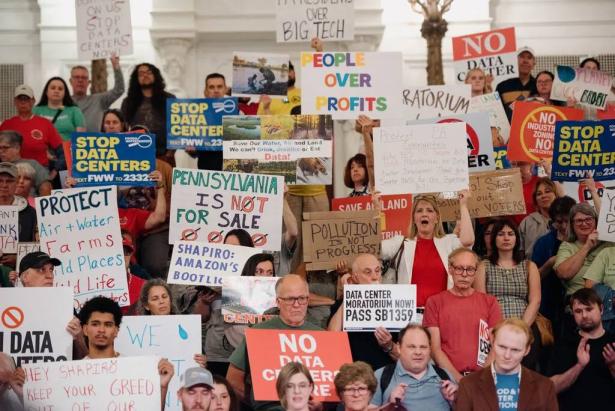
- Democracy and Data Centers
- The Big Bad Press Ban
- Speaking Out Against the Paramount Settlement
- The Future of CNN
- CRISPR and Gene Editing
- AI: New Tech, Ancient Realities
- Pentagon’s Anthropic Blacklisting
- Surveillance News
- Covering Climate
- Digital Capitalism
By Eduardo Porter, The Guardian
Silicon Valley’s power players have just been blindsided by democracy, which has slammed into their program to transform the world with artificial intelligence. A cabal that never doubted the greatness of their ambitions unexpectedly finds their project in the hot seat, forcing them into the unusual position of having to persuade the great unwashed of the merits of their endeavor.
By Tom Jones, Poynter
The week started with Trump banning CNN, MS NOW and Politico from White House grounds, essentially because he doesn’t like their coverage. On Wednesday, a federal judge heard arguments from the outlets and the administration about the bans. Ultimately, the ban was officially lifted. But journalists were still not allowed to return even after the judge blocked the ban.
Speaking Out Against the Paramount Settlement
By Ruth Livier, Ph.D. and Qing Saville, Free Press
Over the last year, a huge movement arose to block Paramount Skydance’s takeover of Warner Bros. Discovery. Free Press, our partners in the Block the Merger coalition and hundreds of thousands of people across the country spoke out — and helped push 12 state attorneys general to sue to stop the deal.
By Brian Steinberg, Variety
Under Bari Weiss, CBS News’ editor in chief, credibility has eroded; several prominent journalists and executives have chosen to exit; and the senior staff of “60 Minutes” has been gutted. There has been significant speculation that Weiss will be handed similar oversight of operations at CNN.
By Avery Hurt, Discover
Gene editing has been both exciting and controversial since the development of CRISPR-Cas9, a technology that repairs genetic errors by essentially cutting and pasting sections of DNA. CRISPR has been heralded as a medical miracle. However, in some cases, the process can miss the target or make cuts in places other than the targeted area, leading to considerable unintended effects.
AI: New Tech, Ancient Realities
AI and the Class Struggle By Hugo Pompougnac, Socialist Project
No Trust By Gemma Ware, The Conversation
The Politics of Frontier Labs By Georg Diez, Survival in the 21st Century
Video: Will It Destroy Us? By Joe Tidy, BBC World Service
Pentagon’s Anthropic Blacklisting
By Webb Wright, Gizmodo
A federal appeals court in Washington, D.C., has thrown its support behind the Trump administration’s efforts to blacklist Anthropic as a “supply chain risk,” a label which would prevent the company from partnering with the U.S. military or federal contractors.
Surveillance News
Flock Cameras in Knoxville By Matt Sledge, The Intercept
Seattle Bans Surveillance Policing By Olivia Rosane, Common Dreams
Video: Chicago Pushes Back By Mark Rivera, Barb Markoff, Christine Tressel and Tom Jones, ABC7 Chicago
By Carolina Abbott Galvão, Ivan L. Nagy and Riddhi Setty, Columbia Journalism Review
Speaking with climate reporters about staying on the beat—because, as Bill McKibben put it, “for better or for worse, by this time next year, there’s no doubt in my mind that climate coverage will be at the forefront.”
By Dr Matiur Rahman, The Daily Observer
Aitor Jiménez’s The Crimes of Digital Capitalism: Corporate Crime in an Age of Exploitation arrives amid growing enthusiasm for artificial intelligence and digital transformation. The book’s central claim is simple but unsettling: the vast social harms tied to digital technology are not accidents of otherwise beneficial innovation.
Spread the word