Who Needs the Supreme Court?
Slate
 Gay marriage might just become the law of the land without ever heading back to Justice Kennedy.
 Gay marriage might just become the law of the land without ever heading back to Justice Kennedy.
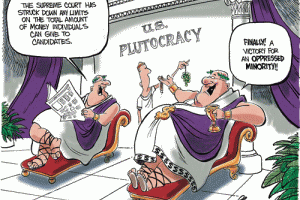
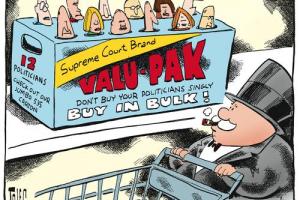
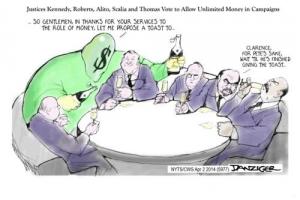
 The way most of us “participate in electing our political leaders” is by voting. A tiny minority also “participates” by contributing more than $123,200 to federal political campaigns. In 2012, just 591 donors reached that limit on giving to federal candidates. For some perspective, that represents a little more than 0.000002 percent of the U.S. voting age population.
 If the Supreme Court upholds a police officer's right to search your smartphone without a warrant, the door is opened to the use of arrests on petty offenses to justify fishing expeditions of those computers we carry in our pockets.
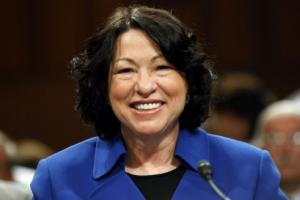 The Michigan case, Judge Sonia Sotomayor explained, is simply the latest example of an old and familiar abuse of the Constitution. The white majority used its power to change the rules in the middle of the game and deprive racial minorities of a fair shot at acquiring their just political rights.
 Reader Comments - NLRB and UAW-Volkswagen; Supreme Court and McCutcheon decision; Full employement, jobs, trade, economic policy; Sports, gender and homophobia; NASA study and climate change;
Portside discussion - Bernie Sanders for President (Jack Kurzweil);
Announcements: Canadian Ecosocialist Ian Angus speaking in Oakland - April 25th
Reader Comments - NLRB and UAW-Volkswagen; Supreme Court and McCutcheon decision; Full employement, jobs, trade, economic policy; Sports, gender and homophobia; NASA study and climate change;
Portside discussion - Bernie Sanders for President (Jack Kurzweil);
Announcements: Canadian Ecosocialist Ian Angus speaking in Oakland - April 25th
 Jobs, Jobs, Jobs!; Progressive Budget, Ryan Budget and economic inequality; General Motors; Supreme Court McCutcheon decision; USAID, Twitter and Cuba; Ukraine
 The vast middle class and poor don't have enough purchasing power, as 95 percent of the economy's gains go to the top 1 percent. Some wealthy people and big corporations have a strangle-hold on our politics. "McCutcheon" makes that strangle-hold even tighter. Connect the dots and you see how the big-money takeover of our democracy has lead to an economy that's barely functioning for most Americans.
Spread the word