
Sunday Science: A Powerful El Niño Is Forming. If History Is a Guide, It Could Hit Hard.
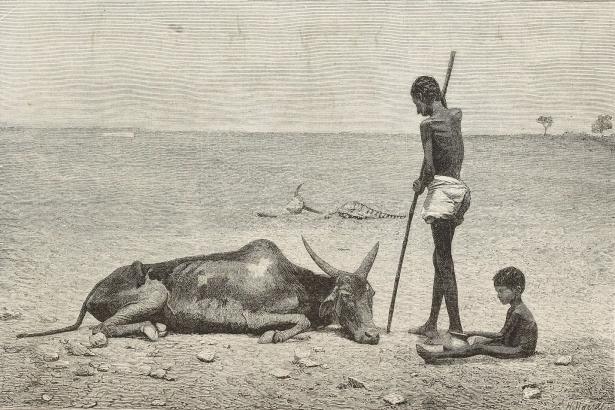
Well before it was understood, the El Niño phenomenon was leaving its marks on humanity.
El Niño is the name given to powerful shifts in Pacific Ocean winds and water temperatures that can drastically transform global weather patterns. Over the centuries these natural patterns have sparked epic droughts and heat waves, and have intensified epidemics.
Some academics even claim to see the fingerprints of El Niño on political and economic crises in ancient Egypt, or on the downfall of the Moche civilization in present-day Peru, more than 1,000 years ago. And in 1877 and 1878, a famine fueled by El Niño killed millions of people across the tropics, hardening inequities that, as one research paper put it, “would later be characterized as the ‘first world’ and ‘third world.’”
Right now, the world is entering a new El Niño phase. Researchers are warning it could be one of the strongest on record and are invoking this history as an admonition that natural forces, when they reach their highest magnitude, can lead to profound volatility and hardship.
In general, El Niño makes for wetter conditions in some parts of the Americas while suppressing the Atlantic hurricane season. The phenomenon raises the risk of dryness in South and Southeast Asia, Australia, and southern Africa.
Of course, the current El Niño is in the early stages of formation and might not live up to the hype. But if the forecasts prove accurate, it would be a whopper and its consequences would play out across a world that has grown far more resilient but also has new vulnerabilities.
Compared with those early times, countries today track El Niño events with oceanic gauges and early warning systems. Agriculture is far more sophisticated, and many countries vulnerable to food shocks hold strategic grain reserves. Nobody is predicting large-scale famine.
But experts say an El Niño would add pressure to an already precarious global system. Fertilizer shortages caused by the effective closure of the Strait of Hormuz are straining farmers. Rising energy prices resulting from war in Ukraine and Iran are eating into countries’ budgets. And a longstanding safety net has been weakened by cuts in foreign aid to poorer countries by the United States and other nations.
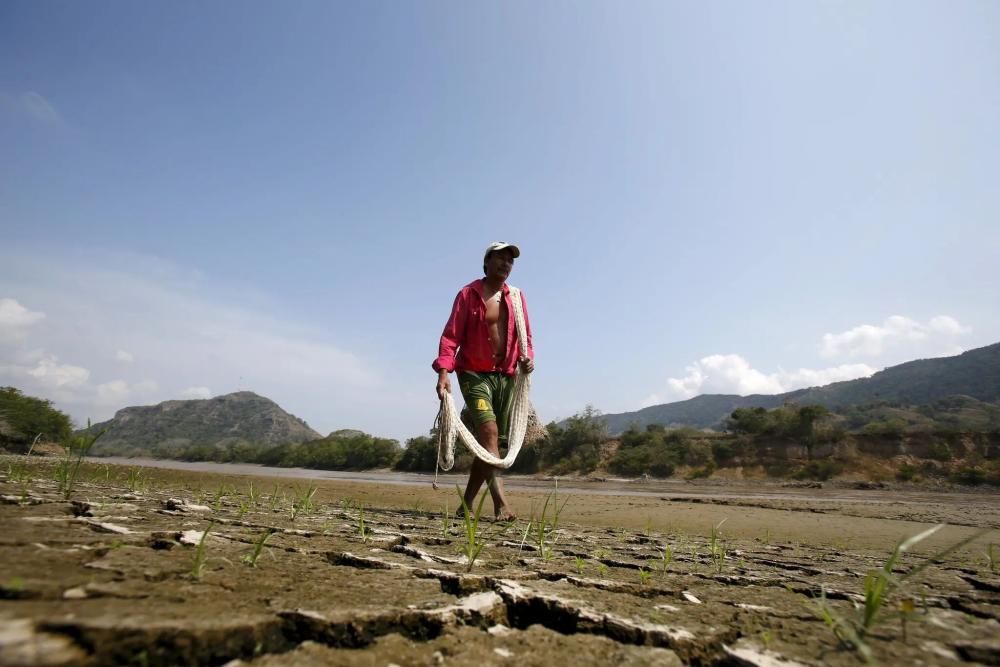
A fisherman beside the Magdalena River in Colombia amid a severe drought during the 2016 El Niño. John Vizcaino/Reuters
There’s possibility for “a perfect storm of factors,” said Laurie Laybourn, who leads the Strategic Climate Risks Initiative, a think tank based in Britain. “You could see an increase in poverty, malnutrition, conflict, indebtedness, and all of the domino effects that come from that.”
If history offers any lesson, it’s that strong El Niño events, like the one that started in 1877, play upon existing weaknesses. That El Niño led to punishingly dry conditions that spanned the world, including Brazil, southern Africa and China.
Few places were hit harder than southern India. Contemporaneous accounts describe stick-thin people trying to survive on roots and even selling off children they couldn’t afford to care for.
But for all the power of nature, man-made factors very likely raised the death toll, which ultimately rose to tens of millions of people. At the time, India was under British colonial rule, and the historian Mike Davis, in his 2001 book “Late Victorian Holocausts,” portrays Britain as prioritizing its imperial interests by maintaining huge grain exports from India even as Indians starved.
“Londoners were in effect eating India’s bread,” Mr. Davis wrote.
Of course, there was another factor complicating the response. People at the time had no idea why the monsoon rains had failed. Scientists in the 19th century theorized a link with weakened sunspot activity.
But a far better picture emerged in the 1960s, when Jacob Bjerknes, a meteorologist at the University of California, Los Angeles, pieced together the global consequences of the feedback between the ocean and atmosphere in the Pacific. Centuries earlier, Peruvians had noticed that sometimes tropical fish would unexpectedly show up on their shores around Christmas, a phenomenon eventually named “El Niño,” or “the Christ child” in Spanish. Dr. Bjerknes made the connection: The Pacific warming that the Peruvians had spotted was, in fact, altering weather patterns around the world.
“That was the big bang” realization, said Michael McPhaden, a senior scientist at the National Oceanic and Atmospheric Administration. “He opened up a new universe of study.”
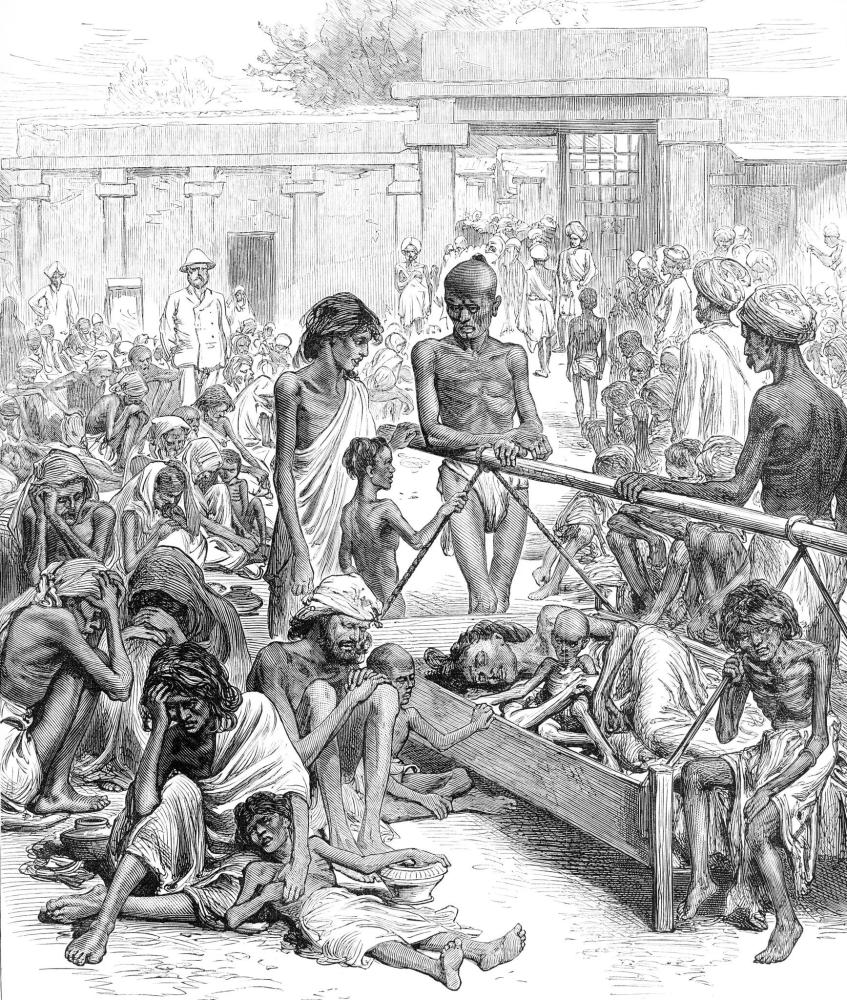
An 1877 illustration from a London newspaper showed people in Bangalore, southern India, seeking famine relief. Universal Images Group, via Getty Images
By the 1980s, scientists were on a vessel in the middle of the Pacific, anchoring buoys that enabled improved monitoring of ocean temperature. Separately, researchers sought out clues for El Niño’s place in human history, studying tree ring samples, coral reefs and sailors’ logbooks, and creating a crude timeline of its spikes.
The records weren’t sharp enough to measure past events with certainty. But they have led to speculation about the role of El Niño events across history, including that an El Niño in the late 1700s might have played a role in the crop failures that contributed to uprisings in the French Revolution.
For the 1877 El Niño, the one that hit India so hard, the documentation is better, but still involves guesswork. “Working with nineteenth-century sea surface temperature data is a bit like assembling a puzzle with many missing pieces,” Boyin Huang, a NOAA oceanographer who has studied the scale of the event, wrote in an email.
El Niño events are measured by looking at temperature levels in a vast rectangular zone in the central Pacific. In a moderate El Niño, temperatures might climb, say, 1 degree Celsius, or 1.8 degrees Fahrenheit, above a longer-term average. But in the biggest El Niños of the past 50 years — the ones that started in 1982, 1997, and 2015 — temperatures have soared 2 degrees Celsius or more beyond the norm. Each of those events levied a global economic toll.
This year, many forecasts say the temperature could increase by an unprecedented 3 degrees Celsius. Even the 1877 El Niño, by the best estimates, didn’t have that magnitude.
“A number of the models now show a real chance for a record-setting El Niño event,” said Zeke Hausfather, a research scientist at Berkeley Earth. “It is still too early to know for sure.”
El Niño events typically peak in strength late in a calendar year, and then cause warmer global temperatures on land in the months that follow. As a result, many scientists predict that 2027 will be the warmest year on record.
In India, which tends to be drier during El Niño periods, the government has already held preparatory meetings. Vimal Mishra, a professor at the Indian Institute of Technology Gandhinagar, said his country did not face risks on the same scale as it did more than a century ago. “If one year the monsoon fails, we won’t see famine,” he said. He cited India’s public distribution system, which guarantees access to basic staples at subsidized prices.
But Dr. Mishra said India, like other countries, still faced risk. If there is very little rainfall, people will draw down on savings. They’ll spend less. They’ll close down businesses. During droughts, school dropout rates rise. “It has a direct impact on the growth rate of India’s economy,” he said.
Dr. Mishra has studied India’s major famines and he draws a direct line between the one from the 1870s and the preparations India is now taking. “It gives us an idea of how to be better prepared,” he said. “It shows you, this is the worst that could happen.”
Chico Harlan joined The New York Times in April 2026 as a global climate reporter on the Climate desk.
He has detailed how camels were replacing cows and changing culture after drought in the Horn of Africa. He has revealed how Iceland was preparing for the collapse of an ocean current that could trigger a new ice age in Northern Europe. And he has documented how cookstoves for villagers living in poverty that were touted as beneficial for emissions and health were actually doing more harm than good.
Chico, an experienced and versatile journalist who has reported from 50 countries, is bringing his considerable talents to the Climate desk at The New York Times, becoming our next global climate reporter.
Chico comes to The Times from The Washington Post, where he spent 18 years, much of it on the foreign staff, but also with stints as a sportswriter, economics reporter and national enterprise writer.
He spent four years as the East Asia bureau chief, focusing on Japan and the Korean Peninsula. He was awarded the Madeline Dane Ross Award from the Overseas Press Club for his coverage of the 2011 triple disaster of a 9.0 magnitude earthquake, tsunami and nuclear crisis in Japan.
Chico moved to Europe in 2018 as the Rome bureau chief for The Post, where he covered migration, the Catholic Church’s sexual abuse crisis and the early days of the Covid pandemic as it raged through Italy.
He became The Post’s first global climate reporter in 2023 and in that role he has traveled the world to deliver beautifully rendered tales of life on a planet where a changing climate is affecting people, communities and governments.
An elegant writer, Chico has twice been a finalist for the Gerald Loeb Award, once for feature writing and again for beat reporting.
A Pittsburgh native, Chico worked at The Pittsburgh Post-Gazette and The Daily Telegraph in Sydney. He is a graduate of Syracuse University.
Subscribe to the New York Times
Brothers in Arms
Richard Stone
Science
Key human defenses against pathogens were forged billions of years ago in microbial battles with viruses
May 212, 2026
Spread the word