
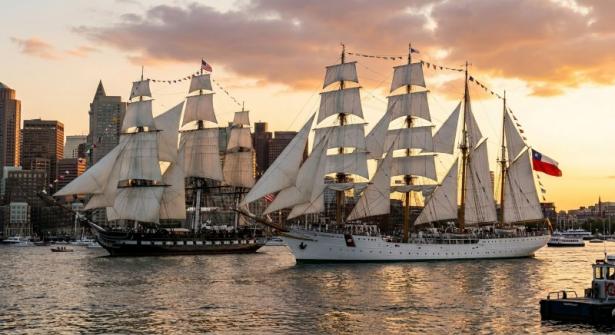
In 1976, I was a student at Columbia University when Operation Sail brought 16 tall ships from around the world into New York Harbor. Among them was the Chilean naval training vessel Esmeralda.
To many, she was simply spectacular. To us, she was something sinister.
Three years earlier, Gen. Augusto Pinochet had seized power in a violent coup. The Esmeralda had been used as a detention and torture site in the regime’s early days. Just a few months earlier, a young Chilean woman, Michelle Peña Herrera, had been admitted to Columbia to study engineering. She was a labor organizer. Before she could leave Chile, she disappeared. It was widely believed she had been detained and tortured and killed on the Esmeralda.
Though I never met her my classmates and I had worked to secure her admission. When the Esmeralda docked in New York, we protested around the clock to focus attention on her disappearance and the Pinochet regime's human rights abuses.
Four decades later, in 2017, I was working on Boston Harbor as Director of Strategy and Communications for Save the Harbor/Save the Bay, a position I held for more than 30 years. My office was on the Fish Pier, and when Sail Boston brought the Esmeralda back to our harbor, I could see her masts from my desk.
Chile was no longer a dictatorship. Pinochet had left power after losing a national plebiscite. Civilian rule had returned. The country had held decades of competitive elections and built democratic institutions that, while imperfect, were real.
I walked over to the ship early one morning and spoke with members of the crew. It was a thoughtful conversation about history and responsibility. The vessel had not changed. The nation she represented had.
I left believing that countries, like ships, can be restored.
But history is not a straight line. In recent years, Chile has experienced intense political polarization, waves of protest met at times with heavy police response, and fierce debate over constitutional reform. In the 2021 presidential election, far‑right candidate José Antonio Kast — who has defended elements of the Pinochet era and whose father served in the German army during World War II — won the first round of voting before ultimately losing in the runoff. His strong showing was a reminder that even countries that have suffered dictatorship are not immune to its echoes.
On July 11, tall ships returned to Boston again. The Esmeralda was among them. So was the USS Constitution, berthed a short distance from my home port at Constitution Marina in Charlestown.
I love the Constitution, the sound of her cannons every day at 8 AM and again at sunset and the continuity she represents. And yet, lately, when I look at her, I feel something new. Unease.
In recent years, we have seen families separated at the border, some children still not reunited. We have witnessed political violence and efforts to revise history and suppress dissent. We have seen retribution against perceived adversaries and disdain for longstanding democratic norms. Our president has been openly hostile toward traditional allies while expressing admiration for authoritarian leaders abroad.
The United States is not Chile in 1973. We are not under military rule. But I recognize warning signs from my youth: contempt for institutions, language that casts political opponents as enemies, the testing of legal and constitutional boundaries to see how far they bend.
The histories are not identical. But they rhyme.
When I was 20, I knew why I was protesting. The injustice was visible. The stakes were clear.
Today the danger is no less visible though it is wrapped in patriotic language and asks us to confuse loyalty to a person with loyalty to the Constitution.
The arc of history is long. But it is not smooth. And it does not bend on its own.
Ships are preserved through constant maintenance. They are sanded, sealed, and repaired before rot spreads. Republics demand the same care and attention.
When I stood on the pier in New York Harbor in 1976, I felt compelled to speak because silence felt like complicity. I feel compelled to speak again today — not because I doubt what the Constitution stands for, but because I believe in it.
Our Constitution, like the USS Constitution, will endure only if we work to preserve it.
[Bruce Berman served as Director of Strategy & Communications for Save the Harbor/Save the Bay for more than 30 years. He lives, works, writes and fishes aboard his trawler at Constitution Marina on Boston Harbor from April - November. From November - April he serves as lead organizer of the Miami Beach Cupid Splash to raise funds to heal Biscayne Bay.]
Spread the word