
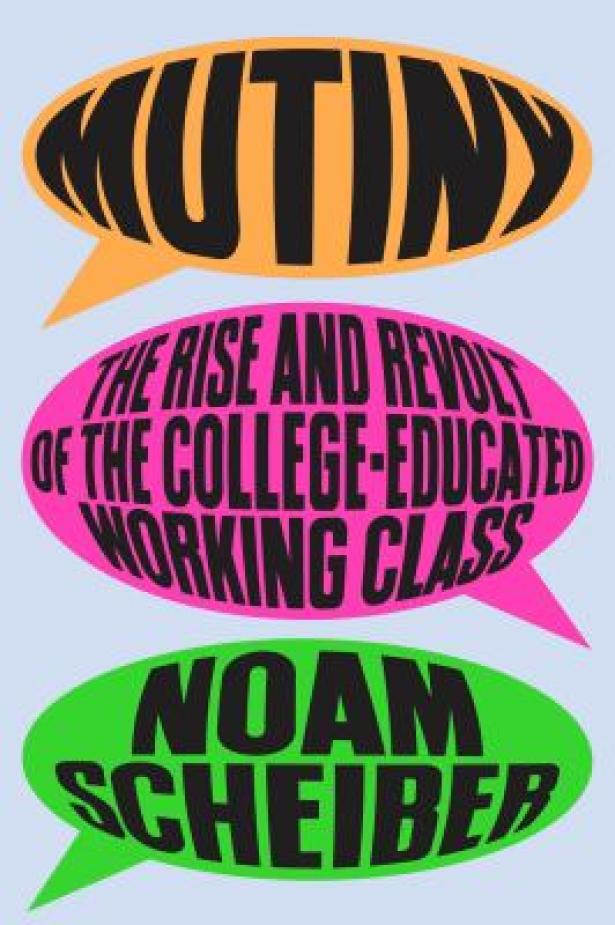
Mutiny: The Rise and Revolt of the College-Educated Working Class
Noam Scheiber
Farrar, Straus and Giroux
ISBN-13 9780374610814
It’s been a dramatic spring and summer for the democratic socialist left. As primary season has gotten underway, left-wing challengers have begun to break through the dams that largely held in 2016 and 2020. The victories of Chris Rabb, Claire Valdez, Darializa Avila Chevalier, Melat Kiros, and others have provoked a furious conversation—encompassing everyone from the center left to the far right—about democratic socialism. Who are the Democratic Socialists of America? What does the organization stand for? Whom does it represent?
Despite the rise of the Squad, years of intensified union activity, the movement against the genocide in Gaza and its electoral expression in the Uncommitted campaign, the discrediting of Joe Biden and disaster of Kamala Harris, and the municipal victories of Brandon Johnson, Katie Wilson, and Zohran Mamdani, the tone of this conversation is puzzlement and surprise. For Democratic officialdom, the whole Biden-Harris sequence, from the South Carolina primary in 2020 to the Chicago DNC in 2024, signaled that the party machinery could not be wrested away from them. Even the second victory of Donald Trump seemed to announce that American politics was moving rightward and enjoined liberals to follow. As for the Republicans, they became persuaded that liberalism was a spent force and only MAGA had anything to offer. Either way—patriots were in control.
The rise of the socialist left, however, was something more than they had reckoned. It was not just the insubstantial fluctuations of youth culture—nor reducible to memes or TikTok trends—but a phenomenon with a social basis, developing over years, even decades, and giving rise to grievances that the political system proved unable to address. On the left, this phenomenon, along with its ideological emanations, is much better known. It is more widely discussed, although often polemically, under the sign of a term loved by few and used by many: the professional-managerial class, or PMC.
While the complex relationship between the middle class and radical politics is a very old issue, few—not none, but few—foresaw its reemergence on the left wing of American politics. While the years of the Great Recession were littered with commentary on the quirks of the millennial generation, economically wrongfooted at the beginning of adulthood and prone thereafter to indulgences like Occupy Wall Street, Black Lives Matter, and the Bernie Sanders campaigns, it somehow still failed to sink in that a lasting and meaningful development had taken place. At each step, the mandarins of the political mainstream reassured themselves that a tantrum was all they were looking at. And when that tantrum reached its high pitch this spring and summer, their own howl went up: these were rich kids, white gentrifiers, engaged in a kind of extremist fantasy camp. In other words, hysteria, itself a compensation for complacency, has so far dominated the response.
Noam Scheiber’s new book Mutiny: The Rise and Revolt of the College-Educated Working Class, by contrast, is the first serious and fair account of the radicalized PMC from outside its own ranks. The book documents the rising anger and mobilization in the bottom layers of this group, which might not fit into the category of “middle class” at all, despite college diplomas and great expectations. Scheiber is a labor reporter at the New York Times: the renewal of this beat across print journalism, where it seemed virtually dead a decade or two ago, is itself a symptom of the phenomenon the book is about. In a closely reported and often moving and intimate account of workers’ struggles at Apple and Starbucks and in Hollywood—with some briefer accounts of organizing in academia and at Amazon—Mutiny shows that we’ve witnessed something more than a fit of whimsical proletarian roleplay. The ground has eroded under what was once the middle class, a rift has begun to open, and people are scrambling to get out and to give each other a hand up.
The modern middle class emerged in something like its current form in the late nineteenth and early twentieth centuries. The consolidation of large-scale corporate enterprise—industrial capitalism in its continent-spanning, bureaucratic form—established a vast new labor market for lawyers, accountants, and engineers. Industrial labor forces needed to be taught and supervised by teachers, social workers, nurses, and doctors; and entertained and informed by the emerging new culture industries—Hearst and Pulitzer, the record industry, radio, Hollywood. Many of these functions required training at universities, triggering the expansion of higher education in both scale and scope. And once the benefits of application of scientific expertise to practical problems made themselves known, the idea became something of a mania: scientific housekeeping, scientific philanthropy, scientific policing.
The economist Thorstein Veblen, imagining in 1921 a future society governed by a “soviet of technicians,” was one of the first to observe that this emerging stratum didn’t have the same interests as employers. The professionals wanted to do things well: to do their jobs correctly, to follow the science, to profess their ethical codes. The owners of property, on the other hand, wanted to make money. If that goal coincided with advancing knowledge or improving the fiber of society, fine; if not, their employees ought to remember who pays the bills.
As Veblen saw, the technical professions stood in the middle—not just in terms of the distributive stratigraphy of the class structure, but also in terms of social relations. The authority the capitalist exercised over the technician was quite like the authority that he exercised over the worker. There was therefore something worker-like about the new professionals, who after all increasingly did work for large organizations, many of them for-profit—rather than hanging a shingle of their own. This parallel seemed especially clear in an era when skilled manual laborers still held powerful positions in many factory processes: the engineer and the craftsman thus stood somewhat in parallel to each other. On the other hand, technicians were also enemies, competing with craftsmen over a middle niche in the economic ecology that could not sustain them both. The engineer’s job was to rationalize production and make the craftsman obsolete, and he had the enormous advantage of the employer’s support in this pursuit. In the long view, the engineer won—or rather, the employer did, with the engineer’s help—and the craftsman became an endangered species, in turn creating space for the conflict between engineer and employer to come to the fore periodically. This friction naturally raised the question of the affiliation between the skilled technician in the middle, and the more epochal conflict between labor and capital at the bottom and the top of the pyramid.
Over the twentieth century, the professional middle class oscillated politically with the times. Early in the twentieth century, commenting acerbically on the appeal of the Socialist Party of America to professionals, Leon Trotsky called it a party of dentists. Members of this social group moved further left in the 1930s with the Popular Front, presenting themselves as brain workers and culture workers, and hence part of the working class. In the 1950s, after McCarthyism, they ran rightward, pursuing the conformist dream of the Organization Man. The 1960s and 1970s brought another leftward lurch: this was the New Left, embodied in Mario Savio’s famous rebuke: “We’re a bunch of raw materials that don’t mean to be—have any process upon us. Don’t mean to be made into any product! Don’t mean—Don’t mean to end up being bought by some clients of the University, be they the government, be they industry, be they organized labor, be they anyone! We’re human beings!”
It was in the aftermath of this moment that Barbara Ehrenreich and John Ehrenreich reconstructed Veblen’s account from a Marxist perspective in the mid-1970s, coining the concept of the “PMC” to explain both what made the 1960s uprising possible and where its potential lay, as well as why it had not succeeded. They argued that the social barriers between the PMC and the working class had been too great for the New Left to universalize itself, but that the radicalism of professionals still contained political potential: as capital ground down the skill and autonomy of professional work, it would systematically push bottom layers down toward the working class. Instead, from the 1980s, yuppiedom pulled rightward again at the long neoliberal end of history, inviting the middle class to take an upward ride on the escalator of home values, stock options, and 401(k)s, alongside the rising college wage premium. It was the Great Recession and its turbulent aftermath that brought everything crashing down, setting up Scheiber’s narrative.
While Scheiber’s story takes place over the last few years, he acknowledges that its immediate precursors go back to the aftermath of the financial crisis. Occupy Wall Street, the Sanders campaigns, the first Trump administration, and Black Lives Matter were all symptoms of the deterioration of neoliberalism’s promises and social compromises, and also occasions to name that deterioration, to identify its consequences, and to propose alternatives. Even before 2020, Scheiber observes, DSA had undergone dramatic growth, and the generational opinion shift toward socialism and the labor movement was underway. Still, it was the compounding effects of the second Sanders campaign, the George Floyd uprising, the COVID-19 pandemic, and the defeat of Trump in the annus mirabilis of 2020 that escalated a long-term trend into something more pointed.
Of the narratives in Mutiny, it is the campaign of Starbucks Workers United (SBWU) that shines most brightly. The prior decade, after all, had seen a kind of organizing campaign among fast food workers, bankrolled by the Service Employees International Union, also the parent organization of SBWU today. While it stoked some public opinion heat behind a wave of successful minimum wage campaigns, and contributed vaguely to the rising pro-worker sentiment of the 2010s, Fight for $15’s goal of unionizing fast-food workers went nowhere in terms of actually building shop-level organization. Workers at Starbucks, on the other hand, achieved a genuine breakthrough, first winning an election in Buffalo, New York, then hundreds more across the country. Here, Scheiber draws close to the very bottom layer of the PMC, where it ceases recognizably to be middle-class at all.
Some of the workers he profiles have resumes that shine with achievement of a recognizably professional sort: Teddy Hoffman, a Chicago Starbucks worker whom Scheiber follows throughout Mutiny, attended the elite Grinnell College and won a prestigious Watson Fellowship to spend a year after college traveling the world studying how theater programs include people with disabilities. When an acting career in Chicago didn’t work out, he landed at Starbucks. Many workers at the coffee chain have some college education under their belt, even a degree like Teddy. Many others are studying concurrently with their jobs. They heard an invitation from their society to get educated and climb into interesting, rewarding work. Perhaps they took on debt in the process. What marks them as members of the PMC is more a cultural residue than a live material fact.
Starbucks in particular attracted a progressive young workforce with its vaguely cosmopolitan, even pseudo-intellectual branding. In some parts of America, a Starbucks might be the only public space where a legibly queer or trans person would be able to get employment. More to the point, it offered benefits: education benefits, gender medicine benefits. A corporate holdover of the vision of progressive neoliberalism of the 1990s, the decade of the company’s nationwide expansion, Starbucks’s implicit ideology made little sense in the discontented and disillusioned 2020s. This was also true for Apple and Amazon (and even academia—which fizzed in the 1990s and early 2000s with growth and playfulness before entering its steep and bitter decline after 2008). As Scheiber recounts, by 2020 many of these firms were years into a regression to the mean of corporate America. At Apple, for instance, the transition from the reign of Steve Jobs to the era of Tim Cook brought about a shift in the function of the company’s stores: Jobs had envisioned them as jewel cases for Apple’s perfect products, while for Cook their purpose was to move inventory.
Disillusionment is at the center of the workers’ movement in Scheiber’s narrative. A perennial refrain of the Starbucks campaign—neither wholly true nor altogether bad-faith—has been that workers flocked to the company for its image and want to help it live up to it. Of a group of union activists at Apple, Scheiber notes, they “had all nursed a crush on the company before their eventual disillusionment.” Chris Smalls, the crucial figure in the early and partial breakthrough of the Amazon Labor Union, similarly turned toward the movement after his ambitions to rise into management were frustrated.
The same rule writ large across society elucidates the structural dynamic: a debt-fueled expansion of higher education, driven by pursuit of the college wage premium, refluxed into outrage when that premium stagnated and the proportion of graduates working in jobs that didn’t require their skills began to rise. Now former Watson Fellows and Harvard graduate students were fighting over break time, understaffing, and part-time schedules. Pile on the threat of AI, especially to the creative and intellectual professions, and the kindling for an uprising was there.
The social movements of the previous decade were ready to strike the spark. For instance, Teddy Hoffman was friends with Joe Engleman, a graduate student at the University of Illinois-Chicago, whose union had fought an offensive strike in 2019 and gained significant ground. The two texted during the early days of the pandemic, and Joe made clear to Teddy the difference between his union job and Teddy’s. By the time that workers at some Buffalo Starbucks stores filed for National Labor Relations Board elections (led by Jaz Brisack, a Rhodes Scholar turned salt—an undercover operative for the labor movement), Teddy had already been talking about unionization for a year. “Really anytime he had a frustrating day, Teddy would quip . . . that he was going to organize the store,” Scheiber writes. “‘I was coming home feeling this impotent rage,’ he said. ‘I was sharing with friends this pipe dream of organizing, almost as a therapeutic pipe dream.’”
The organic and materially grounded origins of this wave of organizing should, at this point, be beyond dispute. They are not a fad, a mere viral trend, or a status game. But this does not resolve the question of their significance and consequence. Beneath the sneering, this is the more substantive issue raised in the venom directed at DSA: this might be a layer of society with real grievances, but are those grievances the same as, or even compatible with, those of the wider working class? This distinction may be eroding as the ranks of college-educated workers grow, and as borderline, credentialed occupations such as nursing and teaching take on greater importance. But even if the boundary cannot be drawn precisely over the sociological reality, it’s reasonable to believe that some difference remains.
Here the question becomes more difficult. If the United States had a functional labor relations system, the problem would be less acute. But workers at Starbucks and Amazon who won their union elections in 2021 and 2022 still do not have contracts and, as Scheiber documents, those companies have engaged in extensive anti-union activity that violates labor law in spirit and sometimes in actuality. At Apple, workers at only one store, in Towson, Maryland, fought all the way through to a union contract—a story Scheiber narrates in full. Apple has since closed the store. Hollywood, with its incumbent unions, and the academic sector, which is subject to numerous other pressures from below, represent more of a success story. Not coincidentally, workers across lines of skill, race, and other such criteria have had much more luck forming coalitions in those industries, where alliances of blue-collar and professional workers have become routine, if not altogether uncomplicated. Indeed, as scandalized right-wing observers have become fond of pointing out, one-quarter of the membership of the United Auto Workers (UAW) are now academics, and this growing element of the union played a crucial role in capturing leadership from the complacent and corrupt Administration Caucus in 2023.
Wherever real or even perceived differences are operative, however, political fissures may open when circumstances become difficult. They are there, largely implicitly, in the UAW, which has tried to thread the needle by maintaining progressive positions on immigration and foreign policy and endorsing left-wing candidates, while hedging on the other side with its support for tariffs. In the long term, if the union can capitalize on left-wing activist energy to create a more favorable political environment and win better contracts, it will bring the traditional membership along with it. They in turn can wield their economic leverage over the actual profits of actual capitalists, which graduate students cannot do. It’s difficult to see what a better approach might be. An unhappier version of the problem is found in the experience of the Amazon Labor Union. After its initial strategy ran aground on the company’s intransigence, the union devolved into bitter internal power struggles. “As the rift widened, Smalls’s inner circle framed it as a conflict between college-educated white people, led by Spence, and working-class Black people,” Scheiber writes. “Never mind that some of the dissidents were themselves Black or Latino, and that some of the white dissidents were working-class.”
The danger runs in both directions, too, although not in quite the same way. Where working-class organizations and communities may be on guard about middle-class takeovers, professional-class progressives are sometimes prone to projections about the working class. One need only think of what we now know about how political operatives Morris Katz and Dan Moraff talked about Graham Platner: “looks like he’s a union working-class guy.” With the benefit of hindsight, it’s easy to see here how old anxieties took hold of these operatives of the party of dentists and drove it into a fantasy—but one that corresponded to a real political demand, and a real political opening.
The question of whether or not these groups—auto workers and grad students, screenwriters and teamsters—belong together is not one that has a self-evident or objective answer. It is an eminently political question. Every class formation has contradictory edge cases, and the way it handles these forms part of its character, rhetoric, ideology, and identity. Certainly, classes cannot be made from just anything: there must be some material substrate that is shared or at least comparable. But no two workers, much less groups of workers, are identical. Rather, all workers must decide to affiliate with each other, see themselves in each other, and become something together. That is true at every scale, from two workmates to whole sectors of the economy. Classes are made politically. Indeed, the political work of deciding what to bring to the fore, of how to make experiences commensurable, is what organizing is. The necessity of the activity itself reveals the lack of the guarantee. When someone says that grad students have hijacked the UAW, or that gentrifiers are taking over the Democratic Party, they are not making a descriptive observation, but a normative one. Let them make their case.
It’s easy to blow hot air about who doesn’t belong with whom. But it’s not a serious idea if it has no stakes: it’s the reaction of a child who thinks peas and ketchup shouldn’t touch on the plate. If the center and the right think the working class and professionals don’t belong together, they should make an offer to one group or the other about a better affiliation. Their failure to do so in any serious way is the condition for today’s growing socialist coalition. What Mutiny shows is how this alternative proposition has, over a decade and more, been painstakingly turned into something concrete. It has limits and contradictions of its own. But it is on the table now, people can see it, and some of them like it. If the incumbent political order is anything other than historically exhausted, it will have to produce an answer that is more than a temper tantrum.
Gabriel Winant teaches history at the University of Chicago.
Spread the word