
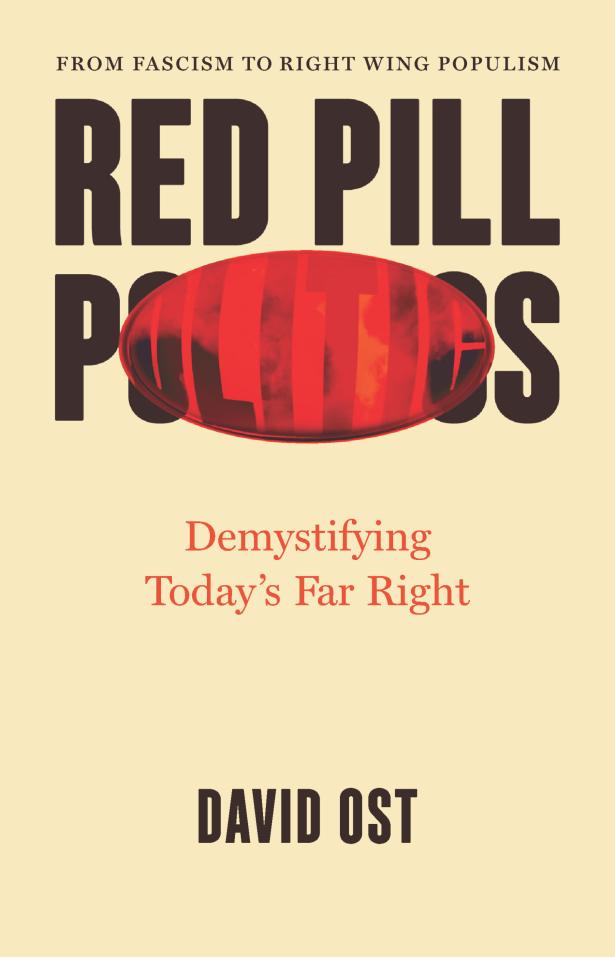
David Ost,
Red Pill Politics: Demystifying Today’s Far Right
The New Press
ISBN: 9781620978511
David Ost, longtime professor at Hobart and William Smith Colleges, has written an engaging book about far-right politics. In Red Pill Politics, Ost portrays the shared features of ultraright movements in or endeavoring for power in diverse countries. The far-right engages in cross-pollination. Ost has a substantial background in Eastern European politics, especially Poland. Ost’s comparative assessment of authoritarian regimes – including Hungary - makes the book unique. Several of his examples pre-date Trump, whose advisors have seriously studied them.
Ost generally avoids professional jargon. The book is written in the first person, moreover in conversational style and tone, rendering it easily accessible. He assumes the task of analyzing fascist and fascistic tendencies along with the broader thoroughfares of right-wing populism. The latter promises some workers apparent benefits: “But its commitment to offering something to workers other than being sacrificed to the whims of private owners distinguishes it from other right-wing movements—think of the Latin American dictatorships of the 1970s—which simply want to crush workers and their movements.” Ost sets aside these or other Latin American regimes, other than Chile. Perhaps another volume will follow. He confines himself instead to parallels in “developments in today’s West.” The latter purview is broad, however: Turkey and India enter the picture too.
Ost demonstrates that fascism is antecedent, influence, and trend within these categories. Ost makes no secret of his affinity with the Left, or his disdain for the movements covered in Red Pill Politics.
What does he mean by “Red Pill?” He explains, with reference to the fabled film “The Matrix,” which offers a red pill that unveils the truth that has been obscured, hidden, covered up. Polite society has buried this revelatory knowledge: Ost asserts that the far right carries this message into bluntly political analogy, disseminating ostensible revelations that prove the bankruptcy of widely accepted democratic thinking and politics.
The far right thus dishes out the red pill for all who are allegedly brave enough to swallow it. At last, “You see that everything you thought you knew is false. You learn that your everyday thoughts are the result of an elaborate brainwashing hoax.” Ost maintains that “fascism was “the original Red Pill politics.”
To begin, Ost offers a chart of abbreviations used throughout the book. While unnecessary to memorize, the abbreviations surface as a sort of shorthand throughout Red Pill Politics. PiS is the abbreviation for Poland’s rightwing Law and Justice Party. RPP stands for Red Pill Politics, the purported superior understanding that comes from subscribing to far-right ideologies. RWP is right-wing populism as a movement, sharing features with fascism, but perhaps without the dictatorial lawlessness associated with fascist regimes. Intriguing and worthy of reflection are two other designations: DEW – dominant-essence worker; and MEW – marginalized-essence worker. The first refers to the majority nationality or even religion in a society, the second to minority, nationally or racially oppressed groups and immigrants. Ost expands Red Pill Politics acronymically: “Right-wing, exclusively nationalist-democratic, populist illiberalism.” But adds: “Both classic fascism” and current right-wing populism “champion all these aspects at the same time and are the only kinds of movements that do so. Everyone today talks of right-wing populism without recognizing the fascist origins of the combination.”
To be sure, readers may need a GPS to keep track of RPP, RWP, and so forth: the initials may be daunting to follow. Suffice it to say that fascism is the parent: the occasionally cumbersome abbreviated trends are related. Nonetheless, Ost makes the designations clear. Hence, he explains, “I speak of the ‘dominant essence’ and not the dominant race or nationality because the relevant categorical division can be based on any number of cultural factors, including also religion, ethnicity, language, gender, sexual orientation, or political creed.” And it is true that Ost is assessing developments toward fascism in a sweep of different societies.
Yet the abbreviations open the window to Ost’s presentation. These illustrate currents in fascistic outlook and rule, for example, how “different organisms that are now interbreeding all the time and producing fertile offspring in the shape of the different types of radical right movements we see now in the world.” Ost poses their intersecting lines: “glorification of ‘the nation,’ denigration and verbal exclusion from that nation of a wide variety of ‘others,’ constant deployment of identity-based us-versus-them conflicts, demonization of opponents as ‘traitors’ rather than opponents, contempt for liberal democracy.” Common denominators include a worship of power and use of “lies as a strategy.” Yet, there may also be “the formal acceptance of democracy, refraining from outright physical violence against opponents, the absence of mass repression.” Elections may continue to take place; harassed labor unions may still retain bargaining rights. Ost asks: “So is this fascism?”
Ultra-rightists in Hungary, Germany, the UK, France, Poland, the US and other countries feed this harsh medicine to tens of millions, yielding what they consider eye-opening red pill revelations that the Left does not want you to see: thus, immigrants and minorities really are the enemy; one’s nation is defined only by the majority group – dominant-essence workers - and all who exist outside of it are alien; likewise, oppressed populations – the marginalized-essence workers - are always threatening and yearning to take over; electoral and court systems prop outmoded democratic forms that render government ineffective while assuring rights for those who do not count, should not count.
As rRightwing regimes dispense the red pill, they debase elections, reduce voting rights, impose control over judicial systems, and concentrate political power in executive branches. They retain constitutions for appearance’s sake, trying to avoid overt association with the fascist legacy. Periodic sidestepping of their true pedigree distills the remark of a Polish fascist sympathizer, “The problem is that Hitler gave fascism a bad name.” Thus, a search for other formats with the same essence.
Common to right-wing politics and regimes is a very special demagogy. They portray their premises as pro-worker and anti-elite. Some, like Tucker Carlson and Steve Bannon, use leftwing terminology, therefore blasting the “ruling class” for perpetuating inequalities and keeping white native-born working people down. They pair their appeals with derision of minority national groups and the foreign-born, channeling denigration in thought and action that drives a wedge between working people: marginalized-essence workers “are blamed by RPP for the misfortunes” of dominant-essence workers “and the misfortunes of the nation.” This is so in Poland, France, and the United States.
In the eyes of Red Pill Politics “the dominant essence is . . . the group that is ‘nationally correct.’” Red pill regimes may accordingly cede apparent benefits to this group, thus improved public health feints by Hungarian or Polish right-wingers. “At most, Red Pill politics offers gifts to nonelites” but nothing to disrupt or dilute class inequalities. “Yet…these can be and are taken away when it fits the regime to do so.” For “there is no independence or autonomy whatsoever for the recipients of RPP largesse.”
Exclusion of “marginalized-essence” workers from jobs, social protections, and legal status may resonate with some from the dominant group, those most swayed by discriminatory entreaties. Ost provocatively describes the resultant illusion: “while capitalists are equal-opportunity exploiters, a group of workers can obtain an advantage by being the only workers that capitalists exploit, as this gives them a bargaining power they otherwise lack.”
An air of toughness typifies today’s far right political figures: this applies to ones in power and those on the make. In Poland, they sing “the praises of the thugs who physically disrupt gay pride demonstrations.” Says Ost, founding father Mussolini “liked to present himself as a kind of thug too,” a “smart but common tough guy.” Given the history of Nazi Brownshirts and Mussolini’s Blackshirts, not to mention the KKK and the Proud Boys, Ost submits “It seems impossible to imagine fascism without such enforcer-thugs.” Thug ties inhabit the swamps of gambling, crypto, ultimate fighting, real estate. Ost points out that violent paramilitaries preceded the development of fascist parties in Italy and Germany and were absorbed into those parties on the road to power. He further suggests that Hitler de-emphasized violence when Nazis ran for elections, though never absent was its implementation.
Ost gives special attention to violence as an element of far-right movements and governments. The Red Pill thesis would hold that nothing is as effective in righting the ship as the threat of brute force. From Hitler’s “In eternal warfare mankind has become great” to Mussolini’s idea that it’s “blood alone which moves the wheels of history,” the theoretical undergirding is substantial. Sharp objects are implied or brandished, ready to eject bureaucracies enabling egalitarian nonsense. Red pill politics argues that “woke” custom and law perpetuate the do-good philosophy enfeebling the human spirit. Strong versus weak, tough versus pathetic: such is the dichotomy through which forceful measures become legitimate. Stoking otherworldly fears – pet-eating Haitians, “sharia law”-conspiring Somalis – suffuses policy. Behind it lies the potential recourse of to political repression.
The fascistic current, Ost points out, takes “a variety of forms.” One is represented by utter brutality: “authoritarians and dictators who reject popular input altogether, who tie their regimes directly to the elites. Chile’s Augusto Pinochet exemplifies this model.” However right-wing populism assumes different guises. Ost submits: “We need to show why it is attractive to many, clarify that it takes different forms, accept that it is coming back even when it doesn’t deploy mass violence,” and force right-wing populism to “own the pedigree it tries so hard to deny.” Ost holds that the Vladimir Putin’s rule retains authoritarian symptoms: strident nationalism and mystifying the tsarist Russian Orthodox past, nourished by fascist philosophy. But unlike most rightwing populist stylists, Putin eschews mass involvement: “Except for brief times in 1917 and during Mikhail Gorbachev’s time in power in the late 1980s, the nonelite public . . . in Russia has never been a meaningful political actor.” Therefore, “Putinism is something completely different” from Red Pill Politics.
Ost observes that while fascism may threaten violence, it does not always employ it. Fascism in fact had “a good name” among ruling circles in the West right up until the Second World War: Ost cites relevant words of praise from Winston Churchill. Fascism was accepted as a battering ram against socialism by Western governments. But wartime conflicts and proof of Nazi atrocities, says Ost, instead sustained the Communist perspective: that fascism was “the open, terrorist dictatorship of the most reactionary, most chauvinist, and most imperialist elements of finance capital.” Broadly associating fascism with murder became necessarily common.
Current rightwing populists may pause before explicitly advocating violence for fear of turning off potential followers. Still, today’s modern states, no matter how democratic, may possess a history of violence ranging to genocidal: thus, the USA. Still, rightwing movements officially abjure the employment of force. Bloody discourse may be counter-productive: right-wing populism “understands that in today’s age, having an electoral mandate is, for most people, the ultimate democratic imprimatur. Somewhat paradoxically, authoritarianism by elections is actually more efficient for the authoritarians than doing it the old-fashioned way, by dictatorship. Open dictatorship always ends up unifying most of society in opposition.”
Here Ost jumps in: “Yet, as they say, not so fast!” For indeed, “violence is not entirely absent from rightwing populismright-wing populism.” He analyzes Trumpian exhortations and paramilitary invocations, accompanying outright governmental violence against immigrants and their defenders. In fact, notes Ost, the Right seems to be lifting its hesitation to include force in advancing its agenda.
Among far-right theorists, an infatuation with a narrow notion of the nation tends to prevail: “This is a notion of nation in which there is only one right, one interest, and one group able, entitled, and mandated to define, articulate, and defend it.” Thus, right-wingers claim to distinguish “real” Poles or “true” Hungarians from those who do not qualify.
Under genuine and deep inequalities in capitalist societies, right-rooted populistic appeals to working class interests and anti-elite resentments have often led to desertion from leftwing parties and sharp declines in their vote totals. Ost cites France. One may add India. Exceptions exist: Austria for instance. But electoral results in many places sustain Ost’s thesis of a left to right voter migration.
Still, far right concepts may occasionally appeal to groups long oppressed and excluded. While showing relatively small support given to Trump by Latino and Black men, Ost however demonstrates female disaffection with him to be significantly greater. When it comes to Trump’s measures to drum up minority support for his persecution of immigrants, Ost is convinced that “The natural instinct of most people subject to discrimination on the basis of identity is to have solidarity with others facing the same. Yet there are always those who are ready to treat others instrumentally in order to gain something for themselves.” Thus, in France some Muslim voters have endorsed the anti-Muslim National Rally movement of Marine Le Pen. A number of Muslims have also supported the Hindu-supremacist Modi government in India.
Said gains are minimal, transitory. Trump’s unpopularity is particularly severe among peoples of color. Besides, “Minorities are not able to dispossess others. They cannot take over their countries.” Ost opines that Trump’s attempts for minority support, though never central to his racist program, may gain the ear of those who are wealthier, for “Trumpism is aligned with big business (always in policy, not always in rhetoric).” Ost goes further: “Economic populism does not make RPP leftist, even on economic issues.” Yet unlike 18th and 19th century conservatives who sought to keep working people out of politics, fascist-types attempt to pull them in – especially the “superior” group – albeit under subterfuge.
On the temptations of fascism within a group among the long-oppressed populations, Ost’s analysis of the fascistic implications of Revisionist Zionism is particularly outstanding. Ost goes well beyond simply discussing the ideas of that current’s founder, Zeev Jabotinsky, demonstrating in the process that it is precisely Benjamin Netanuyahu who epitomizes that movement’s racist premise: that Palestinians do not belong to the body fabric of humanity. Says Ost, “revisionist principles simply justify ethnic cleansing,” and one may say likewise about its associated streams.
Contrary to the nationalism, racism, and religious bigotry that fill the pool of Red Pill Politics, Ost credits the Russian Revolution for establishing more equitable models between diverse races and peoples. He points out that Communist parties – including the Communist Party in the United States – consequently attracted substantial support from among nationally and racially oppressed groups. He also notes missteps and inconsistencies. Yet Ost retains confidence that barriers arising from special oppression can be surmounted: “I disagree profoundly with the premises…that ‘race’ is all-determining and that people with different identities cannot get along. Centuries of social life before the rise of nation-states prove otherwise, as do big cities today almost everywhere on earth.”
Ost’s insights especially reverberate in the US perspective. He attributes the strength of the reactionary impulse to globalization and the Reaganite effort to overthrow pro-labor (rooted in 1930s Left-led unionization) and civil rights gains (arising also from a mass movement). The Cold War itself had helped spur the endeavor for racial equality: “In the United States, Jim Crow became an international liability.” Ost continues: “The Soviet Union, after all, had always opposed racism. Despite inconsistencies, its handling of ethnic and racial diversity was far more progressive and inclusive than in any country in history up to that point. If the West was going to defeat the East in the Cold War—meaning win the hearts and minds of people outside the two blocs—it had to show that it opposed racism too.”
Progressive advances in the US had benefited all working people. A coalition uniting union and civil rights constituencies took root and exerted influence. But in the 1980s “you see whole industries being downsized and new attacks on unions initiated by President Ronald Reagan.” Indeed, “what triggered a breakdown in the historical alliance of DEWs with the Left was the confluence of globalization and a twisted narrative about civil rights protections.” The latter underpinned a fundamental postulate of right-wing populism, that the lives of racially and nationally oppressed people in the US were improving at the expense of whites, that the former had captured power.
Ost gives serious thought to how the Left might respond to the appeals of the far right’s pseudo-populism. He outlines “three ways that right-wing populism “and its assault on democracy can be checked: by courts, by civil society, and by elections.” Court decisions “can help” but are subject to influences that people’s movements cannot always reach: “There are prosecutors, lawyers, judges, and sometimes juries. The rest of us are bystanders. This is not a way regular people can get engaged to try to stop the assault on democracy.”
Ost has more confidence in “civil society action.” Organizations, unions, rallies, marches, strikes, “cultural interventions like films, TV shows, and social media campaigns—or books, like this one.” These can persuade “young people just coming into political consciousness, or people who don’t follow politics closely.”
Yet civil activism alone “cannot topple RWP.” Elections provide much potential for this worthy goal. In response, the far right makes every effort to “gerrymander them to the max and make it hard for opponents to get to the polls.” Still, people cannot confine themselves to “denouncing… dictatorial ways.” When elections are fairer, rightwing populists are forced to compete for votes. Hence, elections, including fighting for democratic processes, provide viable avenues against the Right: “In these cases, the main way things can change is by winning elections.”
Ost feels the Left “needs to embrace economic populism if it wants to win the votes of the popular classes and keep them away from right-wing populism. This means both talking about populist policies—these will be different in different countries—and introducing them when in power.” He urges an appeal to class interest in popular tones – exemplified by electoral victories of democratic socialists in the US, the pervasive popularity of Bernie Sanders. At the same time, “A turn to left populism must not mean a rejection of what is often labeled ‘identity politics.’” For it is necessary “to recognize the specificity of different groups and also target what all nonelites have in common.”
Given the obstacles, successful left populism is a tall order. “Many workers likely to be attracted to economic populism will still prefer the anti-immigrant and anti-other policies offered by” right-wing populism. Ost advocates that genuinely progressive populism will bear fruit as it adds an element of “toughness.” For “The Left must, in other words, match the political energy of the best’ Red Pill politics” with “audacity, daring, optimism, determination, and triumph.” This assumption “embraces conflict, revels in its victories, and takes credit—again and again —for the good things it is doing. It is always on the offensive, for it understands that people get their views of politics from politicians. It doesn’t just react to public opinion but tries actively to shape it.”
That “Liberals rooted in Enlightenment ideas about reason and persuasion tend to refrain from belligerence and swagger” is a challenge waiting to be transcended. Writes Ost, the labor movement from the 1930s to 1950s stand as a model of toughness, or the New Deal, fueled by mass input. Progressive victories of recent vintage lead him to believe “that more people “are recognizing that radicalism, economic populism, and political toughness might be needed to revitalize democracy, given the strides RPP is making in dismantling it.”
Though he doesn’t advocate belligerence to match the invective of the far right, Ost does urge that victorious progressives seek to invalidate illegitimate statutes passed under the auspices of right-wing populism. In Poland for instance, a liberal left coalition that defeated the far right PiS party in 2023 discovered it “could not restore the rule of law unless it violated laws that PiS had introduced.” Looking ahead, Ost feels that a government arising after the potential defeat of Trumpism “will likely need to use special executive powers to reverse the authoritarian path” already in force.
One may use this book as a weapon against the far right everywhere, including or especially the United States. In closing, Ost avers: “Red Pill politics is always chaotic. It depends on constant crises, ever more enemies, and endless conflicts. These crises and conflicts can backfire against it. Opportunities for change can present themselves suddenly. We have to be ready.”
Spread the word