
In Virtually Every State, the Poverty Rate is Still Higher than Before the Recession

Between 2013 and 2014, the poverty rate in most states was
largely unchanged, according to yesterday's release of state
poverty statistics from the American Community Survey (ACS).
While the poverty rate fell slightly for the country as a
whole, most of the changes at the state level were too small
to signify a meaningful difference. As of 2014, only two
states-North Dakota and Colorado-have poverty rates at or
below their 2007 values, before the Great Recession.
From 2013 to 2014, the national poverty rate, as measured by
the ACS, fell from 15.8 percent to 15.5 percent. Poverty
rates declined in 34 states plus the District of Columbia,
but only five of these changes were large enough to signify
a measurable difference: Mississippi (-2.5 percentage
points), Colorado (-1.0 percentage points), Washington,
(-0.9 percentage points), Michigan (-0.8 percentage points),
and North Carolina (-0.7 percentage points). (A number of
other states had similar reductions in their poverty rates,
but the sample sizes for these states are too small to tell
whether these changes were statistically significant.)
Alaska was the only state where the poverty rate increased
significantly, rising from 9.3 percent to 11.2 percent.
The lack of improvement in state poverty rates echoes the
trends we've seen in household income. However, the data
suggest that the lack of real income growth over the past
decade and a half has been even more pronounced for
households at the bottom of the income scale. As of 2014, 38
states had lower median household income than in 2000, yet
47 states-nearly the entire country-had higher poverty rates
in 2014 than in 2000.
This is another reminder that the chief roadblock preventing
greater improvement in living standards for middle-class
Americans is also holding back progress in reducing the
ranks of the poor: stagnant wages. While states can and
should adopt targeted programs to alleviate poverty, these
programs face an uphill battle if policymakers do not
prioritize broad-based wage growth.
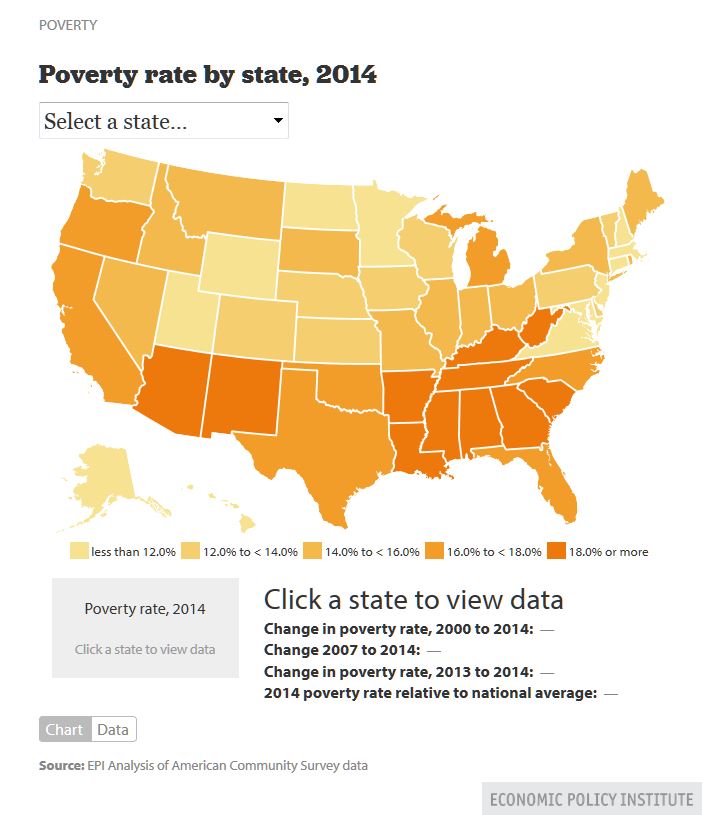
Click here, then click on any state.
Then click on any state to view the data for that state.
Spread the word