What's at Stake in Spain
Jacobin
 A guide to tomorrow’s Spanish election.
 A guide to tomorrow’s Spanish election.
 A new progressive coalition seeks to end Spain's punishing austerity regime and confront the country's staggering unemployment. The new kid on the block has raised the pressure on the center-left Socialists to make a choice: follow the lead of Portugal, where the Socialist Party formed a united front with the Left Bloc and the Communist/Green alliance, or imitate the Social Democrats in Germany and join a "grand coalition" and make common cause with the right?
 The alliance between Podemos and United Left makes them the chief left-wing force in Spanish electoral politics.
 A new progressive alliance could break the stalemate—but whoever wins will face a hamstrung economy and deep discontent with politicians.
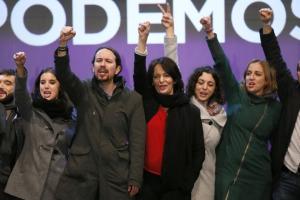 After a year of earthshaking victories and devastating setbacks, Europe's new progressive parties are slowly learning how to balance governance with activism.
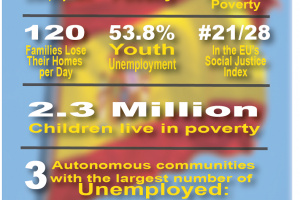 Whatever party ends on top in the Spanish election, it will have to form a coalition, thus ending the reign of the two-party system that has dominated the country since Franco. Late polls show the right-wing PP taking a beating, dropping from 44 percent that it won four years ago to 28%, but it will still win the largest number of votes of any one party. Followed by the Socialists, at 21%, the center-right Ciudadanos Party at 19%, and the left-wing Podemos Party at 15.7%
 In upcoming votes for the European Union's most indebted countries, the left will have to battle both the forces of austerity and a resurgent xenophobic right. The backdrop for elections in Greece, Portugal, Spain, and Ireland is one of deep economic crisis originally ignited by the American financial collapse of 2007-08. The response of the EU is massive cutbacks in government spending, widespread layoffs, and double-digit tax hikes on consumers.
 How Spain's 15M movement went from occupying city squares to city halls-without compromising its independence. An important part of progressives' recent electoral success can be traced to a strong network of locally organized 'social centers' across Spain. These are spaces where community members can interact and share ideas, whether that means organizing a demonstration, taking Zumba classes or checking out library book.
 Reader Comments: Can Women End Korean War?; Countess vs. Communist-Battle to Become Madrid's Mayor; How the United States Strangled Puerto Rico; Obama's Human and Moral Challenge: Oscar López Rivera; The Press and Bernie Sanders; The Female Mathematician Who Changed the Course of Physics;
Appeal by Dr. Kristin Neuhaus, successor to Dr. George Tiller; Cross Borders Concert at the Gaza Strip border;
Today in History - Tiananmen Square Massacre; Angela Davis Acquitted
Reader Comments: Can Women End Korean War?; Countess vs. Communist-Battle to Become Madrid's Mayor; How the United States Strangled Puerto Rico; Obama's Human and Moral Challenge: Oscar López Rivera; The Press and Bernie Sanders; The Female Mathematician Who Changed the Course of Physics;
Appeal by Dr. Kristin Neuhaus, successor to Dr. George Tiller; Cross Borders Concert at the Gaza Strip border;
Today in History - Tiananmen Square Massacre; Angela Davis Acquitted
 Charismatic and tough as nails, the two ideologically opposite women are leading the showdown for the job of mayor of Madrid, in one of the most closely watched electoral battles to emerge from the political and social transformation gripping Spain.
Spread the word