What the Supreme Court Didn't Strike Down Yesterday
The Nation
 Yesterday's victory in the Supreme Court should still be celebrated - but only cautiously so.
 Yesterday's victory in the Supreme Court should still be celebrated - but only cautiously so.
 Chris Kromm and Sue Sturgis at the Institute for Southern Studies argue in the latest issue of The American Prospect that a state can become both more progressive and more conservative at the same time, and that is actually happening in North Carolina -- creating an especially turbulent moment in the state's political history.
 The United States is one of only a few democracies that places the responsibility of registering primarily on each individual voter, rather than making government accountable for ensuring that eligible persons are registered. Not surprisingly, obstacles to registration result in fewer people who are registered to vote. Disparities in voter registration rates directly result in disparities in who votes in any given election, leaving many voices unheard.
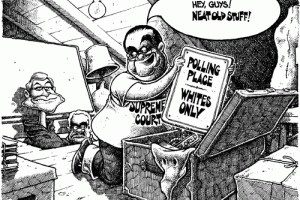
 After today's oral arguments on Section 5 of the Voting Rights Act, it seems unlikely that the Supreme Court's conservative wing will want to uphold the landmark win for civil rights.
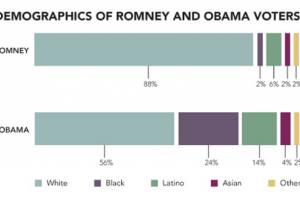 What was most striking about the 2012 election, then, was that in the face of this attack on our right to vote, there was something akin to a popular revolt by the African American and Latino electorate. Latinos voted over 70% for Obama and African Americans over 93%. What happened in the 2012 election was very much about demographics. African Americans, Latinos and Asians turned out in significant numbers, voting overwhelmingly for the Democrats.
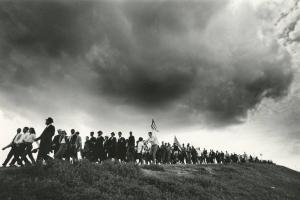 On Wednesday, February 27, 2013, the Court will hear argument in one of the most significant cases of the current term, Shelby County v. Holder, a constitutional challenge to key provisions of Congress’s 2006 reauthorization of the Voting Rights Act of 1965. The preclearance provisions being challenged are viewed as the heart of the Voting Rights Act and are credited with the enormous gains in the enfranchisement of black and other minority citizens.
 The Supreme Court will decide whether to strike a key part of the Voting Rights Act, which conservatives say is outdated and unfair to the South. As many as 5 million votes may have been lost in 2012 had the U.S. Department of Justice not been able to use Section 5 to block voter suppression initiatives in Texas, South Carolina and Florida.
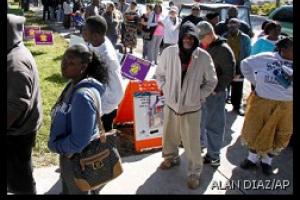 A Florida coalition is working to amend the Florida state constitution so that it guarantees voting accessibility for all citizens—a state-level voting rights act. “We’re focusing on legislation that grants an explicit right to vote in Florida,” says Katherine Culliton-González. “It would aim at big picture issues and make voting a fundamental right so no election law changes could happen that would take us back in time.”
Spread the word