
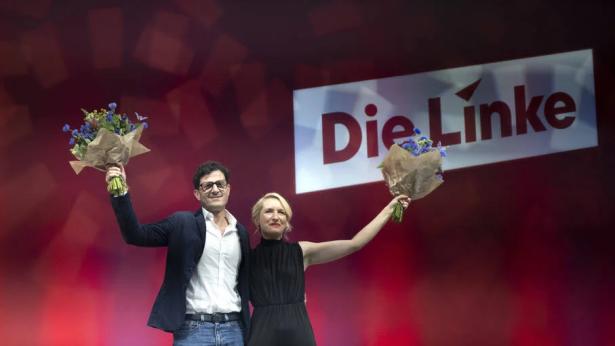
Economic, demographic, environmental, democratic, geopolitical — the multitudinous crises besetting Germany only seem to deepen by the month. The situation may be dire, but the resurgence of Die Linke over the past 18 months has established a much needed counterweight to the incessant right-wing drift of German politics. In August 2026, Die Linke overtook the SPD in national polling for the first time in the party’s history, crossing the 12 percent threshold. And among younger people in particular, democratic socialism is an increasingly appealing alternative to the mainstream consensus of austerity, militarization and xenophobia—one which has pushed the catastrophic possibility of the far-right party Alternative for Germany (AfD) attaining power frighteningly close to reality.
The party’s annual conference, held in June in Potsdam outside of Berlin, saw the party more energized and unified than at any time since the 2000s. A mass of new delegates (more than half attending a party conference for the first time) revealed the changes undergone by the party’s base, which recently doubled its membership to 126,000: there were more women, young people, and those with a family history of migration, more West Germans, and more wearing the Palestinian keffiyeh.
From 3% to Frontrunner
Seemingly fated for oblivion ahead of a federal election in February 2025, the party was polling at 3 percent and harried by the left-conservative Sahra Wagenknecht Alliance (BSW), which split from it a year before. But Die Linke rallied during the campaign under the dual leadership of Ines Schwerdtner and Jan van Aken (who announced he was stepping aside due to health concerns in Potsdam), taking several direct mandates through mass door-knocking campaigns and proving itself a major force on social media. The party beat expectations and won 8,8 percent of the vote.
This year's conference saw the party consolidate its newfound momentum, sharpen its social, economic and foreign policy positions, and debate how to advance itself as a workers' party.
Time to ensure that the fascists, while out of power, never even come close to it again. Time to build counter-power.
Die Linke could lead a state government for the first time in Berlin, where it is in the lead ahead of elections in September. But the urgency of Germany's crisis allows no time for celebration. In the eastern states of Saxony-Anhalt and Mecklenburg-Vorpommern, which also go to the polls next month, only the margins of AfD’s certain victories are open to contest. In her conference speech, Schwerdtner spoke somberly about the challenges ahead: not only the party’s lasting struggle to establish itself as a worker’s party worthy of the name, but a simultaneous fight against the reactionary center and the fascist right.
"We must realize that the best we can achieve in September is to buy ourselves time,” she said. “Time to ensure that the fascists, while out of power, never even come close to it again. Time to build counter-power. Time to become anchored in society.”
Fighting Austerity
In July, the governing coalition of the Christian Democratic Union (CDU) and SPD announced a “Programme for Revival and Employment,” an attempt to revitalize Germany’s dysfunctional economy by rolling back pension entitlements, working conditions and healthcare access.
Schwerdtner has called the measures the greatest assault on the welfare state since Gerhard Schröder’s Agenda 2010 reforms of the early 2000s, which led to Die Linke’s formation. The party has called for nationwide protests against the cuts, attempting to unite unions and social movements under the “Enough is Enough” campaign. The results have been modest so far, but the consequences have only begun to take effect: Citing a predicted shortfall in revenue from the reforms, hospital chain Vivantes walked back an agreement with union Ver.di, leading to a two-month strike in Berlin, seriously affecting patient care.
As a matter of solidarity and credibility, Potsdam conference delegates voted to cap the salaries of deputies at slightly above the average national wage.
To address the cost of living pressure on workers, the party wants a higher minimum wage, cheaper public transport, a nationwide rent freeze and VAT exemptions on essential goods. As a matter of solidarity and credibility, Potsdam conference delegates voted to cap the salaries of Bundestag and European Parliament representatives at slightly above the average national wage. The leadership pushed this measure through against considerable resistance from within the parliamentary party.
Germans might be facing austerity, but for guns the government’s chequebook is open. The government has doubled down on its frenzied remilitarization, allocating 110 billion Euros in next year’s budget to defense spending, which is predicted to account for one-third of all government expenditure by 2030. A lucky few of the tens of thousands of industrial workers facing redundancy may find themselves manufacturing rocket parts for the Israeli Defence Forces or drones to chase Russian soldiers between trenches in Donestsk. Dismal numbers of volunteers to fill the ranks of Germany’s armed forces mean conscription will likely be reintroduced.
Die Linke’s “practical antimilitarism” links barbarisms at home and abroad, proposing that peace and diplomacy be given the highest priority, imperialist military interventions be resisted, and international justice pursued with allies from the Global South. Domestically, it is already assisting young men to register as conscientious objectors, and organising opposition against the transformation of industry toward arms manufacturing. The party has proposed a 20 billion Euro fund for climate investments, backed by stronger worker protections, which could revive the economy, reduce inequality and help Germany reach its climate targets—which the present government has all but abandoned.
Saxony-Anhalt: Holding the Line Against The AfD
The increased antagonism between Die Linke and the CDU is of critical importance in Saxony-Anhalt, where they are the only parties certain to make it into parliament behind the AfD, which is chasing an outright majority with 43% in polls. How many, if any, of the other four parties will clear the 5% entry hurdle will decide what form an anti-AfD alliance might take. Fragile minority coalitions in the neighbouring states of Saxony and Thuringia have kept the AfD at bay so far, but have not required close cooperation between the two parties. According to a leaked internal Die Linke paper mapping out potential post-election scenarios, refusing collaboration with CDU altogether would likely result in the AfD electing a leader in the third round, which only requires a simple majority to break a deadlock.
Whether Die Linke should prioritise protest or governance (with all the compromises it requires) has been a fundamental strategic question since its founding, but the stakes today are higher than ever before.Should the AfD take control of the state’s interior ministry, right-wing extremists could direct its police and intelligence apparatuses against political opponents and minority groups. The local party’s attacks on “un-German” culture, particularly the Bauhaus in Dessau, leave no doubts as to its affinity to the völkisch ideology of the Nazis, who pressured the art school into closing in 1932 when they took control of the local government.
Die Linke will refuse to support any AfD-like policies advanced by the CDU, or any that undermine social and economic rights.
A gaffe by newly-elected co-chair, Luigi Pantisano, only worsened tensions between Die Linke and the CDU. Just days after publicly supporting cooperation with the conservatives in Saxony-Anhalt, he told the party conference that there was “absolutely no difference” between the fascist politics of the CDU and the AfD. A retraction a few days later was rejected by the CDU’s chairman, and Merz reaffirmed once again his party’s refusal to work with Die Linke. Eva von Angern, Die Linke’s lead candidate in Saxony-Anhalt, was particularly irritated by Pantisano: in other states, the party might have the luxury of choosing more suitable coalition partners; she does not.
Die Linke will refuse to support any AfD-like policies advanced by the CDU, or any that undermine social and economic rights. But nevertheless, the so-called firewall (Brandmauer) between the mainstream and far right might soon be a relic of a previous era. Both the BSW and liberals (FDP) now reject it, and the CDU, which is already cozying up to the far-right in the European Parliament in Brussels, cannot be relied upon to maintain the firewall for much longer. Parliamentary arrangements alone plainly will not contain this development. Support for the AfD is now deeply embedded in the social worlds of tens of millions of Germans. Whether Die Linke’s anti-fascist organizing in schools, workplaces, and unions will manage to put up meaningful, long-term resistance to German society’s drift to the right remains to be seen.
A Socialist Mayor For Berlin?
In Berlin, the situation could hardly be more different. Polling in first place under lead candidate Elif Eralp, who is running a Zohran-Mamdani inspired campaign to “make Berlin affordable,” Die Linke has its first chance to implement municipal socialism in the German capital. Alongside the reintroduction of a 9 euro travel ticket and the opening of public canteens, the party has vowed to finally implement the 2021 referendum demanding the expropriation corporate landlords, which passed with 59% of votes cast. The move would take hundreds of thousands of apartments into public ownership. Over the past decade, rents have risen faster in Berlin than almost any major European city.
The revival of the expropriation campaign, which the incumbent CDU-SPD Berlin government had simply refused to even consider, has drawn immediate hostility from the right and center. In early July, the federal government announced plans to legally prohibit German states from expropriating private landlords––which Die Linke has has criticised as unconstitutional. The primary target, already identified by Eralp, will be Vonovia, a DAX-listed real estate giant which owns 138,000 apartments in the capital, many of which were once state-owned until mass privatisation in the 2000s.
More quietly, Die Linke have also proposed cutting funding and powers to police––a welcome change from the CDU’s proclivities to use fences, security cameras and police batons to address drug use, petty crime and peaceful pro-Palestine marches. Despite a low crime rate, Berlin has significantly more police officers per resident than New York.
On the first day of the party conference delegates voted both to describe Israel’s war there as a genocide, and recognize Israel’s continued right to exist.
A return to the Red-Red-Green coalition of Greens, Die Linke and SPD is, however, far from certain. The SPD’s lead candidate has absolutely ruled out expropriation or cuts to the police’s budget. In interviews, party head Ines Schwertner has insisted upon implementing the referendum. The strategic value of this position is self-evident: Only by achieving a reversal of neoliberal privatisation— which the political mainstream has claimed is impossible—will a socialist agenda gain nationwide credibility.
However late in the day, the party has also begun to take a clear stance on what has been its most divisive issue: Palestine. Much of the first day of the party conference was taken up with discussions around Gaza—with delegates ultimately voting both to describe Israel’s war there as a genocide, and recognize Israel’s continued right to exist. As incongruous as these positions may seem, they mark a significant shift for the party, whose equivocation around Gaza has severely damaged its reputation among the international left. Though opinions do not break cleanly along generational lines, the influx of young pro-Palestine members—its youth branch recently described Israel as fundamentally racist and colonialist—has undoubtedly offset the pro-Israel sympathies of many older members. Still, positions in line with other European socialist parties, whether principled anti-Zionism or the economic and cultural boycott of Israel, remain unthinkable for Die Linke—and would isolate it from potential coalition partners. How to engage with other parties will be a central question after the elections in September, when the influx of new members and Die Linke's principled stand against fascism and austerity may pay off.
Ruairí Casey is a freelance journalist based in Berlin.
The Rosa Luxemburg Foundation is one of the largest political education institutions in the Federal Republic of Germany, and part of the broader international democratic socialist movement.
Spread the word