In the Future, Will There be Any Work Left for People to Do?
Fortune
This is a precedent setting agreement for the Twin City region, Minnesota and even the nation. Many of the workers affected by this new deal with Target represent a segment of the work force that has often been considered “unorganizable.” Language barriers and use of immigration status to threaten workers have all been contributing factors in explaining the difficulty in organizing vast segments of low-wage workers in the United States.
“If they can get you asking the wrong questions, they don’t have to worry about answers.” Progressives have all kinds of ideas to shape a more equitable primary distribution. But those ideas will never get much oxygen if we remain voluntary trapped in the cramped debate of a short-sighted economics.
Corporate interests have taken credit for reducing private-sector unions to a fraction of their former strength, and for eroding public-sector collective bargaining, especially since the 2010 “Tea Party midterms.” A resurgence in low-wage worker organizing, sparked by growing inequality in the United States, promises to help defend the rights—and paychecks—of vulnerable workers. But corporations and their paid shills aim to snuff out the movement before it catches fire.
Inside squalid quarters, bedrooms are so crowded that men must sleep three to a stack — one on the upper bunk, one on the lower bunk and one below the lower bunk, separated from the floor by only a thin pad for a mattress. In the space between the beds, the men pile cauliflower, onions and sacks of Basmati rice to cook after working all day and washing the construction dirt from their clothes. Exposed wiring hangs from the ceiling, and cockroaches climb the walls.
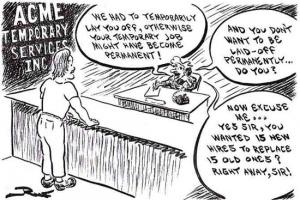
"Workers increasingly serve businesses that do not officially 'employ' the worker — a distinction that hampers organizing, erodes labor standards and dilutes accountability," said Catherine Ruckelshaus, general counsel for the National Employment Law Project, which advocates on behalf of low-wage workers. A recent Federal Reserve study showed that nearly 7.5 million people who are working part time — contract workers included — would rather have full-time jobs.
Spread the word