Canadian, U.S. Unions Push for Wage Hike Amid NAFTA Talks
New York Daily News
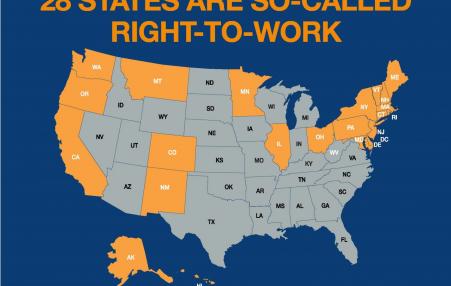
If New Hampshire, Missouri and Kentucky succeed in enacting "right-to-work" bills, it would be the most states rolling back union power in one year since 1947, according to the National Conference of State Legislatures. Success in New Hampshire would also make it the first state in the Northeast with a "right-to-work" law. The bills are a further reflection of organized labor's falling clout. Just 10.7 percent of American workers belonged to a labor union in 2016.
That states can pass laws banning mandatory union dues is not new. Congress amended labor law in 1947 to allow individual states to pass right-to-work laws.
“How it affects the workforce is really simple: It lowers wages,” said Stephen Herzenberg, executive director of the Keystone Research Center. “If you strip it to its core, this is about reducing the power of workers to bargain for a decent living.”
It compares the right-to-work law with laws passed in Southern states in the 1950s as part of the massive resistance to the U.S. Supreme Court’s desegregation orders in Brown v. Board of Education, with legislation intended to discourage membership in the NAACP — laws that were ultimately overturned in court for violating 1st and 14th Amendment rights of free expression and association.
Last week, the Republican-controlled legislature in West Virginia overrode a veto by Democratic Gov. Earl Ray Tomblin, making the measure officially law. The story of how West Virginia got to that point is a boiled-down version of the changes America has undergone over the past half-century — the pain of de-industrialization, the shift in political power, the casting about for anything that might create jobs.
Manitowoc Company in northeast Wisconsin is a preview of the future for what workers will face as states pass "right-to-work" legislation. Over 200 workers went on strike there four years ago. Workers say they think the company set up the workers and union to set the stage for right-to-work and other antiunion laws.
As more states feel they’ve been put at a competitive disadvantage by their right-to-work neighbors, the pressure only increases to follow suit and enact their own right-to-work laws. And after a while, a national right-to-work law might not be far behind.
“I suspect that will happen within the next decade,” says Marquita Walker, an associate professor of labor studies at Indiana University.
Spread the word