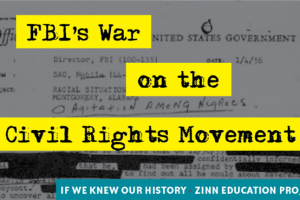
Why We Should Teach About the FBI’s War on the Civil Rights Movement

Ursula Wolfe-Rocca Zinn Education Project
On March 8, 1971—while Muhammad Ali was fighting Joe Frazier at Madison Square Garden, and as millions sat glued to their TVs watching the bout unfold—a group of peace activists broke into an FBI office in Media, Pennsylvania, and stole every document they could find. These documents revealed an FBI conspiracy—known as COINTELPRO—to disrupt and destroy a wide range of protest groups, including the Black freedom movement.

Free College for All: An Idea Whose Time Has Come (Again)

Stephen Brier The Indypendent
The ideology and practice of neoliberalism, resulting in rising inequality and the imposition of austerity policies, brings us to the national debate about whether it is appropriate for public funds to underwrite the costs of public higher education or whether higher education is essentially to be seen as a private good and an individual (or familial) responsibility.

It Didn't Start with Stonewall

Peter Montgomery The American Prospect
A new history deepens our understanding of the origins of the gay rights movement and the transformation it has brought about.

Tidbits - February 18, 2016 - Reader Comments: Protest Music; How Social Change Happens; Bernie, Hillary, Kissinger and Scalia; Announcements and more...

Portside
Reader Comments: How Social Change Happens; Bernie, Hillary, Kissinger and Scalia; AFL-CIO Election Survey; DNC Lets Lobbyists Back In; Bernie as the Peace Candidate and Remembering 1972; Teaching - With Protest Music; Obama's Military Aid to Israel; Announcements - 50 Years After the Mississippi Summer Project; Slavery and the Making of American Capitalism; Labor for Bernie and Beyond - National Meeting;

Black Culture and History Matter

Kirsten Mullen The American Prospect
It took 150 years after America officially abolished slavery to get a national museum on the black experience.

February 4 - Rosa Parks Birthday; How History Got the Rosa Parks Story Wrong

Jeanne Theoharis The Washington Post
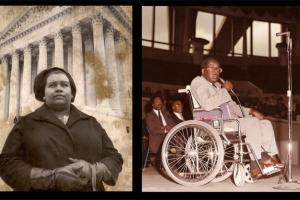
Rosa Parks was a lifelong activist who had been challenging white supremacy for decades before she became the famous catalyst for the Montgomery bus boycott. We see a woman who, from her youth, didn't hesitate to indict the system of oppression around her. As she once wrote, "I talked and talked of everything I know about the white man's inhuman treatment of the Negro." Today we honor her, as part of African American History Month.

What Can Be Learned from Hillary Clinton's Slurs Against Reconstruction

Ryan Cooper The Week
Monday night, Hillary Clinton butchered Reconstruction's history. It's a good opportunity to correct the record, and glean why Lincoln really was America's greatest president. Reconstruction in reality was a briefly successful attempt to build a true democracy in the South. Clinton implies that it was Southern anger at unjust Reconstruction policy that led them to institute Jim Crow, but Jim Crow was the goal from the very end of the war.

books

Joe Hill Again!

Paul Buhle Portside
The centennial celebration of Joe Hill's execution is being marked by concerts, symposiums, meetings and forums, and the publication of new books, or new editions. Labor historian Paul Buhle reviews two of these. Franklin Rosemont's Joe Hill: The IWW & the Making of a Revolutionary Workingclass Counterculture, with a new introduction by David Roediger; and Philip S. Foner's The Letters of Joe Hill, with new material by Alexis Buss and foreword by Tom Morello.

Bringing Socialism Back: How Bernie Sanders is Reviving an American Tradition

Joseph M. Schwartz In These Times
The Sanders campaign is resurrecting socialist electoral politics and paving the way for a more radical public discourse. Only the revival of a decimated labor movement and the rebirth of socialist political parties that can bring them all together could result in the major redistribution of wealth and power that would allow real movement on these individual issues.
Subscribe to U.S. history