
- Marwan Barghouti, Hamas and Palestine’s Future
- Denmark’s Linke
- Clampdown in Ankara as NATO Meets
- Ecosocialist Encounters
- ‘Woman, Life, Freedom’ and the Iran War
- Armenia’s Elections
- Remembering the Oaxaca Commune
- Indonesia: More Than a Student Protest
- African States’ Goal: Reparatory Justice
- Díaz-Canel on Cuba, Socialism and the Workers
Marwan Barghouti, Hamas and Palestine’s Future
Muhammad Shehada / London Review of Books
Barghouti enjoys unparallelled popularity and is often described as Palestine’s Nelson Mandela. Like Mandela, he’s far from perfect, but his activism, his writings and his long imprisonment have made him a legend. His power and influence are unique. Releasing Barghouti would be a step towards unifying the Palestinian leadership and energising the masses.
__________
Albert Scharenberg and Pelle Dragsted / Rosa Luxemburg Stiftung (Berlin)
Our goal [Enhedslisten] is not just a little bit more money for this, and a little bit more money for that – that’s the traditional social democratic approach. We believe there are things that need structural change, so we need to alter power relations. We need to de-commodify. And that’s exactly what we were able to do with dental care: We converted it into a social right.
__________
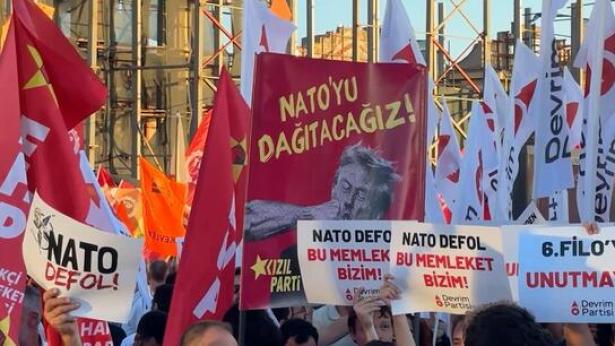
Clampdown in Ankara as NATO Meets
Ruth Michaelson / The Guardian (London)
Authorities in Turkey have widened a crackdown on public life, arresting more than 200 people during raids across Ankara last month, jailing a comedian and blocking a cruise ship carrying LGBTQ+ passengers from docking in the run-up to the Nato summit in the capital. The arrests followed a ban on demonstrations in Ankara that was put in place until 10 July.
__________
William van den Heuvel / Europe Solidaire Sans Frontières (Paris)
In May 2026, more than 250 activists from some forty countries gathered in Brussels Université libre for the 7th International Ecosocialist Encounters. An apparent diversity of themes pointed toward a single strategic insight: that these separate struggles share one crisis, and can only be turned around together.
__________
‘Woman, Life, Freedom’ and the Iran War
Saeedeh Fathi / Women’s Media Centre (Washington DC)
In the months since the U.S. and Israel launched their joint assault on the Islamic Republic of Iran, the “Zan, Zendegi, Azadi” movement — known internationally as the “Woman, Life, Freedom” movement — has yet to articulate a clear public position on the war. Feminist responses have been diverse, with contradictory and dispersed reactions.
__________
Mikael Zolyan / Posle (Berlin)
Can Armenia’s recent elections really be reduced to a contest between a pro-Western Pashinyan and a pro-Russian opposition? To what extent was the outcome driven by foreign policy considerations alone? What is happening inside the country on issues such as labor rights and extractivism? And where does the Armenian left stand today?
__________
Remembering the Oaxaca Commune
Gerardo Rénique / Crónica Sonora (Hermosillo, Mexico)
[Moderator’s note: Use your search engine’s translator to read in English.]
June 14th marks the twentieth anniversary of the popular and citizen uprising in the state of Oaxaca, one of the most significant political and social mobilizations in the country so far this century. For nearly six months, a diverse array of organizations, collectives, unions, Indigenous authorities, and citizens in general, coordinated through the Assembly of the Peoples of Oaxaca (APPO).
__________
Indonesia: More Than a Student Protest
Farheen Hussain / Asia Media Centre (Wellington)
Marching in Jakarta under the slogan Menuju Indonesia Bangkrut (“Heading Towards Bankruptcy”), more than 1,000 protesters demanded lower fuel and food prices and an end to what they described as wasteful government spending. But beneath the chants, placards and clashes with police lay a deeper anxiety about the future of Southeast Asia’s largest economy.
__________
African States’ Goal: Reparatory Justice
Al Jazeera (Doha)
A conference on slavery and reparatory justice held in Accra is still resonating across Africa and the Caribbean. The three-day “Next Steps” conference brought together heads of state, policymakers, academics, legal experts, civil society groups and African diaspora representatives to discuss the long-term consequences of the transatlantic slave trade and ways to advance reparatory justice.
__________
Díaz-Canel on Cuba, Socialism and the Workers
Miguel Díaz-Canel / World-Outlook (Golden CO)
The Federation of Cuban Workers (CTC) held its 22nd congress in Havana, Cuba, on June 26-27, 2026. Delegates from every province on the island discussed the new economic and social measures adopted nine days earlier by the National Assembly of People’s Power, the country’s highest legislative body. Cuban president Díaz-Canel spoke to the delegates at the conclusion of the congress.
Spread the word