
Columbia, Other Universities, Systematically Suppressed Pro-Palestinian Speech, ACLU and Amnesty International Report Alleges
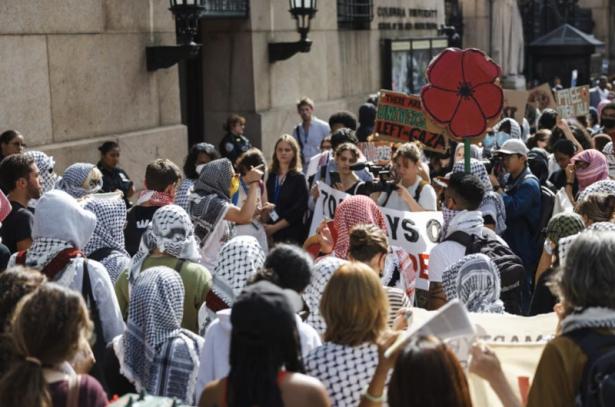
The 322-page joint report is the result of a two-year investigation that covered 80 universities across the country. | Photo by Jackson Dilks / Deputy Photo Editor / Columbia Spectator
Columbia, alongside other U.S. universities, systematically suppressed pro-Palestinian speech, the American Civil Liberties Union and Amnesty International USA claims in a Sept. 23 report.
The report alleges that Columbia suspended student groups for peaceful protest in an “unlawful” manner that exposed student activists to “excessive force” by calling law enforcement to campus, and was disproportionately harsh in its issuance of suspensions and expulsions against activists.
The analysis used the University’s disciplinary responses, concessions made in negotiations with the federal government, and testimony from student protesters and other University affiliates to substantiate its findings.
The 322-page document comes after a two-year investigation that covered 80 universities across the country. Columbia is featured as one of the report’s six university case studies.
Jennifer Turner, principal human rights researcher at the ACLU and main author of the report, told Spectator that, during the course of the investigation, “what became clear was that there’s a really widespread pattern of suppression of speech” across U.S. universities.
In addition to Columbia, the report provided detailed case studies on the City College of New York; the University of California, Los Angeles; the University of Michigan; Tulane University, and the University of Texas at Austin. Turner explained that they had chosen those universities because they were “particularly problematic” in their responses to student protests.
“Columbia, we included for a number of reasons having to do with its response being particularly punitive,” Turner said. She added that Columbia was also featured due to the federal government’s “attempts to weaponize the civil rights laws to force, of course, universities like Columbia into broad-ranging agreements that are frankly unconstitutional.”
“Our University rules clearly establish how members of our community can exercise their free speech rights, regardless of their viewpoint, while respecting the rights of others to study, teach, research, and participate fully in campus life,” a University spokesperson wrote in a statement to Spectator. “Protest and activism have been a part of the fabric of Columbia for decades. The University regulates the time, place, and manner of protests in a content neutral manner to ensure we can fulfill our academic mission.”
Response to campus protests
Columbia gained notoriety as a hotspot for student protests following Hamas’ Oct. 7, 2023, attack on Israel and the start of Israel’s war in Gaza. An Amnesty International investigation the same year stated that Israel’s actions in Gaza amount to genocide, accusations which the Israeli government has denied.
Tensions on campus remained high, peaking during the April 2024 “Gaza Solidarity Encampment.” After President Donald Trump returned to office in 2025, his administration cut $400 million in federal funding to Columbia, later alleging that the University had violated Title VI of the Civil Rights Act of 1964 by failing to prevent antisemitism during pro-Palestinian protests. The University issued a list of commitments to the federal government in March 2025, and in July 2025, the University agreed on a $221 million settlement with the federal government to restore the “vast majority” of its funding.
“Columbia’s capitulation only emboldened the administration to keep up these kinds of attacks,” the report states.
The report includes information from a questionnaire distributed to student protest organizers from October 2024 to February 2025. The questionnaire asked participants about their experience at demonstrations and whether they experienced an “excessive use of force by law enforcement and campus security, use of crowd control weapons, and arrests, among other issues.”
The report alleges that universities violated free speech rights by calling on law enforcement to arrest pro-Palestinian protesters, resulting in “unlawful and unnecessary use of force.” Citing disciplinary actions such as expulsions and suspensions, the investigation also discovered that universities’ responses to pro-Palestinian advocacy were “more punitive” in comparison to their historical responses to other types of demonstrations “over decades.”
The report describes this imbalance as being particularly stark at Columbia, which has a rich history of student activism stretching back past 1968.
The report argues that while past protests often involved tactics such as sit-ins, building occupations, and blockades similar to those used in recent years, punishments have become significantly more severe.
Since 2023, Columbia has asked the New York Police Department to assist in handling pro-Palestinian protesters, including at the “Gaza Solidarity Encampment,” during which the NYPD made a total of 217 arrests, and at the May 7, 2025, protest at Butler Library, which resulted in 78 arrests.
“We also conducted interviews and meetings with students and faculty, where we learned more about the ongoing disciplinary punishments and punitive punishments of students and faculty involved in activism, as well as instances of censorship and suppression of speech and association that’s been ongoing,” Turner said.
In total, the report estimates that more than 100 students who participated in pro-Palestinian demonstrations at Columbia received severe punishments, including expulsion, suspension, and revocation of academic degrees.
“By doing so these universities directly or indirectly have made it easier for the Trump administration to crack down on student activism, causing long-term damage to higher education,” the report notes.
Crackdown on international students
The report includes a series of case studies on six individuals it describes as being targeted “solely because of their political viewpoints and constitutionally protected expression” by Immigration and Customs Enforcement.
“The Trump administration has crafted and carried out a policy of revoking the visas and green cards of noncitizen students and scholars who engaged in pro-Palestinian advocacy, and of arresting, detaining, and deporting them,” the report alleges.
Four of these individuals are Columbia affiliates: Mahmoud Khalil, SIPA ’24; Mohsen Mahdawi, GS ’25, SIPA ’27; Yunseo Chung, CC ’26; and Rümeysa Öztürk, TC ’20.
Turner said that, “in cases of Columbia students,” the Trump administration “had no evidence whatsoever to support the revocation of their visas, for instance, or their attempts to revoke their green card, and in fact went ahead and pursued this despite it being these actions being based entirely on constitutionally protected lawful speech and association.”
In a statement to Spectator, a spokesperson for the Department of Homeland Security wrote, “It is a privilege to be granted a visa or green card to live and study in the United States of America. The Trump Administration has acted well within its statutory and constitutional authority with any alien who advocates for violence, glorifies and supports terrorists, harasses Jews, and damages property.”
Barnard
Barnard is also included as an example of where the report alleges a school overreacted to student protests.
“The expulsions of two Barnard College students in February 2025 for their participation in a protest disrupting a History of Modern Israel class mark the first official expulsions for nonviolent political protest on a Columbia University campus since 1936,” the report notes.
During the incident, masked student demonstrators entered a Columbia classroom, gave a speech alleging that the University was normalizing genocide, and handed out flyers, one of them depicting a boot stomping on the Star of David alongside the words “Crush Zionism.” Two of the protesters who were affiliated with Barnard were subsequently expelled.
“When rules are broken, when there is no remorse, no reflection, and no willingness to change, we must act,” Barnard President Laura Rosenbury wrote in a statement to Jewish Insider at the time.
The report also includes a Sept. 18 letter from Akilah Rosado, interim dean of Barnard and vice president of inclusion and belonging, responding to the ACLU and Amnesty’s findings.
“Barnard’s approach to conduct matters is careful and fact-specific. While your letter suggests that Barnard’s response to the ‘History of Modern Israel’ disruption was ‘more punitive’ than its response to other (unspecified) incidents, we are not aware of any comparable incident in which Barnard students intentionally targeted and shut down an academic class,” Rosado wrote.
Recommendations for free speech and expression
The report included a list of recommendations for both universities and the federal government to uphold First Amendment values.
The report called for universities to allow students to demonstrate in multiple areas of campus, including “outdoor, high-traffic locations,” during a broad time period. Another recommendation was to ensure that students are able to “spontaneously protest in response to unanticipated events, when speech is often the most essential.”
Columbia’s chapters of Students for Justice in Palestine and Jewish Voice for Peace were both suspended in November 2023, following a series of violations of the University’s event policy regarding when and where students could protest. Seventeen days before the University suspended the pro-Palestinian student groups, Columbia added a new section to its University Event Policy web page, emphasizing the administration’s power to “regulate the time, place and manner of certain forms of public expression.”
“Universities cannot impose their rules specifically because of the content of the protest, simply because the university finds it divisive or abhorrent or problematic in some way that isn’t unlawful,” Turner said.
The University has since further narrowed the circumstances under which protests can occur, and the current Rules of University Conduct do not allow for spontaneous protests on certain dates. As stated in the 2026 prenotification policy, “During periods of increased activity or heightened risk of disruptions to University functions, pre-notification is required at least 48 hours (two business days) in advance.”
The recommendations also tackled anti-discrimination policies, asking universities to refrain from policies “that rely on overly broad and vague definitions, including definitions of antisemitism,” that can lead to violations of “lawful political speech.”
In 2025, the University adopted the International Holocaust Remembrance Alliance’s definition of antisemitism, a decision that received pushback from activists on campus.
“The new commitments to ‘combat antisemitism’ are a dangerous escalation of Columbia’s commitment to silencing opposition to genocide,” Columbia JVP wrote in a statement to Spectator following the adoption.
The report also stressed the role of universities in protecting student privacy, specifically by resisting “unlawful government requests for personal information” and rejecting “any federal pressure to surveil or punish noncitizen students and faculty for their lawful speech.”
“I hope it documents what has happened and is happening, and showing that both the pattern of suppression of free speech, showing that it’s still going on today, and that there’s a profound chilling effect because of both universities’ actions and the Trump administration’s actions that we are experiencing,” Turner said.
[Staff Writer Simon Leton can be contacted at simon.leton@columbiaspectator.com. Follow him on X @simonoleton.
University News Editor Emily Pickering can be contacted at emily.pickering@columbiaspectator.com. Follow her on X @emilypckk.]
Spread the word