
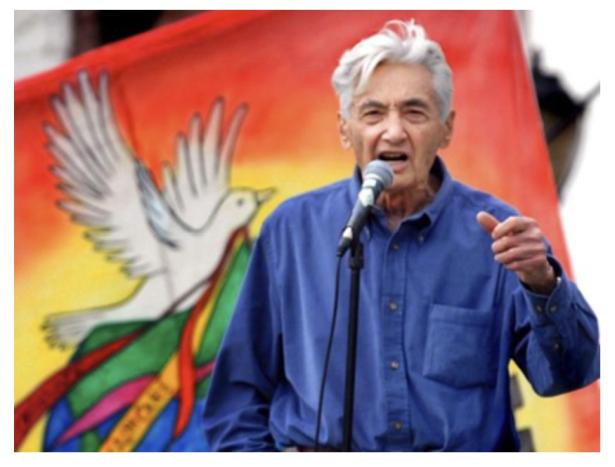
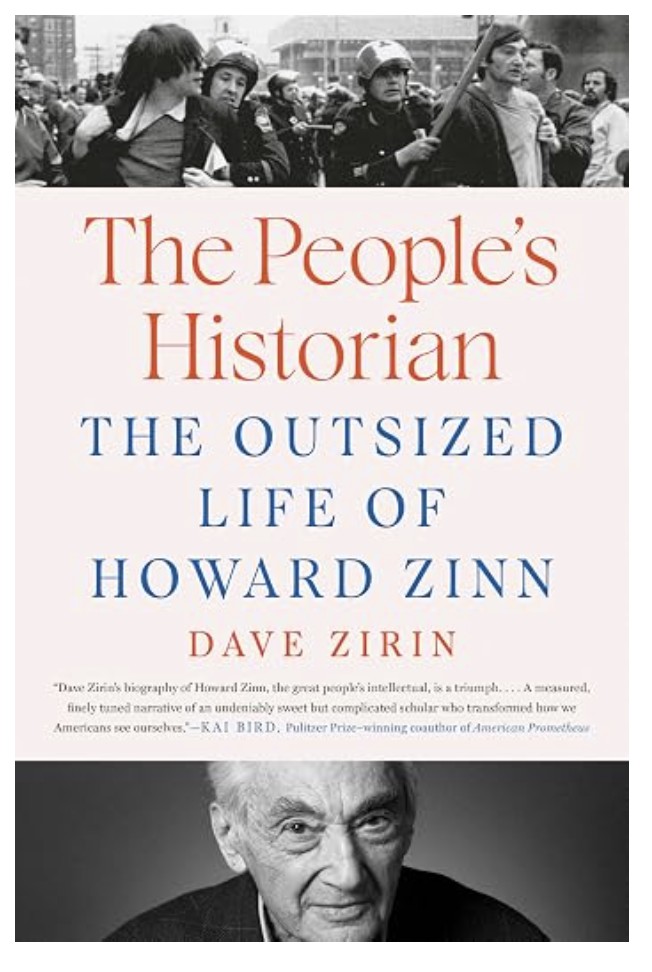
The People’s Historian: The Outsized Life of Howard Zinn
by Dave Zirin
Dutton Books; 320 pages
Publication date: August 4, 2026
Hardcover: $33.00; Pre-publication offer (Aug. 4, 2026: $30.76 (Social Justice Books of Teaching for Change - All orders support local bookstores)
ISBN-10 : 0593473655
Oversize personalities converge, if this is not a frivolous way to introduce or, for most readers, reintroduce subject and author, Howard Zinn. More than fifteen years after his death, he evidently remains a terrible menace—to the people around Trump, who surely wrote this phrase for the president’s mouth: “Our children are instructed from propaganda tracts, like those of Howard Zinn, that try to make students ashamed of their own history.” (11).
Trump himself may have never even heard of Howard Zinn. Yet Zinn’s work and life stand against what Trumpians seek to do to US history and today’s hardly-surviving democratic institutions. Author Dave Zirin is also himself sui generis, sports journalist/historian and (according to the book jacket) the very first sports editor in the august history of the Nation magazine!
Taking on the life of Howard Zinn is no small task. You Can’t Be Neutral On a Moving Train, Zinn’s 1994 memoir (I happened to review it for the Nation) covered a lot of space and very eloquently, indeed. Zirin speaks up here because, as he says, a whole lot of people ask even now, “What would Howard say?” That is, about the catastrophic events at present, with their weighty historical implications. It’s a good question. Since the great historian and public personality passed, things have definitely gotten worse.
If Zirin renews Zinn’s own look backward in the memoir, the burden of this book is to offer a fuller biographical picture, and to bring us up to date on Zinn’s lasting importance. Zirin’s access to the author-activist’s notebooks, along with access to his friends and his family, including son Jeff and daughter Myla, becomes more and more important as we read along.
We learn more about Roz, the courageous companion with her own distinct contribution to the struggles. And we learn about the children who cheerfully took up and continue on with the work. Notably, and not only for culture devotees is the family friend of the Brookline 1970s neighborhood, young Matt Damon, who traces his understanding of society to the friendly dad almost next door, and who himself made a crucial commitment to carrying the message onward.
But perhaps we should first go back to basics and to heavily Jewish and working class Brooklyn in the first decades of the twentieth century. Son of a casual laborer from Eastern Europe who managed to become the waiter who took his son along to the best jobs, “Howie” read furiously. As a teen, Howard instinctively joined a demonstration in Union Square that faced off against mounted police, and naturally asked around about the Communist Party leading the struggle. By the time he passed the civil service test to qualify for a job at the Brooklyn Navy Yard, he already considered himself a revolutionary and a lifetime unionist. No less important, he met Rosemary Schechter, an autodidact reader-radical like himself. By the time they married, he was heading off to the air force aka the Wild Blue Yonder of the crusade against fascism.
Unlike the bombardier of legend, of comic books, films and novels, the real-life volunteers had a reputation of self-taught intellectuals. Many of whom, like Zinn himself, had begun before the end of the war to doubt the morality of anonymous mass killing thousands of feet below. During his final months in the air, Zinn consoled himself that planes like his could safely drop low enough to offer food and medicine to desperate civilian populations. A large handful of his comrades, meanwhile, didn’t make it back. “Never again” were his own last words as an airborne soldier.
Zinn had already met men of color in numbers in the Naval Yard and his views of their situations had deepened. He went onward after varied experiences well covered in his memoir, to teach at Spelman College and there, in 1960, to make direct contact with the rising civil rights movement, as teacher, as activist and as journalist (a widely read report on Spelman in the Nation). Zirin reveals to us that he has Zinn’s old address book in hand, and the first address in it is Ella Baker, the great black civil rights leader, a founder of SNCC and a decisive personal connection between the Left past and then-present. The FBI would have known that his old connections with the CP were long gone but his opposition to the Cold War had already set him up for decades of redbaiting by turncoat former socialists as well as avowed reactionaries.
If Dr. King brought a moral/spiritual dimension and a politics new to the Movement, Zinn might be said to have brought back something from the mobilizations of the 1930s-40s. Almost from the time he settled in at Spelman College in 1958, he inspired students and also taught them political tactics. The sedate-sounding Social Sciences Club had already committed itself to civil rights before he arrived. He schooled them and others to take the leadership upon themselves. He joined demonstrations boldly, actually supporting the black coeds who had already moved ahead.
One of his students destined for fame, future novelist Alice Walker later recalled, “He was a participant with you, not over you.” (p.108). And he was personally courageous. SNCC notable Bob Zellner called him “one of the most-jailed, most-beaten, most-respected SNCC figures,” handsome and optimistic despite the odds (p.111). The Anti-Defamation League (ADL) and NAACP had already placed him under their own version of suspicion. You might say that Howard or Howie Zinn had already become HOWARD ZINN, public figure, without ceasing to the strategist and tactician admired up close by the admiring youngsters in SNCC.
The US War on Vietnam offered another dimension, new allies and hardened liberal as well as conservative, opponents by the time the high-handed Spelman administration had fired him in 1962. Working from Boston, he had a peaceful army of activists around him, mostly but by no means entirely young, full of idealism and energy but not excluding hotheads or Marxist sectarians. He withstood attacks on all sides while becoming more and more a national figure. The 1960s anti-war movement saw many great speakers in constant demand from the growing audience. None was more in demand than Zinn.
Or placed under more suspicion. Along with Father Daniel Berrigan, Howard flew to Asia to bring home two American flyers aka bombers, as per a prisoner exchange. The two became marooned in Laos, unable to reach North Vietnam or return home, a poignant reminder to Roz of waiting for him in the midst of the Second World War.
Zinn was, of course, good friends with Daniel Ellsberg and their friendship is part of the Pentagon Papers episode that, in its own way, made the War and Nixon’s presidency impossible. Compared to this drama, the conspiracy of the Boston University administration against Howard somehow pales. He was always, predictably, bigger than his enemies.
A People’s History and the various emanations from its renown take up much of the rest of the book, and for good reason. Charles and Mary Beard’s Rise of American Civilization, read by a higher percentage of ordinary Americans than any other national history before or since, remains a landmark. A People’s History is surely second in line. Its critics point to something less-than-perfect but without diminishing the continuing power of the text for young people in particular.
An attempted TV series organized in part by Matt Damon and Ben Affleck got nowhere with the networks. “The People Speak,” a 2009 film production with famed actors (think Morgan Freeman and Viggo Mortenson among others) and musicians (Bob Dylan, Bruce Springsteen) reached a wide audience. His own plays—as a young man, he had dreamed of writing and producing theater—on Emma Goldman and Karl Marx reached college productions in particular.
More, much more could be said but is best left to the fortunate reader of this remarkable book. I want to part on this note: he died on tour. As Robin D.G Kelley would say after meeting and hearing Howard, “he didn’t have time to be famous” (p.249), because he wanted to know what people were doing, no doubt what they would go on doing—with his inspiration—when he was gone. ##
[Paul Buhle edited the graphic novel, A People’s History of American Empire, the adaptation of Zinn’s work, with Mike Konopaki doing the artwork and Dave Wagner writing most of the text.]
Spread the word