
- The Limits of BRICS
- More on the Win in Berlin
- Arab Parties Blocked in Israel
- Environmental Strategies for Puerto Rico’s Communities
- Bello: What Happened to the NPA Philippines?
- Marching Everywhere for Justice
- Why China Wants Myanmar’s Junta to Win
- How the Mexican Left Defined Itself
- Indigenous Governance to the Climate’s Rescue
- Patricio Guzmán 1941-2026
The Limits of BRICS
Manuel Medina / Aporrea (Caracas)
[Moderator’s note: This is an excerpt from an article that originally appeared in Spanish. Lee aquí el texto original del artículo completo.]
The meeting between representatives of Iran and the United Arab Emirates helps to understand another characteristic of the group. Both accepted a declaration calling for restraint and the protection of the civilian population. The Iranian president also met with the crown prince of Abu Dhabi. It was an important diplomatic contact between countries at odds over the war, although it did not resolve their differences.
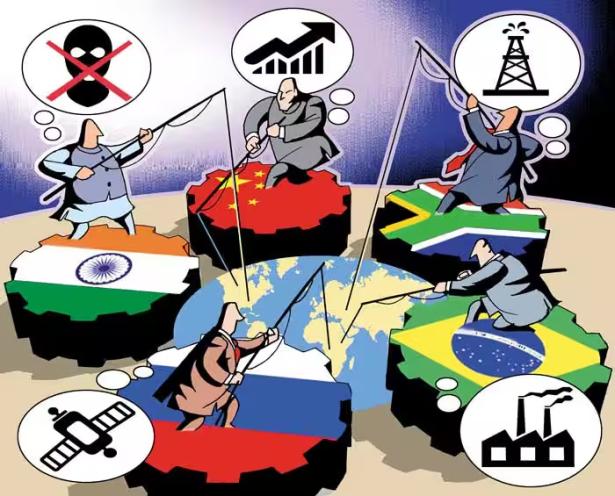
The BRICS allow for dialogue and concrete agreements. However, its members do not form a unified team that always acts with a single purpose. Each government protects its alliances, its companies, and its needs. They may collaborate on one issue and compete on the next.
China needs buyers for its products. India wants to develop its own industries, which can compete with China’s. Energy exporters seek customers, while buyers seek favorable prices. Sharing an acronym doesn't eliminate these differences. Nor does it make all its members advocates for the same causes.
A RICHER COUNTRY CAN HAVE POOR WORKERS
When it’s announced that an economy is growing, it's often unclear how the benefits are distributed. Exports can increase while wages barely rise. A company can conquer foreign markets and demand more effort from its workforce. The success celebrated by a government or certain social classes can be perceived very differently in a corporate office than by factory workers.
This also happens when a country sells raw materials to another BRICS member. If it exports cheap minerals and then buys expensive industrial products, it may still depend on others for machinery and technology. Changing buyers doesn’t mean it controls a larger share of the business.
To know if a trade relationship improves that situation, we must look at its results. Are manufacturing skills being learned within the country? Are jobs with full rights being created? Do the revenues allow for improvements in healthcare and education? Do communities continue to retain their lands? These questions reveal infinitely more about development than a signing ceremony.
Several powerful nations do not guarantee a just world.
More on the Win in Berlin
Contradictory Victories Elias König and Immanuel Nikelski / Rosa Luxemburg Stiftung (Berlin)
Antisemitism Allegations Against Die Linke / Agence France-Presse (Paris)
Hope for Immigrants Shola Lawal / Al Jazeera (Doha)
Mamdani’s Role Steven Methven / Novara Media (London)
SPD in Decline Sabine Kinkartz and Max Hofmann / Deutsche Welle (Berlin)
Housing is the Issue Nette Nöstlinger / Politico (Brussels)
Meet Elif Eralp Fatma Aydemir / The Guardian (London)
__________
Arab Parties Blocked in Israel
Caolán Magee / Al Jazeera
Israel’s Central Elections Committee has voted to bar the country’s two main Arab-majority political lists from next month’s parliamentary election. The committee also voted to disqualify Ofer Cassif, a Jewish politician from the Arab-Jewish Hadash party, and Sami Abu Shehadeh, the leader of the Palestinian nationalist Balad party.
Environmental Strategies for Puerto Rico’s Communities
Luis Joel Méndez González / Prism (Vancouver)
As another anniversary of Hurricane Maria approaches, and Puerto Rico continues to face unique and pressing climate challenges, the pressure to strategize thoughtfully is growing. Coalición Paseo Responsable, a coalition of environmental groups, residents, business owners, and surfers understands the importance of global forums, but as a nascent organization, its focus is elsewhere.
Bello: What Happened to the NPA Philippines?
Walden Bello / Foreign Policy in Focus (Washington DC)
At the launch of his book Deeper Ground, Darker Shadows in Manila a few weeks ago, Eddie Quitoriano asked, “How did the New People’s Army’s image change from being the ‘Nice People Around’ to one of being only interested in imposing revolutionary taxes and obtaining weapons?”
Marching Everywhere for Justice
Madrid: Thousands March to Defend Evicted Woman David Sharrock / The Times (London)
Toronto: Resisting Mercury Crisis Sarah Law / CBC News (Toronto)
Anti-Racist Students in Australia Isaac Nellist / Green Left (Sydney)
South African Students Turn Out To End Gender-Based Violence Lynne Rippenaar-Moses / Stellenbosch University Student Affairs (Cape Town)
Why China Wants Myanmar’s Junta to Win
Luqmaan Thein / McGill International Review (Montreal)
After five years of civil war, Chinese-brokered ceasefires, and promises of Chinese aid for a national election, Burmese voters returned to the polls. The junta disqualified major opposition parties and criminalized criticism of the election’s handling. It came as no surprise that the junta-backed political party won over 80 per cent of seats.
How the Mexican Left Defined Itself
Meizhu Lui and Tony Wood / Mexico Solidarity Project (Mexico City)
In 2025, under the new Morena government, a constitutional reform gave indigenous and Afro-Mexicans the authority to govern their own internal affairs. Now for the first time, an Indigenous person not only sits on the Supreme Court but is also its Chief Justice. Mexico’s Indigenous peoples are couching longstanding demands in new language and with stronger governmental support.
Indigenous Governance to the Climate’s Rescue
Joseph Lee / Grist (Seattle)
Indigenous lands from Canada to Ecuador to Nepal are increasingly being hit by catastrophic storms, fires, and floods. Worse, these climate disasters often come one after the other as overlapping crises rather than isolated incidents. Still, Indigenous peoples continue to prove that they have the knowledge and skills to respond, if only global powers will let them.
Harsh Thakor / CounterCurrents (Kottayam, Kerala)
Chilean filmmaker Patricio Guzmán passed away in Paris on Tuesday, September 15, at the age of 85. A filmmaker, screenwriter, researcher, theorist, and teacher, Guzmán devoted more than five decades of his life to chronicling and documenting his homeland. He gained global recognition for his 1970s trilogy, The Battle of Chile, a pathbreaking feat in political documentary filmmaking.
Spread the word